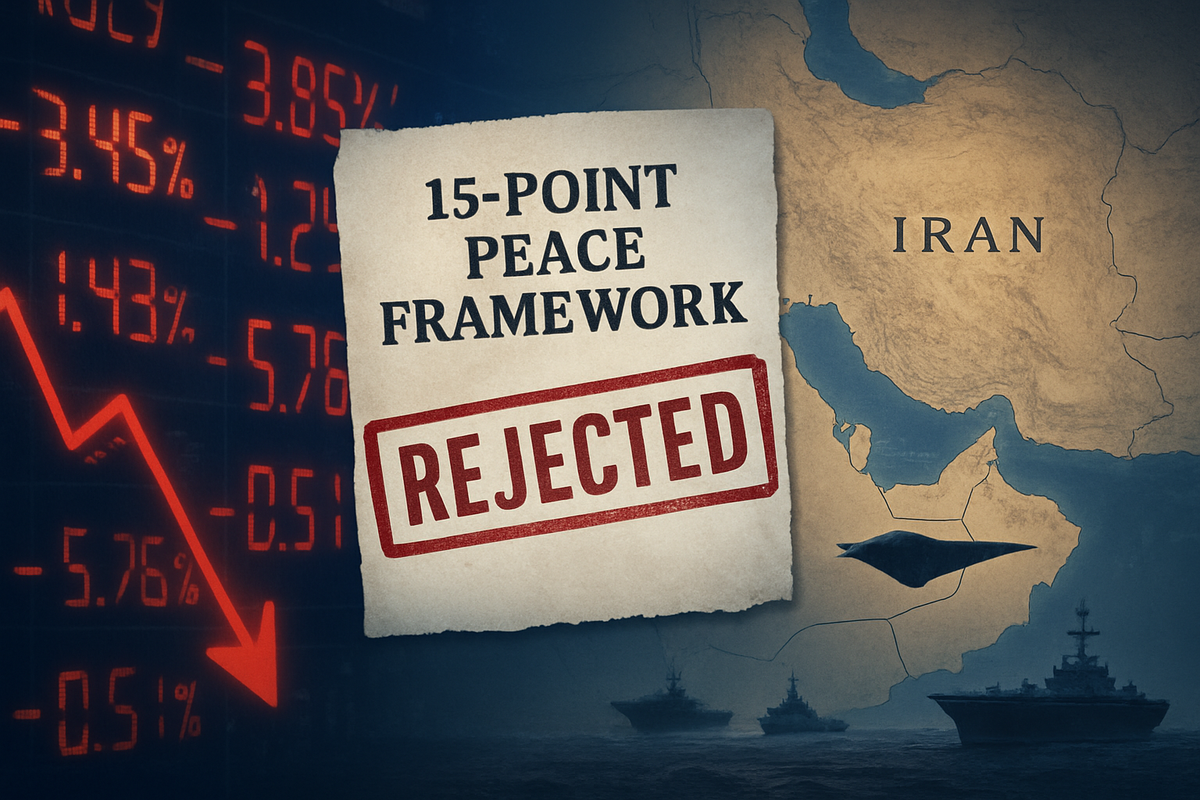
Wall Street’s brief flirtation with a geopolitical resolution ended abruptly on March 26, 2026, as the U.S. stock market succumbed to intense volatility following the definitive collapse of a proposed peace framework with Iran. Investors, who had pushed markets higher the previous day on rumors of a diplomatic breakthrough, were met with a harsh reality check when Tehran formally rejected President Trump’s 15-point peace proposal, labeling it a "document of surrender."
The fallout was immediate and widespread. The S&P 500 (NYSE: SPX) and the Dow Jones Industrial Average (NYSE: DJI) both suffered sharp reversals, erasing all gains from the previous session and casting a shadow over the spring trading season. As the prospect of a prolonged regional conflict intensified, the "risk-off" sentiment triggered a flight to safety, spiking the CBOE Volatility Index (VIX) and leaving market participants to grapple with the return of a high-stakes geopolitical premium.
The 15-Point Stalemate: A Timeline of Diplomatic Failure
The volatility observed today is the direct result of the high-stakes brinkmanship between the Trump administration and the Iranian leadership. On March 25, leaked reports of a "15-point peace framework" sent shockwaves of optimism through the trading floor. The proposal, which aimed to permanently de-escalate the kinetic conflict that began with strikes on Iranian nuclear sites earlier this year, offered a phased lifting of all nuclear-related sanctions and a multi-billion dollar "Regional Stability Fund" in exchange for the total dismantlement of Iran's nuclear facilities at Natanz and Fordo.
However, the optimism was short-lived. By the early hours of March 26, 2026, Tehran issued a scathing response via Pakistani intermediaries. The Iranian leadership rejected the demand for "anytime-anywhere" IAEA inspections and the mandatory decommissioning of their ballistic missile program. Instead, they countered with a demand for $50 trillion in war reparations, a move the White House immediately dismissed as a non-starter. This total breakdown in communication triggered a massive sell-off as the opening bell rang in New York, with the Dow Jones shedding over 1,000 points in the first hour of trading.
The key players in this drama extend beyond the political figures. Military contractors and energy giants have been positioned on a knife's edge throughout the negotiations. The rejection of the deal suggests that the "Epic Fury" military operations, which had been paused during the secret talks, may now resume with greater intensity. Market analysts note that the timeline has shifted from a potential "peace dividend" back to a wartime footing, with the Pentagon reportedly readying the deployment of an additional 3,000 troops to the region to secure the Strait of Hormuz.
Market Winners and Losers in the Wake of Rejection
As is often the case with geopolitical shocks, the pain was not felt equally across all sectors. The primary "losers" of the day were large-cap technology and consumer discretionary stocks, which investors often dump during periods of high uncertainty. Apple (NASDAQ: AAPL) and other tech giants saw their shares dip as the market pivoted away from growth-oriented assets. The broader S&P 500 felt the weight of this rotation, testing critical support levels as institutional investors moved toward more liquid safe havens like Treasury bonds.
Conversely, the defense and energy sectors emerged as the clear beneficiaries of the renewed tension. Lockheed Martin (NYSE: LMT) and Northrop Grumman (NYSE: NOC) saw their share prices surge by more than 5% within minutes of the news, as the failure of the peace plan virtually guarantees sustained demand for advanced missile defense systems and long-range strike capabilities. RTX Corporation (NYSE: RTX) also saw a significant uptick, driven by the anticipated need for interceptor missiles to protect regional assets from potential Iranian retaliation.
The energy sector, led by ExxonMobil (NYSE: XOM), capitalized on the sudden spike in crude oil prices. With the threat of a blockade in the Strait of Hormuz back on the table, Brent crude surged past $105 per barrel. Investors viewed XOM as a particularly strong play, given its significant production in the Permian Basin and Guyana—regions entirely removed from the physical conflict zone. This "conflict-free" energy production allows these companies to capture the high-price environment without the logistical risks facing Middle Eastern producers.
Geopolitical Shifts and Historical Precedents
The collapse of the Trump peace plan fits into a broader global trend of "fragmented diplomacy," where traditional multilateral agreements are increasingly replaced by bilateral, high-pressure negotiations. The failure of this 15-point plan signals a shift away from the era of the JCPOA and toward a more confrontational model of regional containment. Analysts are drawing comparisons to the 1970s oil shocks, noting that while the U.S. is more energy-independent today, the globalized nature of supply chains means that a spike in energy costs still acts as a significant "tax" on global economic growth.
Furthermore, the rejection by Tehran highlights the internal instability within Iran following the reported death of the Supreme Leader in previous strikes. The power vacuum in Tehran appears to have favored hardliners who view any compromise with the West as a betrayal of the revolution. This internal dynamic creates a "feedback loop" of escalation that makes traditional diplomacy nearly impossible. For competitors and partners alike, from the European Union to the GCC nations, the failure of this plan necessitates a massive recalibration of their own energy and security policies for the remainder of 2026.
Regulators and central banks, including the Federal Reserve, are now watching the market closely. If energy-driven inflation becomes entrenched due to the conflict, it could complicate any plans for interest rate cuts later in the year. The historical precedent of "market resilience" after geopolitical shocks suggests that indices may recover within 40 to 60 days, but that recovery is predicated on the conflict remaining regional rather than expanding into a global conflagration involving other major powers.
What Lies Ahead: Escalation or Stalemate?
In the short term, the market is bracing for a potential military response from the White House. Strategic pivots are already underway, with the U.S. Navy increasing its presence in the Persian Gulf to ensure the flow of oil. For investors, the immediate challenge will be navigating the high-volatility environment characterized by "headline risk," where a single social media post or diplomatic leak can cause 2% swings in the major indices.
A potential "Plan B" for the administration may involve even harsher "secondary sanctions," which would target any third-party nations or corporations continuing to facilitate Iranian oil exports. This could create new market opportunities in the logistics and maritime security sectors but would likely put further pressure on global trade relations. Strategic adaptations will be required for multinational corporations as they weigh the risks of regional exposure against the potential for high returns in a war-time economy.
Looking at the long-term possibilities, the market could enter a period of "normalization of conflict," where geopolitical risk is permanently baked into stock valuations. If a stalemate persists without a full-scale ground invasion, we may see a slow recovery in the S&P 500, though the energy and defense sectors will likely remain at elevated valuations for the foreseeable future. The potential for a "Black Swan" event—such as a direct strike on a major oil terminal or a significant cyber-attack on U.S. financial infrastructure—remains the biggest threat to market stability.
Closing Thoughts for the Modern Investor
The events of March 26, 2026, serve as a stark reminder that geopolitical reality often moves faster than market optimism. The failure of the 15-point peace proposal has not only wiped out recent gains but has fundamentally shifted the narrative from a "soft landing" and peace to one of "fortress economics" and sustained defense spending. For the Dow and the S&P 500, the path forward will be dictated by the sound of the drums of war rather than the whispers of diplomats.
Key takeaways for the coming months include the essential role of defense and domestic energy as a hedge against global instability. Investors should watch the VIX closely; as long as it remains in the high 20s, the "fear gauge" suggests that the market has not yet reached a bottom. Furthermore, the performance of the U.S. dollar will be a critical indicator of global capital flows as the world seeks safety in the face of Middle Eastern uncertainty.
As we move toward the second quarter of 2026, the resilience of the U.S. consumer and the stability of global energy corridors will be the two most important factors for the market. While the immediate reaction to the failed peace deal is one of fear, history suggests that the market eventually finds a way to price in even the most complex conflicts. For now, however, caution remains the order of the day.
This content is intended for informational purposes only and is not financial advice.