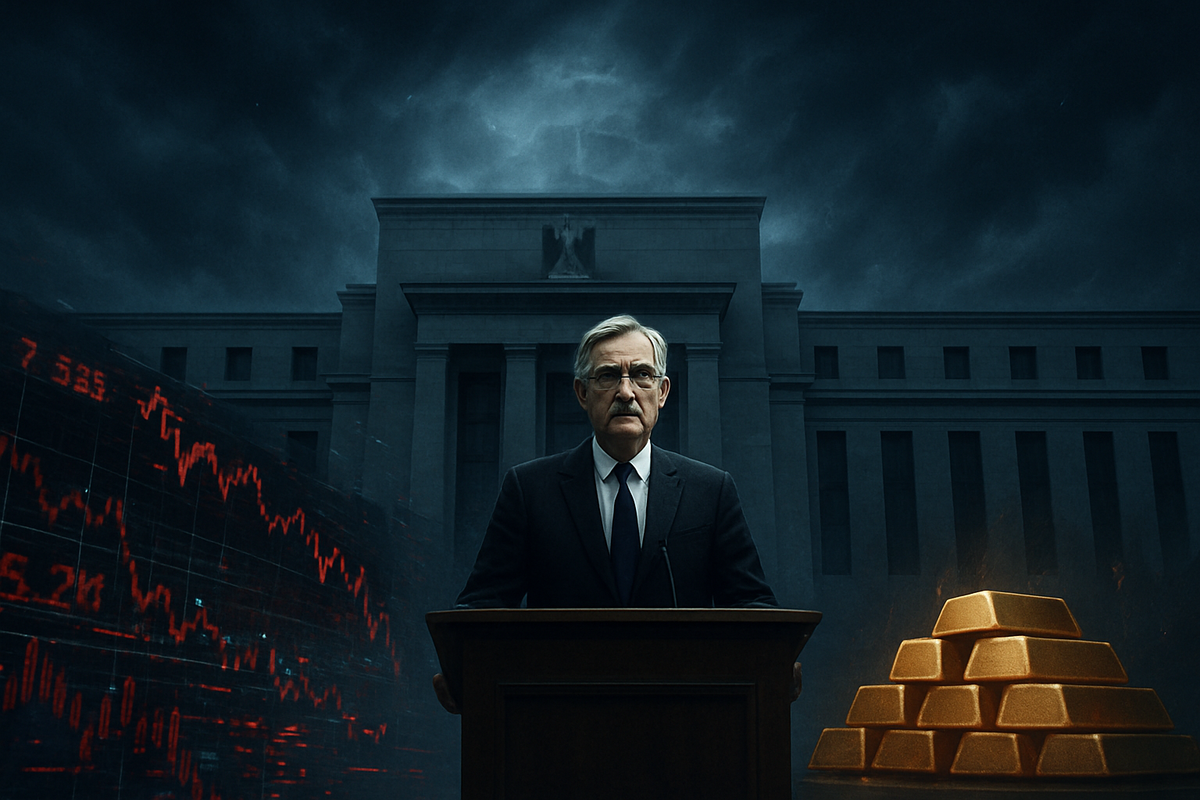
WASHINGTON, D.C. — In an unprecedented escalation of hostilities between the executive branch and the nation’s central bank, the White House has intensified its campaign against Federal Reserve Chair Jerome Powell, culminating in a reported criminal-indictment threat that has sent shockwaves through global financial markets. As of today, March 26, 2026, the traditional wall of independence separating the Federal Reserve from partisan politics has not just been breached; it has been effectively dismantled. During a tense Cabinet meeting earlier today, President Trump openly attacked Powell’s leadership, labeling him a "moron" for his refusal to lower interest rates amidst a burgeoning geopolitical crisis in the Middle East.
The immediate implications for the market are profound. Investors are now forced to price in an "Independence Risk Premium," a concept previously reserved for emerging markets with volatile dictatorships. As the Department of Justice (DOJ) continues to dangle the threat of charges related to a multi-billion dollar renovation of the Fed’s headquarters, the yields on U.S. Treasuries have spiked, and the CBOE Volatility Index (VIX) has surged to levels not seen since the early days of the 2020 pandemic. The market is grappling with a terrifying question: Can the Federal Reserve continue to fight inflation if its leader is under the shadow of a politically motivated indictment?
The Pretext of the $4 Billion Renovation
The current crisis traces its roots back to an aggressive Department of Justice investigation led by U.S. Attorney Jeanine Pirro. The probe focuses on the Federal Reserve’s massive $4 billion headquarters renovation project in Washington, D.C. Prosecutors have alleged that Chair Powell misled Congress during testimony in June 2025 regarding the project's astronomical cost overruns and shifting scope. While the DOJ has hinted at a pending indictment for months, the situation reached a fever pitch on March 13, 2026, when U.S. District Chief Judge James Boasberg took the extraordinary step of quashing grand jury subpoenas issued to the Fed. In a blistering 27-page opinion, Boasberg stated the government had produced "essentially zero evidence" of criminal activity, characterizing the investigation as a "pretext" designed to coerce the Fed into aggressive rate cuts.
Despite this judicial rebuke, the White House has doubled down. During today’s March 26 Cabinet meeting, the President ignored the judge's ruling, pivoting from a discussion on military readiness to a 15-minute diatribe against Powell. He claimed he could have completed the Fed renovation for $25 million and blamed Powell’s "gross mismanagement" for both the building costs and the state of the U.S. economy. This public castigation follows the Fed’s decision at the March 18 FOMC meeting to maintain the federal funds rate at 3.50%–3.75%, defying administration demands for a "patriotic" rate cut to bolster domestic growth as energy prices soar.
The timeline of this conflict has been marked by Powell’s refusal to retreat. In a rare video statement released earlier this year and reiterated following the March 18 meeting, Powell directly linked the criminal probe to the Fed’s monetary stance. "The threat of criminal charges is a consequence of the Federal Reserve setting interest rates based on our best assessment of the economic data, rather than following the preferences of the President," Powell stated, signaling that he would not be intimidated into a policy pivot. This defiance has created a deadlock between the Eccles Building and the West Wing that is now paralyzing the leadership transition.
With Powell’s term as Chair set to expire on May 15, 2026, the succession battle has become a political quagmire. The President has nominated Kevin Warsh to succeed Powell, but the confirmation process is currently stalled in the Senate Banking Committee. Senator Thom Tillis (NC) has led a faction of Republicans vowing to block all Fed nominees until the DOJ drops what he calls its "frivolous and retaliatory" investigation. This impasse suggests the Fed may soon face a "two popes" scenario: Powell has indicated he will remain on the Board of Governors (where his term lasts until 2028) and serve as "Chair Pro Tem" if no successor is confirmed, potentially leading to a constitutional showdown over who actually controls the central bank.
Market Winners and Losers in the Face of Instability
The immediate fallout of this political warfare has created a bifurcated market. The primary "losers" in this environment are traditional safe-haven assets like long-term U.S. Treasuries. The iShares 20+ Year Treasury Bond ETF (NASDAQ: TLT) has seen its heaviest selling in years as investors demand higher yields to compensate for the uncertainty surrounding Fed independence. Similarly, broad-market indices like the SPDR S&P 500 ETF Trust (NYSEARCA:SPY) have struggled, as the "higher-for-longer" rate environment—cemented by the Fed’s hawkish stance in March—clashes with the political instability that typically drives down P/E multiples.
Growth-oriented tech giants, which are highly sensitive to interest rate expectations, have also faced significant headwinds. Companies such as Apple Inc. (NASDAQ: AAPL) and Microsoft Corp. (NASDAQ: MSFT) have seen their shares retreat as the market reprices its 2026 outlook. At the start of the year, futures markets were pricing in four 25-basis-point cuts; following the March 26 rhetoric, the CME FedWatch Tool now shows expectations for only one cut, likely delayed until December. The fear is that the Fed, in an effort to prove its independence from the White House, may over-tighten, risking a "hard landing" for the U.S. economy.
Conversely, "winners" have emerged in the commodities and defense sectors. Gold has become the ultimate beneficiary of the institutional breakdown, with the SPDR Gold Shares (NYSEARCA:GLD) surging toward record highs near $5,400 per ounce as investors flee the dollar's political volatility. The ongoing conflict with Iran has further catalyzed this move, benefiting energy giants like ExxonMobil Corp. (NYSE: XOM) and Chevron Corp. (NYSE: CVX). As oil prices hover between $100 and $130 per barrel, these companies are seeing massive cash flow generation, even as the broader economy groans under the weight of stagflationary pressures.
Defense contractors have also seen a spike in demand, driven by both the geopolitical reality in the Middle East and the domestic political theater. Lockheed Martin Corp. (NYSE: LMT) and other major aerospace firms are benefiting from a market that is increasingly pricing in a prolonged period of global and domestic friction. These companies provide a hedge for investors who believe that the breakdown in traditional institutional norms—such as an independent Fed—will lead to greater volatility and a higher likelihood of expanded military spending to project stability abroad.
The Erosion of the Institutional Safeguard
The broader significance of the criminal threat against Powell cannot be overstated. Since the 1951 Treasury-Fed Accord, the central bank’s independence has been a cornerstone of the global financial system. The current events echo the darkest days of the Nixon administration’s pressure on Arthur Burns, but the use of the Department of Justice as a tool for monetary policy coercion represents a dangerous new frontier. By weaponizing a criminal investigation into a real estate project, the executive branch has signaled that no independent official is beyond the reach of political retaliation, a move that could permanently damage the "full faith and credit" of the United States.
This event fits into a wider global trend of executive overreach and the erosion of democratic institutions. Central banks from Turkey to Brazil have faced similar pressures in recent years, but the Federal Reserve is the world’s anchor. If the Fed's decisions are perceived to be made under the duress of potential imprisonment, the U.S. Dollar’s status as the world’s reserve currency could be jeopardized. Competitors and partners alike are watching this space; the European Central Bank and the Bank of Japan must now navigate a world where the primary driver of U.S. rates may be a legal defense strategy rather than economic data.
Historically, market participants have viewed the Fed as the "adult in the room." The "Powell Put"—the idea that the Fed would always step in to save the markets—has been replaced by a "Powell Protest." The Chair is now prioritizing institutional survival over market comfort. This shift is likely to lead to increased regulatory scrutiny of the Fed's internal operations, as the White House seeks to find any administrative leverage it can. The risk of a policy error is at its highest point in decades, as the Fed is essentially fighting a war on two fronts: inflation in the economy and a "palace coup" in Washington.
Furthermore, the "two popes" scenario—where a nominee and an incumbent both claim leadership—threatens to create a period of paralysis. If the market does not know whose "dot plot" to follow, the result will be a persistent "chaos premium" on all U.S. dollar-denominated assets. The ripple effects will extend to every corner of the economy, from mortgage rates to corporate borrowing costs, as the fundamental predictability of the U.S. monetary regime evaporates.
The Path to May 15: What Comes Next?
In the short term, all eyes remain on the DOJ. If an indictment is actually unsealed despite Judge Boasberg’s dismissal of the subpoenas, it would trigger a constitutional crisis without modern precedent. Powell has shown no inclination to resign, and under the Federal Reserve Act, the President can only remove a governor "for cause." Whether a disputed criminal allegation constitutes "cause" is a question that would likely head straight to the Supreme Court. Investors should prepare for extreme volatility in the lead-up to Powell’s term expiration on May 15.
Strategic pivots are already underway among major institutional investors. Hedge funds are reportedly moving toward "regime change" trades, betting on a massive shift in Fed policy if the White House eventually succeeds in installing a more dovish chair like Kevin Warsh. However, the potential for a "Chair Pro Tem" status for Powell means this transition could be delayed by months or even years of litigation. This creates an environment where "certainty" is the most expensive commodity on Wall Street.
Looking ahead, the potential for a market-clearing event is high. If the political noise continues to drown out economic fundamentals, a major credit event or a sharp recession could force both sides to the table. Alternatively, if the DOJ backs down following further judicial rebukes, we could see a massive "relief rally" in Treasuries and growth stocks. For now, the market remains in a defensive crouch, waiting to see if the world’s most powerful central banker will trade his suit for a legal defense fund.
Summary and Investor Outlook
The events of March 26, 2026, mark a turning point in American financial history. The threat of a criminal indictment against Jerome Powell is not just a personal legal matter; it is a systemic shock to the architecture of the global economy. The fusion of monetary policy and criminal prosecution has created a new era of "Independence Risk," where the federal funds rate is as much a function of legal maneuvers as it is of employment and inflation data.
For investors, the key takeaways are clear: the "higher-for-longer" rate environment is being reinforced by the Fed's need to demonstrate its autonomy. Safe havens like gold and energy remain the preferred play as long as the institutional warfare continues. Moving forward, the most important indicator will not be the Consumer Price Index (CPI), but rather the dockets of the D.C. District Court and the deliberations of the Senate Banking Committee.
In the coming months, watch for the "May 15 Cliff." If the leadership transition is not resolved by that date, the resulting institutional vacuum could lead to a significant repricing of U.S. sovereign risk. The era of a predictable, independent Federal Reserve has ended; the era of the "Political Fed" has begun, and the market's journey into this unknown territory has only just started.
This content is intended for informational purposes only and is not financial advice.