In a dramatic shift for global financial markets, equities staged a massive relief rally on Monday, March 23, 2026, following the U.S. administration's announcement of a five-day pause in planned military actions in the Middle East. The move, which effectively puts a temporary lid on "Operation Epic Fury," triggered a sharp reversal in the "war premium" that had dominated energy and defense sectors over the last fortnight. As the threat of imminent strikes against critical energy infrastructure receded, international investors pivoted back into risk assets, mirroring a massive overnight surge on Wall Street that saw the Dow Jones Industrial Average futures jump by over 1,100 points.
The immediate implications of this de-escalation are twofold: a significant cooling of energy-driven inflation fears and a desperate scramble by fund managers to rebalance portfolios away from geopolitical hedges. While the geopolitical situation remains fluid, the pause has provided a much-needed breathing room for European markets, which are historically more sensitive to energy shocks. Indices across the continent reflected this newfound optimism, with the German DAX and French CAC 40 leading the charge as industrial and consumer confidence received a sudden, albeit cautious, boost.
De-Escalation Triggers Global Buying Frenzy
The rally was set in motion late Sunday evening when the U.S. President announced a 120-hour suspension of military operations, citing "productive diplomatic channels" regarding the security of the Strait of Hormuz. This followed a week of extreme tension where Brent crude had surged toward $120 per barrel, raising the specter of a global stagflationary crisis. The timeline of events leading to this moment had been harrowing for investors; since mid-March, a series of naval skirmishes had forced major shipping lines to reroute, driving up freight costs and energy prices simultaneously.
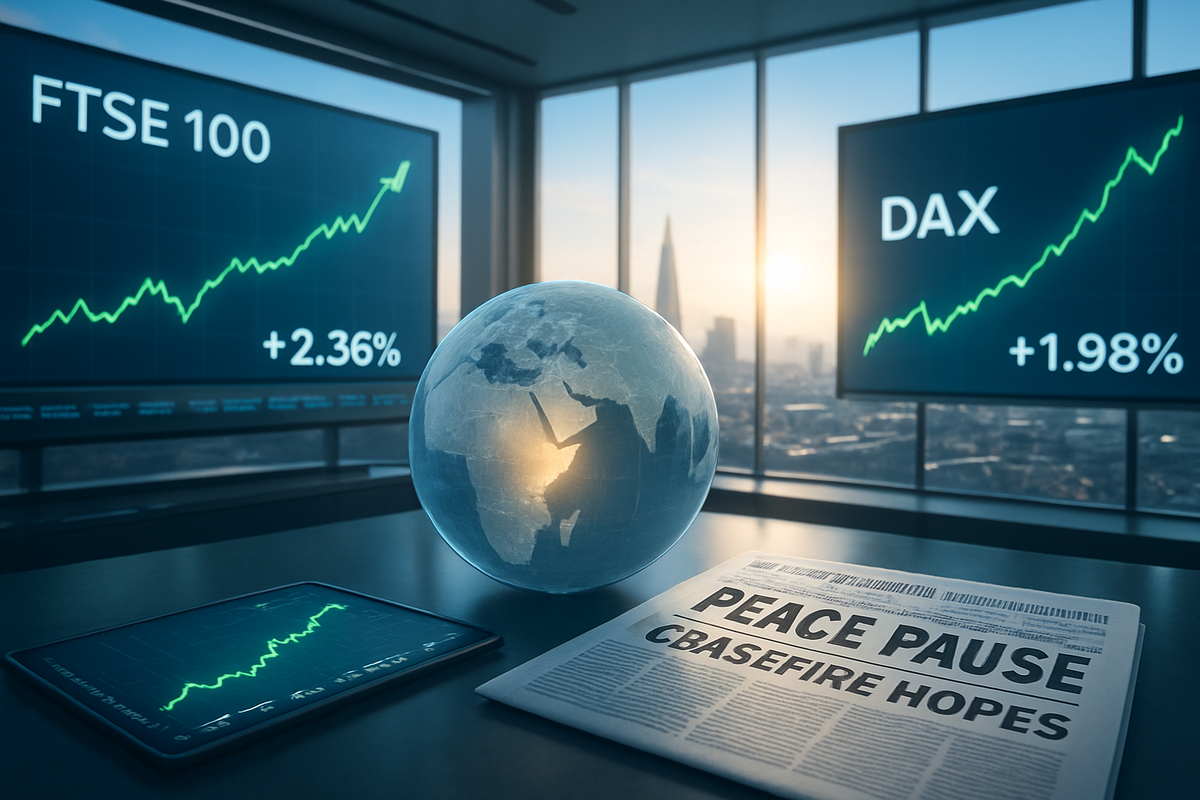
Key players in this diplomatic breakthrough reportedly include a coalition of European and Gulf state mediators who successfully lobbied for a "cooling-off window." Initial market reactions were explosive. In Germany, the DAX (XETRA: DAX) advanced by a staggering 2.51%, breaching the critical 22,900 level as investors bet on lower input costs for the country’s energy-intensive manufacturing sector. Similarly, the CAC 40 (Euronext: PX1) in Paris rose by 1.1%, buoyed by a recovery in the luxury goods and aerospace sectors which had been sidelined during the escalation.
In London, the FTSE 100 (LSE: UKX) presented a more complex picture. While the index initially struggled due to its heavy weighting in energy majors, it eventually clawed back into positive territory as the broader market sentiment improved. The shift reflects a "tactical asset changeover" as institutional investors move out of safe-haven commodities and back into growth-oriented equities, betting that the five-day window might evolve into a more permanent ceasefire.
Aviation and Travel Lead Winners as Energy Majors Retrench
The most visible winners of this diplomatic pivot were the travel and aviation sectors. Airbus (Euronext: AIR) saw its shares climb by over 4%, as the pause eased concerns regarding its significant delivery backlog in the Middle East. Similarly, Lufthansa (XETRA: LHA) experienced a sharp rebound, gaining nearly 5% as jet fuel price expectations plummeted. In the United States, carriers like United Airlines (NASDAQ: UAL) and American Airlines (NASDAQ: AAL) led the S&P 500 higher, gaining 4.5% and 4.9% respectively, as the prospect of lower operating costs and reopened air corridors revitalized the sector.
Conversely, the energy sector faced a harsh correction. Brent crude oil prices collapsed by 10% in a single session, settling near the $100 mark. This led to a sell-off in energy giants that had previously benefited from the price spike. Shell (LSE: SHEL) and BP (LSE: BP) saw their valuations drop by approximately 3.5% and 3.7% respectively. Investors who had flocked to these stocks as a hedge against war found themselves on the wrong side of the trade as the "windfall" narrative evaporated overnight.
The defense sector also saw a cooling effect after a parabolic run-up. Companies like Lockheed Martin (NYSE: LMT) and Northrop Grumman (NYSE: NOC) saw modest pullbacks of around 1% to 1.5%. While the long-term demand for defense systems remains high due to global instability, the immediate "kinetic" demand for missile defense replenishment—from companies like RTX (NYSE: RTX)—is perceived to have hit a temporary plateau. Analysts suggest that the "war-play" stocks are now undergoing a period of healthy consolidation as the market searches for a new equilibrium.
Wider Significance: Easing Inflation and Geopolitical Shifts
The broader significance of this market move extends far beyond daily price fluctuations; it represents a potential turning point for global inflation. The 10% drop in crude oil is a massive "tax cut" for the global economy, likely to be reflected in lower CPI prints in the coming months if the pause holds. This has already had a ripple effect on the bond market, where the U.S. 10-Year Treasury yield eased to 4.35%, reducing the pressure on high-growth technology valuations that have been sensitive to rising rates.
This event fits into a broader industry trend of "geopolitical volatility management," where corporations are increasingly forced to maintain flexible supply chains. The rapid recovery in indices like the DAX highlights how quickly industrial sentiment can pivot when energy tailwinds appear. However, the regulatory and policy implications remain significant. Governments in Europe are likely to use this brief respite to further accelerate the transition away from fossil fuel dependence, viewing the recent price spike as a final warning of the risks inherent in Middle Eastern energy reliance.
Historical precedents, such as the market reactions during the 1991 Gulf War or the 2003 invasion of Iraq, suggest that markets often rally on the "clarity" of an event's resolution. While this is a pause and not a total resolution, the market is pricing in the possibility of a diplomatic exit ramp. The "TACO" (Tactical Asset Changeover) movement observed today indicates that while the geopolitical floor is higher than it was a decade ago, the market’s appetite for growth remains resilient if the threat of a global energy shutdown is removed.
What Comes Next: The Five-Day Diplomatic Tightrope
In the short term, all eyes remain on the 120-hour clock. Any violation of the pause by any party in the Middle East could see the market gains wiped out in a matter of minutes. Strategically, global corporations are expected to spend this week securing energy contracts and rerouting logistics while the window is open. For many, this is not a time for complacency but a time for rapid adaptation. We may see a surge in "pre-emptive hedging" as companies prepare for the possibility that strikes could resume on March 28th.
Market opportunities are likely to emerge in the consumer discretionary space. If the pause leads to a sustained drop in fuel prices, retail giants and cruise lines, such as Norwegian Cruise Line (NYSE: NCLH), could see further upside as household "gas-tank" savings translate into increased spending. However, the challenge remains the fragility of the peace. A scenario where diplomacy fails and military action resumes would likely lead to an even more violent spike in oil prices, potentially pushing Brent past the $130 mark.
Investors should also watch for strategic pivots in the technology sector. As Treasury yields soften, the "long-duration" tech trade becomes more attractive. If the diplomatic window leads to a formal de-escalation framework, we could see a transition from a "defense and energy" led market to a "tech and consumer" led bull run. The next few days will be a litmus test for the durability of this recovery.
Conclusion: A Fragile Respite for Global Investors
The market recovery of March 23, 2026, serves as a stark reminder of how deeply global equities are tethered to geopolitical stability. The rally across the FTSE 100, DAX, and CAC 40, mirrored by the surge on Wall Street, underscores a collective sigh of relief from the global investment community. The primary takeaway is that while the "war premium" has been partially liquidated, the underlying tensions remain, making this one of the most volatile trading environments in recent memory.
Moving forward, the market remains on a knife-edge. The shift from energy majors to travel and industrial stocks reflects a hope that the worst of the crisis has passed, but the five-day deadline ensures that caution remains the order of the day. Investors should watch for the March 28th deadline with eagle eyes, as any headlines regarding the extension—or expiration—of the pause will be the primary driver of market direction.
In summary, the rally is a welcome break from a grueling period of uncertainty. However, with oil still hovering near $100 and the Middle East in a state of delicate suspension, the long-term impact on the market will depend entirely on whether this pause is a precursor to a peace treaty or merely the "eye of the storm" before further escalation.
This content is intended for informational purposes only and is not financial advice.