

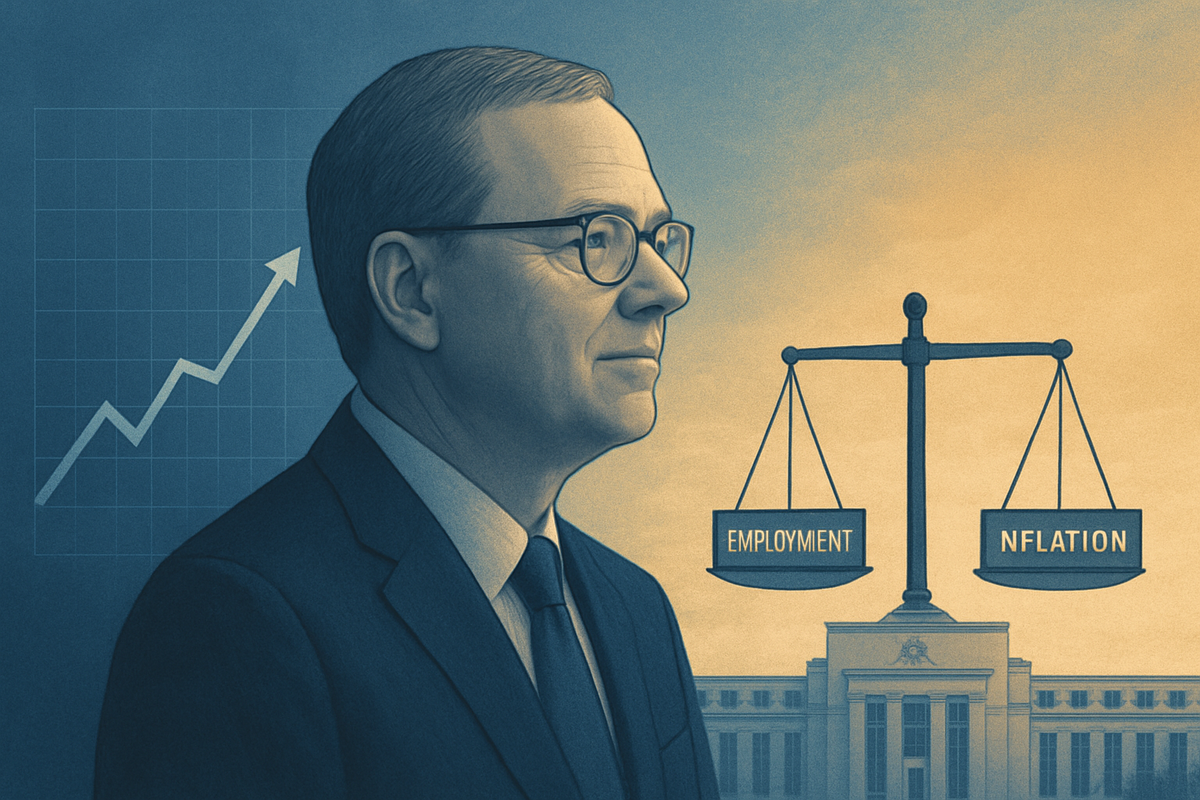
The financial markets are abuzz with speculation surrounding the potential appointment of Kevin Hassett, a prominent conservative economist and former economic advisor to President Trump, as the next Chairman of the Federal Reserve. With current Fed Chair Jerome Powell's term ending in May 2026, Hassett's name has emerged as a leading contender, signaling a potential seismic shift in the central bank's monetary policy direction. His known advocacy for lower interest rates and pro-growth, supply-side economics could usher in an era of more accommodative monetary conditions, profoundly impacting everything from borrowing costs to inflation expectations and the overall economic trajectory of the United States.
Should Hassett take the reins, the immediate implications could be a more aggressive stance on interest rate reductions than currently projected by the Federal Open Market Committee (FOMC). His consistent dovish leanings suggest a willingness to prioritize economic growth and employment over stringent inflation control, especially when faced with trade-offs. This potential pivot from the cautious approach of the current Fed, which has been balancing inflation containment with employment goals, would undoubtedly send ripples through global financial markets, prompting investors, businesses, and consumers to recalibrate their strategies in anticipation of a new monetary policy regime.
A Dovish Hand for the Nation's Central Bank
Kevin Hassett's economic philosophy is deeply rooted in supply-side principles, advocating that tax cuts, deregulation, and accommodative monetary policy are the most effective engines for stimulating investment, job creation, and overall economic expansion. His past tenures as Chairman of the Council of Economic Advisers (CEA) and Director of the National Economic Council (NEC) during the Trump administration, including a return as a senior advisor during the COVID-19 pandemic, underscore his long-standing commitment to these pro-growth strategies. He is widely recognized as a "monetary-policy dove," a stance characterized by a preference for lower interest rates and ample liquidity to fuel economic activity.
Hassett has been vocal in his criticism of the Federal Reserve's past actions, particularly its handling of inflation post-pandemic, suggesting the central bank "lost control" of price stability. He has publicly stated his belief that the U.S. economy benefits from stronger monetary stimulus and has even suggested more aggressive rate cuts, such as a 50-basis-point reduction, if he were at the helm. This perspective aligns closely with former President Trump's desire for cheaper borrowing costs. His experience as an economist in the Federal Reserve's Division of Research and Statistics from 1992 to 1997 provides him with an insider's understanding of the institution, albeit from a different era. Markets have reportedly reacted positively to the prospect of his nomination, with long-term interest rates showing a decline, reflecting expectations of a more accommodative environment.
The current economic landscape, as of December 3, 2025, sees the Federal Reserve having recently cut its target federal funds interest rate by 0.25% in both September and October, bringing the range to 3.75% to 4.00%. Despite these cuts, inflation remains above the Fed's 2% target, even as job gains have slowed and the unemployment rate has edged up. Current Fed Chair Jerome Powell has maintained a cautious tone regarding further cuts, emphasizing persistent inflation. However, investors are pricing in more aggressive cuts by the end of 2026. A Hassett-led Fed would likely lean into these investor expectations, potentially accelerating the pace of rate reductions and prioritizing maximum employment with greater urgency, while also showing openness to new financial technologies like cryptocurrency.
Winners and Losers in a Hassett-Led Economy
A Federal Reserve chaired by Kevin Hassett, with its strong dovish inclination, would likely create distinct winners and losers across various sectors of the economy. Companies that are highly sensitive to interest rates would be among the primary beneficiaries. The housing market, including homebuilders like D.R. Horton (NYSE: DHI) and mortgage lenders, would likely see a surge in demand as lower borrowing costs make homeownership more affordable. Similarly, the automotive industry, with companies such as General Motors (NYSE: GM) and Ford Motor Company (NYSE: F), would benefit from reduced financing costs for consumers, potentially boosting vehicle sales.
Growth-oriented companies, particularly in the technology sector, which often rely on future earnings potential, could also experience a significant uplift. Lower interest rates reduce the discount rate applied to future cash flows, thereby increasing present valuations for tech giants like Apple (NASDAQ: AAPL) and Microsoft (NASDAQ: MSFT), as well as smaller, high-growth startups. Furthermore, Hassett's broader pro-growth agenda, which includes tax reforms and deregulation, could specifically benefit sectors that are capital-intensive or heavily regulated. Manufacturers, energy companies, and businesses involved in research and development could see reduced operational costs and increased investment incentives. His openness to digital assets could also foster innovation and investment in the nascent cryptocurrency and blockchain industries, potentially benefiting companies like Coinbase Global (NASDAQ: COIN) or those developing blockchain solutions.
Conversely, a sustained period of significantly lower interest rates could pose challenges for certain sectors. Traditional banks (e.g., JPMorgan Chase (NYSE: JPM), Bank of America (NYSE: BAC)) might face pressure on their net interest margins, as the spread between what they earn on loans and what they pay on deposits could compress. While increased lending volume might offset some of this, a prolonged low-rate environment can squeeze profitability. Additionally, if Hassett's policies lead to a resurgence of inflation that outpaces wage growth, consumer discretionary companies could suffer as purchasing power erodes. Fixed-income investors, particularly those reliant on bond yields for income, would also see reduced returns in a lower-rate environment, potentially shifting capital towards equities or other higher-yielding, albeit riskier, assets.
Wider Implications and Strategic Shifts
The potential appointment of Kevin Hassett as Federal Reserve Chairman would represent a significant ideological shift from the cautious, inflation-focused approach that has largely defined the central bank in recent years. His emphasis on aggressive rate cuts and prioritizing employment over strict inflation control could fundamentally alter the Fed's reaction function to economic data. This move would align the Fed more closely with a pro-growth, less restrictive monetary policy, contrasting with the current committee's division between "hawks" prioritizing inflation and "doves" advocating for easier policy.
Such a shift could have ripple effects on global markets. Other central banks, particularly those in developed economies, often consider the Fed's direction when setting their own policies. A dovish Fed under Hassett might encourage other central banks to maintain or adopt more accommodative stances, potentially leading to a global environment of lower interest rates. This could also influence currency markets, potentially weakening the U.S. dollar if interest rate differentials narrow. On the regulatory front, Hassett's stated openness to cryptocurrency and digital assets could signal a more forward-thinking approach to integrating these technologies into the financial system, potentially leading to new regulatory frameworks that foster innovation rather than stifle it.
Historically, shifts in Fed leadership have often led to changes in market expectations and economic outcomes. For instance, the transition from Paul Volcker's inflation-fighting tenure to Alan Greenspan's era, which saw sustained economic growth, illustrates how a new chairman's philosophy can redefine monetary policy. While Hassett's background as a former Fed economist provides institutional knowledge, his strong political alignment and outspoken views could challenge the perception of the Fed's independence. His advocacy for a rules-based monetary policy, where the Fed adheres to a published formula for setting interest rates and justifies any deviations to Congress, would mark a significant departure from the current discretionary approach, potentially increasing transparency but also limiting flexibility.
The Road Ahead: Scenarios and Strategic Adaptations
Looking ahead, the short-term implications of a Kevin Hassett appointment would likely involve an immediate market rally in interest-rate-sensitive assets and growth stocks, as investors price in expectations of lower borrowing costs. The bond market would continue to reflect these expectations, with yields potentially falling further. Businesses would need to assess their capital expenditure plans, potentially accelerating investments given the prospect of cheaper financing. Consumers might see a boost in confidence, leading to increased spending on big-ticket items.
In the long term, a Hassett-led Fed could usher in a sustained period of lower interest rates, aimed at maximizing employment and economic growth. However, this strategy carries the inherent risk of reigniting inflationary pressures, especially if fiscal policy remains expansive. Companies would need to adapt their strategic pivots to this new monetary environment. Those with high debt burdens could see improved profitability, while those reliant on yield might need to explore new revenue streams. Market opportunities could emerge in sectors that benefit from robust consumer spending and business investment, such as retail, manufacturing, and technology infrastructure. Conversely, the primary challenge could be managing the risk of inflation, which, if unchecked, could erode purchasing power and destabilize the economy. Potential scenarios range from a successful era of strong, sustained growth with manageable inflation to a situation where an overly dovish Fed struggles to contain price increases, necessitating a future course correction.
A New Era for Monetary Policy: Key Takeaways
The potential ascension of Kevin Hassett to the Federal Reserve chairmanship marks a pivotal moment for U.S. monetary policy. His deeply ingrained dovish perspectives, coupled with a strong emphasis on supply-side economics and pro-growth initiatives, suggest a significant departure from the current Fed's cautious balancing act. The key takeaway is the likely shift towards a more aggressive stance on interest rate reductions, prioritizing maximum employment and economic expansion, potentially at the expense of stricter inflation control. This could lead to a sustained period of lower borrowing costs, benefiting interest-rate-sensitive sectors and growth companies, while posing challenges for traditional banks and fixed-income investors.
Moving forward, the market will be keenly assessing several factors. First, the confirmation process for Hassett, should he be nominated, will be scrutinized for any indications of policy direction. Second, investors will watch for his initial statements and actions as Fed Chair, seeking clarity on the pace and magnitude of potential rate cuts and his approach to the Fed's dual mandate. Finally, inflation data will remain a critical metric. While Hassett's policies aim to spur growth, the ultimate success will hinge on whether this can be achieved without unleashing an uncontrollable inflationary spiral. The coming months will be crucial in understanding the full implications of this potential leadership change and the lasting impact it could have on the U.S. and global economies.
This content is intended for informational purposes only and is not financial advice