
As of today, March 26, 2026, Tesla, Inc. (NASDAQ: TSLA) stands at perhaps the most critical inflection point in its two-decade history. Long heralded as the vanguard of the electric vehicle (EV) revolution, the company has spent the last 24 months aggressively pivoting away from being "just a car company." With the official ground-breaking of the $25 billion "Terafab" project in Austin and the widespread commercialization of the long-rumored "Million-Mile Battery," Tesla is attempting to reinvent itself as the foundational infrastructure layer for the global AI and autonomous economy.
This article examines the structural shifts within Tesla, analyzing whether its massive capital expenditures in semiconductor fabrication and battery longevity can offset a cooling global EV market and intense competition from the East.
Historical Background
Founded in 2003 and led by Elon Musk since its early rounds of funding, Tesla’s journey has been defined by "master plans" that seemed impossible at inception. From the niche Roadster to the mass-market success of the Model 3 and Model Y, Tesla successfully broke the century-old barrier to entry in the automotive industry.
However, the period between 2021 and 2024 saw the company mature from a high-growth disruptor into a global incumbent. The "Great EV Slowdown" of 2024 forced a strategic reassessment, leading to the 2025 "Pivot to Intelligence." Today, in 2026, Tesla is no longer defined by how many cars it delivers, but by the compute power it controls and the durability of the energy ecosystem it provides.
Business Model
Tesla’s revenue mix has undergone a radical transformation over the last fiscal year. While Automotive Sales still represent the largest share of the top line, the margin profile has shifted toward Services and Energy.
- Automotive: Sales of Model 3, Y, S, X, and the Cybertruck. The upcoming "Model 2" (Cybercab) platform is expected to drive the next volume wave.
- Energy Generation & Storage: This segment—comprising Megapack and Powerwall—has become the company’s fastest-growing business, buoyed by the 2025 global grid-stability crisis.
- Services & FSD: Tesla now operates a high-margin recurring revenue model through its "Unsupervised FSD" subscriptions and Supercharger licensing.
- Silicon & AI (The Terafab Initiative): A new revenue stream involving the sale and licensing of custom AI5 and D3 chips, produced in-house to bypass the traditional semiconductor supply chain.
Stock Performance Overview
Tesla’s stock performance has been a tale of two eras.
- 10-Year View: Investors who held from 2016 have seen astronomical gains, though the 2021–2024 period was marked by extreme volatility and a significant "lost 30 months" where the stock traded sideways or down.
- 5-Year View: Since March 2021, the stock has weathered the 2022 tech wreck and the 2024 margin compression. It bottomed near $100 in early 2023 and peaked at nearly $500 in late 2025.
- 1-Year View: Over the last 12 months, TSLA is up roughly 12%, currently trading at $385.95. The market is currently pricing in the success of the Terafab project while discounting the temporary slowdown in car deliveries.
Financial Performance
Tesla’s FY 2025 results, released in January 2026, reflected the "growing pains" of its AI transition.
- Revenue: $94.82 billion (a 3% YoY decline, the first significant contraction in a decade).
- Net Income: $3.79 billion (down 46% YoY), driven by the massive $25 billion R&D and CAPEX commitment to the Terafab facility.
- Automotive Gross Margin: 16.4% (excluding credits). This is a far cry from the 25%+ margins seen in 2021, reflecting price wars with BYD and Xiaomi.
- Cash Position: Despite heavy spending, Tesla maintains a robust $28 billion cash pile, providing a significant buffer against macroeconomic headwinds.
Leadership and Management
Elon Musk remains the polarizing figurehead of the company, though his time is now split between Tesla, SpaceX, and xAI. Critics argue that Musk’s "multi-CEO" lifestyle creates execution risk, but proponents point to the synergy between xAI’s large language models and Tesla’s FSD v13 as evidence of a unified "AI Empire."
The board, led by Robyn Denholm, has faced increased scrutiny regarding governance and Musk’s 2024 pay package re-approval, yet the leadership team's ability to execute on the "dry electrode" battery breakthrough has largely silenced calls for a leadership change in the near term.
Products, Services, and Innovations
The Million-Mile Battery
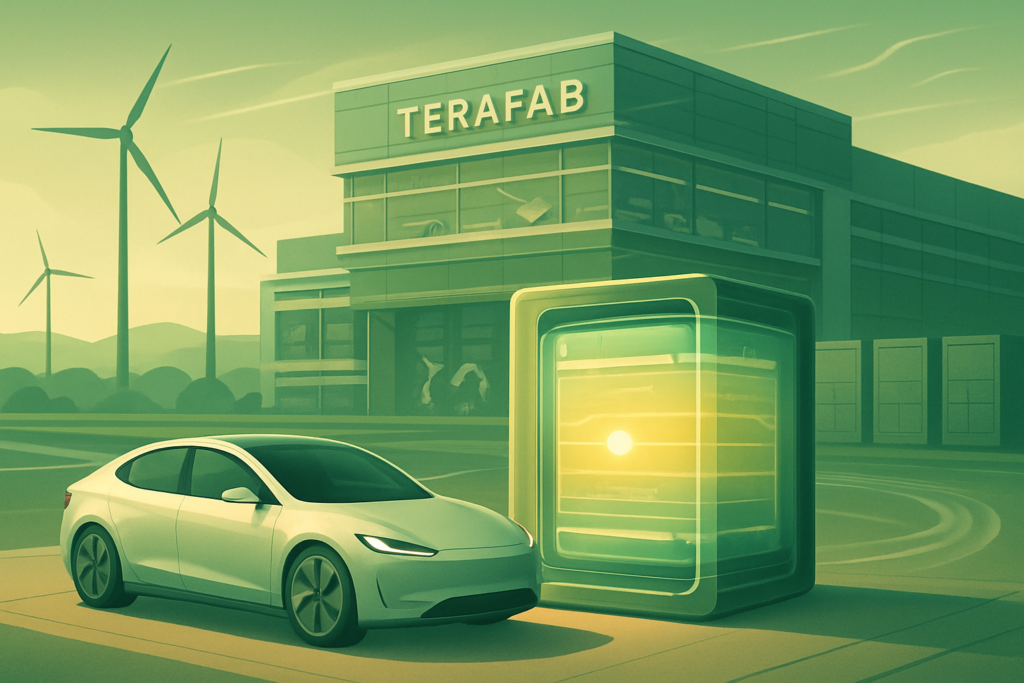
The 4680 Gen-3 cell is now in mass production. Utilizing a revolutionary dry-coating process, these cells boast 10,000+ charge cycles. In practical terms, this allows a Tesla Semi or a Model Y to travel over 1,000,000 miles before the battery capacity drops below 80%. This has effectively killed the "battery degradation" narrative that plagued the industry for a decade.
The $25B Terafab
Located adjacent to Giga Texas, the Terafab is a joint venture aimed at producing 2nm AI chips. This facility is Tesla’s "Declaration of Independence" from third-party chipmakers like Nvidia. By 2027, every Tesla vehicle and Optimus robot will run on proprietary silicon designed and manufactured within this ecosystem.
Competitive Landscape
Tesla no longer holds the title of the world’s largest BEV manufacturer. That crown was officially claimed by BYD (SZSE: 002594) in late 2025. BYD’s dominance in the sub-$20,000 market has forced Tesla to compete on "intelligence" rather than price.
Furthermore, Xiaomi (HKG: 1810) has emerged as a formidable "tech-native" rival in China, capturing significant market share from the Model 3. Meanwhile, legacy players like Ford and GM have largely retreated to Plug-in Hybrids (PHEVs), leaving Tesla to fight a two-front war against Chinese manufacturing efficiency and Silicon Valley software speed.
Industry and Market Trends
The "EV Era" has transitioned into the "Autonomy Era." In 2026, consumer interest has shifted from range and charging speed (mostly solved by the Million-Mile Battery) to software utility. The rise of "Robotaxi" networks in major metropolitan areas has begun to depress private car ownership, a trend Tesla is betting on heavily with its upcoming Cybercab launch in H2 2026.
Risks and Challenges
- Execution Risk: The Terafab is a massive bet. Any delays in 2nm chip yields could leave Tesla with billions in stranded assets.
- Geopolitical Friction: The "pause" of Giga Mexico due to trade tensions highlights Tesla’s vulnerability to shifting U.S.-China relations.
- Margin Compression: Until the "Model 2" achieves scale, Tesla’s automotive margins remain under pressure from lower-cost competitors.
Opportunities and Catalysts
- FSD Europe Expansion: The expected UN R-171 approval in April 2026 will open the European market to Supervised FSD, potentially unlocking billions in high-margin software revenue.
- Optimus Integration: The second-generation Optimus bot is currently being trialed on Tesla’s own assembly lines. Successful internal deployment could lead to external sales by 2027.
- Model 2 Launch: Scheduled for later this year, the "Unboxed" manufacturing process for the $25,000 Tesla is the most anticipated product launch since the Model 3.
Investor Sentiment and Analyst Coverage
Wall Street is currently divided. "Bulls" see the Terafab and Million-Mile Battery as the keys to a $3 trillion valuation, viewing Tesla as a tech utility. "Bears" focus on the declining car sales and the heavy CAPEX, labeling Tesla as an overvalued industrial stock. Institutional ownership remains high at 44%, though retail "HODLers" still account for a significant portion of the daily volume, often driven by Musk’s social media activity.
Regulatory, Policy, and Geopolitical Factors
Tesla’s expansion into India (Giga India) is a strategic move to diversify away from China. However, the company remains at the mercy of the "Battery Passport" regulations in the EU and shifting EV tax credit policies in the United States. The 2026 regulatory environment is increasingly focused on data privacy and the safety of "Unsupervised" autonomous systems, presenting a new hurdle for FSD deployment.
Conclusion
Tesla in 2026 is a company in the middle of a high-stakes skin-graft. It is shedding its skin as a high-volume automaker to reveal an underlying skeleton of AI, semiconductors, and long-life energy storage. The $25 billion Terafab and the Million-Mile Battery are not just product updates; they are the pillars of a new business model.
For investors, the next 12 to 18 months will be telling. If Tesla can successfully launch the $25,000 "Model 2" while scaling its internal chip production, it will likely solidify its position as the apex predator of the 21st-century economy. However, if the automotive slowdown persists and the AI bets take longer to monetize, the current $1.44 trillion valuation may face a harsh correction.
This content is intended for informational purposes only and is not financial advice. As of March 26, 2026, the author has no position in TSLA.