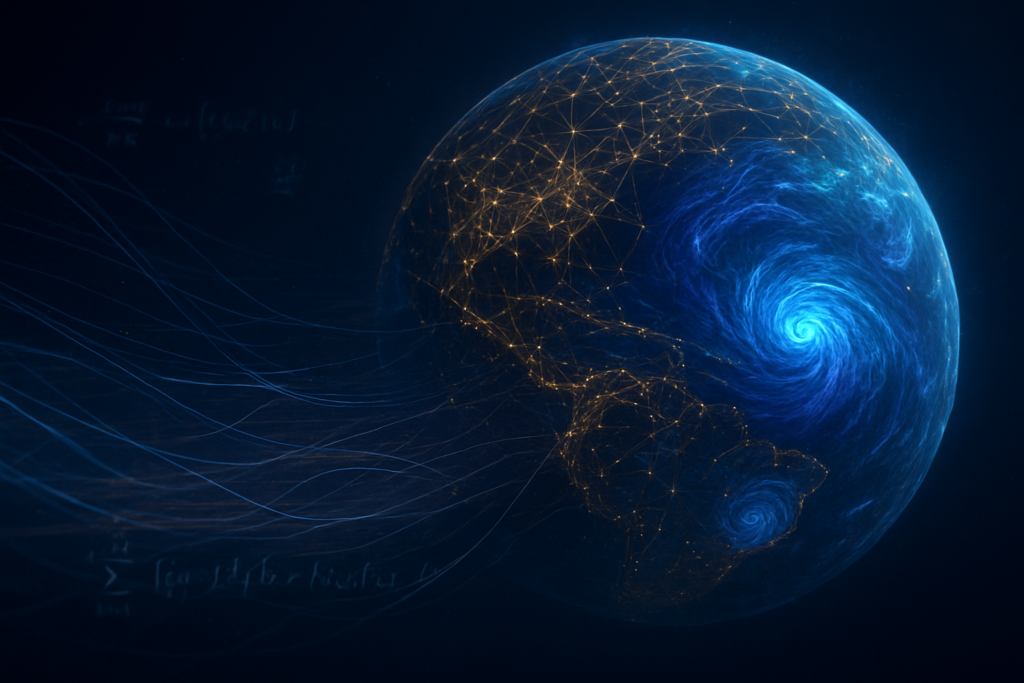
As the global climate enters an era of increasing volatility, the tools we use to predict the atmosphere are undergoing a radical transformation. Google DeepMind, the artificial intelligence subsidiary of Alphabet Inc. (NASDAQ: GOOGL), has officially moved its GenCast model from a research breakthrough to a cornerstone of global meteorological operations. By early 2026, GenCast has proven that AI-driven probabilistic forecasting is no longer just a theoretical exercise; it is now the gold standard for predicting high-stakes weather events like hurricanes and heatwaves with unprecedented lead times.
The significance of GenCast lies in its departure from the "brute force" physics simulations that have dominated meteorology for half a century. While traditional models require massive supercomputers to solve complex fluid dynamics equations, GenCast utilizes a generative AI framework to produce 15-day ensemble forecasts in a fraction of the time. This shift is not merely about speed; it represents a fundamental change in how humanity anticipates disaster, providing emergency responders with a "probabilistic shield" that identifies extreme risks days before they materialize on traditional radar.
The Diffusion Revolution: Probabilistic Forecasting at Scale
At the heart of GenCast’s technical superiority is its use of a conditional diffusion model—the same underlying architecture that powers cutting-edge AI image generators. Unlike its predecessor, GraphCast, which focused on "deterministic" or single-outcome predictions, GenCast is designed for ensemble forecasting. It starts with a base of historical atmospheric data and then "diffuses" noise into 50 or more distinct scenarios. This allows the model to capture a range of possible futures, providing a percentage-based probability for events like a hurricane making landfall or a record-breaking heatwave.
Technically, GenCast was trained on over 40 years of ERA5 historical reanalysis data, learning the intricate, non-linear relationships of more than 80 atmospheric variables across various altitudes. In head-to-head benchmarks against the European Centre for Medium-Range Weather Forecasts (ECMWF) Ensemble Prediction System (ENS)—long considered the world's best—GenCast outperformed the traditional system on 97.2% of evaluated targets. As the forecast window extends beyond 36 hours, its accuracy advantage climbs to a staggering 99.8%, effectively pushing the "horizon of predictability" further into the future than ever before.
The most transformative technical specification, however, is its efficiency. A full 15-day ensemble forecast, which would typically take hours on a traditional supercomputer consuming megawatts of power, can be completed by GenCast in just eight minutes on a single Google Cloud TPU v5. This represents a reduction in energy consumption of approximately 1,000-fold. This efficiency allows agencies to update their forecasts hourly rather than twice a day, a critical capability when tracking rapidly intensifying storms that can change course in a matter of minutes.
Disrupting the Meteorological Industrial Complex
The rise of GenCast has sent ripples through the technology and aerospace sectors, forcing a re-evaluation of how weather data is monetized and utilized. For Alphabet Inc. (NASDAQ: GOOGL), GenCast is more than a research win; it is a strategic asset integrated into Google Search, Maps, and its public cloud offerings. By providing superior weather intelligence, Google is positioning itself as an essential partner for governments and insurance companies, potentially disrupting the traditional relationship between national weather services and private data providers.
The hardware landscape is also shifting. While NVIDIA (NASDAQ: NVDA) remains the dominant force in AI training hardware, the success of GenCast on Google’s proprietary Tensor Processing Units (TPUs) highlights a growing trend of vertical integration. As AI models like GenCast become the primary way we process planetary data, the demand for specialized AI silicon is beginning to outpace the demand for traditional high-performance computing (HPC) clusters. This shift challenges legacy supercomputer manufacturers who have long relied on government contracts for massive, physics-based weather simulations.
Furthermore, the democratization of high-tier forecasting is a major competitive implication. Previously, only wealthy nations could afford the supercomputing clusters required for accurate 10-day forecasts. With GenCast, a startup or a developing nation can run world-class weather models on standard cloud instances. This levels the playing field, allowing smaller tech firms to build localized "micro-forecasting" services for agriculture, shipping, and renewable energy management, sectors that were previously reliant on expensive, generalized data from major government agencies.
A New Era for Disaster Preparedness and Climate Adaptation
The wider significance of GenCast extends far beyond the tech industry; it is a vital tool for climate adaptation. As global warming increases the frequency of "black swan" weather events, the ability to predict low-probability, high-impact disasters is becoming a matter of survival. In 2025, international aid organizations began using GenCast-derived data for "Anticipatory Action" programs. These programs release disaster relief funds and mobilize evacuations based on high-probability AI forecasts before the storm hits, a move that experts estimate could save thousands of lives and billions of dollars in recovery costs annually.
However, the transition to AI-based forecasting is not without concerns. Some meteorologists argue that because GenCast is trained on historical data, it may struggle to predict "unprecedented" events—weather patterns that have never occurred in recorded history but are becoming possible due to climate change. There is also the "black box" problem: while a physics-based model can show you the exact mathematical reason a storm turned left, an AI model’s "reasoning" is often opaque. This has led to a hybrid approach where traditional models provide the "ground truth" and initial conditions, while AI models like GenCast handle the complex, multi-scenario projections.
Comparatively, the launch of GenCast is being viewed as the "AlphaGo moment" for Earth sciences. Just as AI mastered the game of Go by recognizing patterns humans couldn't see, GenCast is mastering the atmosphere by identifying subtle correlations between pressure, temperature, and moisture that physics equations often oversimplify. It marks the transition from a world where we simulate the atmosphere to one where we "calculate" its most likely outcomes.
The Path Forward: From Global to Hyper-Local
Looking ahead, the evolution of GenCast is expected to focus on "hyper-localization." While the current model operates at a 0.25-degree resolution, DeepMind has already begun testing "WeatherNext 2," an iteration designed to provide sub-hourly updates at the neighborhood level. This would allow for the prediction of micro-scale events like individual tornadoes or flash floods in specific urban canyons, a feat that currently remains the "holy grail" of meteorology.
In the near term, expect to see GenCast integrated into autonomous vehicle systems and drone delivery networks. For a self-driving car or a delivery drone, knowing that there is a 90% chance of a severe micro-burst on a specific street corner five minutes from now is actionable data that can prevent accidents. Additionally, the integration of multi-modal data—such as real-time satellite imagery and IoT sensor data from millions of smartphones—will likely be used to "fine-tune" GenCast’s predictions in real-time, creating a living, breathing digital twin of the Earth's atmosphere.
The primary challenge remaining is data assimilation. AI models are only as good as the data they are fed, and maintaining a global network of physical sensors (buoys, weather balloons, and satellites) remains an expensive, government-led endeavor. The next few years will likely see a push for "AI-native" sensing equipment designed specifically to feed the voracious data appetites of models like GenCast.
A Paradigm Shift in Planetary Intelligence
Google DeepMind’s GenCast represents a definitive shift in how humanity interacts with the natural world. By outperforming the best physics-based systems while using a fraction of the energy, it has proven that the future of environmental stewardship is inextricably linked to the progress of artificial intelligence. It is a landmark achievement that moves AI out of the realm of chatbots and image generators and into the critical infrastructure of global safety.
The key takeaway for 2026 is that the era of the "weather supercomputer" is giving way to the era of the "weather inference engine." The significance of this development in AI history cannot be overstated; it is one of the first instances where AI has not just assisted but fundamentally superseded a legacy scientific method that had been refined over decades.
In the coming months, watch for how national weather agencies like NOAA and the ECMWF officially integrate GenCast into their public-facing warnings. As the first major hurricane season of 2026 approaches, GenCast will face its ultimate test: proving that its "probabilistic shield" can hold firm in a world where the weather is becoming increasingly unpredictable.
This content is intended for informational purposes only and represents analysis of current AI developments.
TokenRing AI delivers enterprise-grade solutions for multi-agent AI workflow orchestration, AI-powered development tools, and seamless remote collaboration platforms.
For more information, visit https://www.tokenring.ai/.