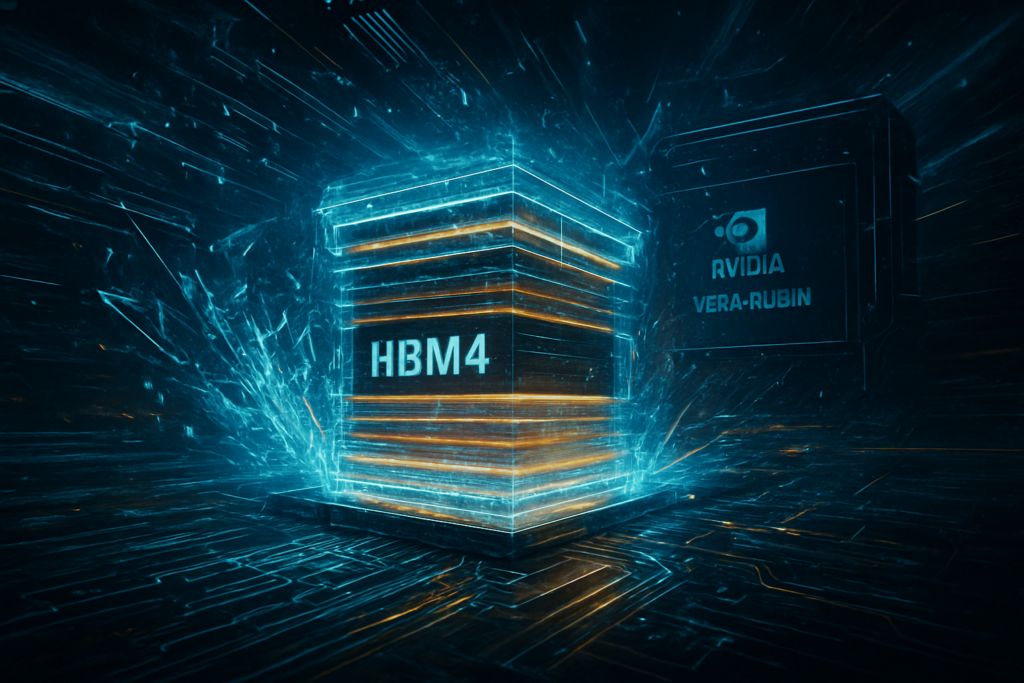
The floor of CES 2026 has transformed into a high-stakes battlefield for the semiconductor industry, as the "HBM4 Memory War" officially ignited among the world’s three largest memory manufacturers. With the artificial intelligence revolution entering a new phase of massive-scale model training, the demand for High Bandwidth Memory (HBM) has shifted from a supply-chain bottleneck to the primary architectural hurdle for next-generation silicon. The announcements made this week by SK Hynix, Samsung, and Micron represent more than just incremental speed bumps; they signal a fundamental shift in how memory and logic are integrated to power the most advanced AI clusters on the planet.
This surge in memory innovation is being driven by the arrival of NVIDIA’s (NASDAQ: NVDA) new "Vera Rubin" architecture, the much-anticipated successor to the Blackwell platform. As AI models grow to tens of trillions of parameters, the industry has hit the "memory wall"—a physical limit where processors are fast enough to compute data, but the memory cannot feed it to them quickly enough. HBM4 is the industry's collective answer to this crisis, offering the massive bandwidth and energy efficiency required to prevent the world’s most expensive GPUs from sitting idle while waiting for data.
The 16-Layer Breakthrough and the 1c Efficiency Edge
At the center of the CES hardware showcase, SK Hynix (KRX:000660) stunned the industry by debuting the world’s first 16-layer (16-Hi) 48GB HBM4 stack. This engineering marvel doubles the density of previous generations while maintaining a strict 775µm height limit required by standard packaging. To achieve this, SK Hynix thinned individual DRAM wafers to just 30 micrometers—roughly one-third the thickness of a human hair—using its proprietary Advanced Mass Reflow Molded Underfill (MR-MUF) technology. The result is a single memory cube capable of an industry-leading 11.7 Gbps per pin, providing the sheer density needed for the ultra-large language models expected in late 2026.
Samsung Electronics (KRX:005930) took a different strategic path, emphasizing its "one-stop shop" capability and manufacturing efficiency. Samsung’s HBM4 is built on its cutting-edge 1c (6th generation 10nm-class) DRAM process, which the company claims offers a 40% improvement in energy efficiency over current 1b-based modules. Unlike its competitors, Samsung is leveraging its internal foundry to produce both the memory and the logic base die, aiming to provide a more integrated and cost-effective solution. This vertical integration is a direct challenge to the partnership-driven models of its rivals, positioning Samsung as a turnkey provider for the HBM4 era.
Not to be outdone, Micron Technology (NASDAQ: MU) announced an aggressive $20 billion capital expenditure plan for the coming fiscal year to fuel its capacity expansion. Micron’s HBM4 entry focuses on a 12-layer 36GB stack that utilizes a 2,048-bit interface—double the width of the HBM3E standard. By widening the data "pipe," Micron is achieving speeds exceeding 2.0 TB/s per stack. The company is rapidly scaling its "megaplants" in Taiwan and Japan, aiming to capture a significantly larger slice of the HBM market share, which SK Hynix has dominated for the past two years.
Fueling the Rubin Revolution and Redefining Market Power
The immediate beneficiary of this memory arms race is NVIDIA, whose Vera Rubin GPUs are designed to utilize eight stacks of HBM4 memory. With SK Hynix’s 48GB stacks, a single Rubin GPU could boast a staggering 384GB of high-speed memory, delivering an aggregate bandwidth of 22 TB/s. This is a nearly 3x increase over the Blackwell architecture, allowing for real-time inference of models that previously required entire server racks. The competitive implications are clear: the memory maker that can provide the highest yield of 16-layer stacks will likely secure the lion's share of NVIDIA's multi-billion dollar orders.
For the broader tech landscape, this development creates a new hierarchy. Companies like Advanced Micro Devices (NASDAQ: AMD) are also pivoting their Instinct accelerator roadmaps to support HBM4, ensuring that the "memory war" isn't just an NVIDIA-exclusive event. However, the shift to HBM4 also elevates the importance of Taiwan Semiconductor Manufacturing Company (NYSE: TSM), which is collaborating with SK Hynix and Micron to manufacture the logic base dies that sit at the bottom of the HBM stack. This "foundry-memory" alliance is a direct competitive response to Samsung's internal vertical integration, creating two distinct camps in the semiconductor world: the specialists versus the integrated giants.
Breaking the Memory Wall and the Shift to Logic-Integrated Memory
The wider significance of HBM4 lies in its departure from traditional memory design. For the first time, the base die of the memory stack—the foundation upon which the DRAM layers sit—is being manufactured using advanced logic nodes (such as 5nm or 4nm). This effectively turns the memory stack into a "co-processor." By moving some of the data pre-processing and memory management directly into the HBM4 stack, engineers can reduce the energy-intensive data movement between the GPU and the memory, which currently accounts for a significant portion of a data center’s power consumption.
This evolution is the most significant step yet in overcoming the "Memory Wall." In previous generations, the gap between compute speed and memory bandwidth was widening at an exponential rate. HBM4’s 2,048-bit interface and logic-integrated base die finally provide a roadmap to close that gap. This is not just a hardware upgrade; it is a fundamental rethinking of computer architecture that moves us closer to "near-memory computing," where the lines between where data is stored and where it is processed begin to blur.
The Horizon: Custom HBM and the Path to HBM5
Looking ahead, the next phase of this war will be fought on the ground of "Custom HBM" (cHBM). Experts at CES 2026 predict that by 2027, major AI players like Google or Amazon may begin commissioning HBM stacks with logic dies specifically designed for their own proprietary AI chips. This level of customization would allow for even greater efficiency gains, potentially tailoring the memory's internal logic to the specific mathematical operations required by a company's unique neural network architecture.
The challenges remaining are largely thermal and yield-related. Stacking 16 layers of DRAM creates immense heat density, and the precision required to align thousands of Through-Silicon Vias (TSVs) across 16 layers is unprecedented. If yields on these 16-layer stacks remain low, the industry may see a prolonged period of supply shortages, keeping the price of AI compute high despite the massive capacity expansions currently underway at Micron and Samsung.
A New Chapter in AI History
The HBM4 announcements at CES 2026 mark a definitive turning point in the AI era. We have moved past the phase where raw FLOPs (Floating Point Operations per Second) were the only metric that mattered. Today, the ability to store, move, and access data at the speed of thought is the true measure of AI performance. The "Memory War" between SK Hynix, Samsung, and Micron is a testament to the critical role that specialized hardware plays in the advancement of artificial intelligence.
In the coming weeks, the industry will be watching for the first third-party benchmarks of the Rubin architecture and the initial yield reports from the new HBM4 production lines. As these components begin to ship to data centers later this year, the impact will be felt in everything from the speed of scientific research to the capabilities of consumer-facing AI agents. The HBM4 era has arrived, and it is the high-octane fuel that will power the next decade of AI innovation.
This content is intended for informational purposes only and represents analysis of current AI developments.
TokenRing AI delivers enterprise-grade solutions for multi-agent AI workflow orchestration, AI-powered development tools, and seamless remote collaboration platforms.
For more information, visit https://www.tokenring.ai/.