LAS VEGAS — In a landmark presentation at CES 2026, NVIDIA (NASDAQ: NVDA) has officially ushered in the next epoch of computing with the launch of the Vera Rubin platform. Named after the legendary astronomer who provided the first evidence of dark matter, the platform represents a total architectural overhaul designed to solve the most pressing bottleneck in modern technology: the transition from passive generative AI to autonomous, reasoning "agentic" AI.
The announcement, delivered by CEO Jensen Huang to a capacity crowd, centers on a suite of six new chips that function as a singular, cohesive AI supercomputer. By integrating compute, networking, and memory at an unprecedented scale, NVIDIA claims the Vera Rubin platform will reduce AI inference costs by a factor of 10, effectively commoditizing high-level reasoning for enterprises and consumers alike.
The Six Pillars of Rubin: A Masterclass in Extreme Codesign
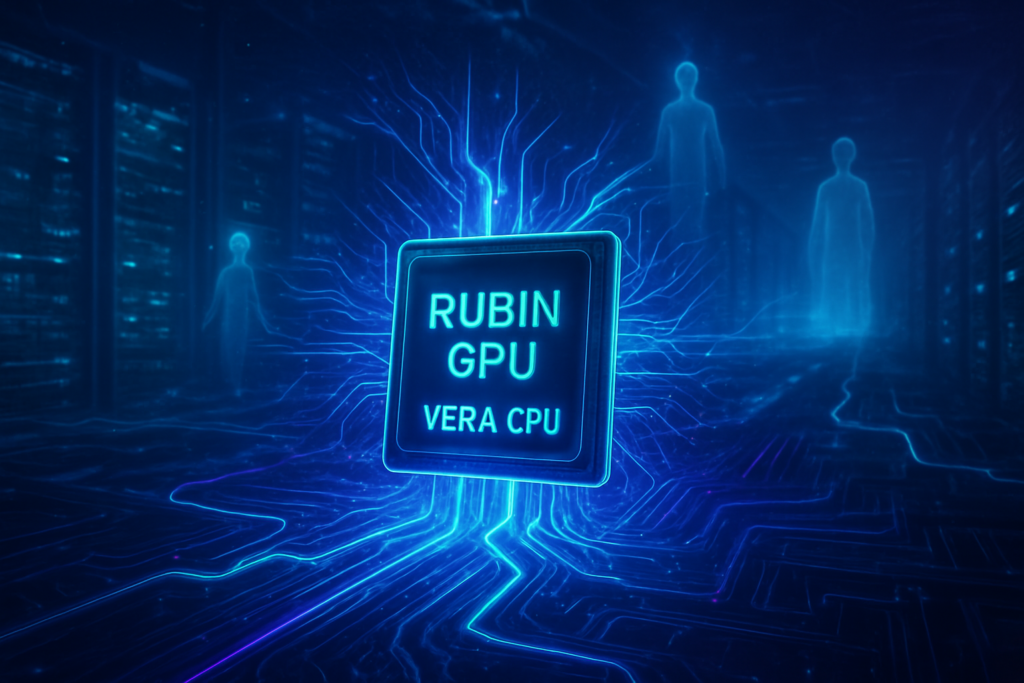
The Vera Rubin platform is built upon six foundational silicon advancements that NVIDIA describes as "extreme codesign." At the heart of the system is the Rubin GPU, a behemoth featuring 336 billion transistors and 288 GB of HBM4 memory. Delivering a staggering 22 TB/s of memory bandwidth per socket, the Rubin GPU is engineered to handle the massive Mixture-of-Experts (MoE) models that define the current state-of-the-art. Complementing the GPU is the Vera CPU, which marks a departure from traditional general-purpose processing. Featuring 88 custom "Olympus" cores compatible with Arm (NASDAQ: ARM) v9.2 architecture, the Vera CPU acts as a dedicated "data movement engine" optimized for the iterative logic and multi-step reasoning required by AI agents.
The interconnect and networking stack has seen an equally dramatic upgrade. NVLink 6 doubles scale-up bandwidth to 3.6 TB/s per GPU, allowing a rack of 72 GPUs to act as a single, massive processor. On the scale-out side, the ConnectX-9 SuperNIC and Spectrum-6 Ethernet switch provide 1.6 Tb/s and 102.4 Tb/s of throughput, respectively, with the latter utilizing Co-Packaged Optics (CPO) for a 5x improvement in power efficiency. Finally, the BlueField-4 DPU introduces a dedicated Inference Context Memory Storage Platform, offloading Key-Value (KV) cache management to improve token throughput by 5x, effectively giving AI models a "long-term memory" during complex tasks.
Microsoft and the Rise of the Fairwater AI Superfactories
The immediate commercial impact of the Vera Rubin platform is being realized through a massive strategic partnership with Microsoft Corp. (NASDAQ: MSFT). Microsoft has been named the premier launch partner, integrating the Rubin architecture into its new "Fairwater" AI superfactories. These facilities, located in strategic hubs like Wisconsin and Atlanta, are designed to house hundreds of thousands of Vera Rubin Superchips in a unique three-dimensional rack configuration that minimizes cable runs and maximizes the efficiency of the NVLink 6 fabric.
This partnership is a direct challenge to the broader cloud infrastructure market. By achieving a 10x reduction in inference costs, Microsoft and NVIDIA are positioning themselves to dominate the "agentic" era, where AI is not just a chatbot but a persistent digital employee performing complex workflows. For startups and competing AI labs, the Rubin platform raises the barrier to entry; training a 10-trillion parameter model now takes 75% fewer GPUs than it did on the previous Blackwell architecture. This shift effectively forces competitors to either adopt NVIDIA’s proprietary stack or face a massive disadvantage in both speed-to-market and operational cost.
From Chatbots to Agents: The Reasoning Era
The broader significance of the Vera Rubin platform lies in its explicit focus on "Agentic AI." While the previous generation of hardware was optimized for the "training era"—ingesting vast amounts of data to predict the next token—Rubin is built for the "reasoning era." This involves agents that can plan, use tools, and maintain context over weeks or months of interaction. The hardware-accelerated adaptive compression and the BlueField-4’s context management are specifically designed to handle the "long-context" requirements of these agents, allowing them to remember previous interactions and complex project requirements without the massive latency penalties of earlier systems.
This development mirrors the historical shift from mainframe computing to the PC, or from the desktop to mobile. By making high-level reasoning 10 times cheaper, NVIDIA is enabling a world where every software application can have a dedicated, autonomous agent. However, this leap also brings concerns regarding the energy consumption of such massive clusters and the potential for rapid job displacement as AI agents become capable of handling increasingly complex white-collar tasks. Industry experts note that the Rubin platform is not just a faster chip; it is a fundamental reconfiguration of how data centers are built and how software is conceived.
The Road Ahead: Robotics and Physical AI
Looking toward the future, the Vera Rubin platform is expected to serve as the backbone for NVIDIA’s expansion into "Physical AI." The same architectural breakthroughs found in the Vera CPU and Rubin GPU are already being adapted for the GR00T humanoid robotics platform and the Alpamayo autonomous driving system. In the near term, we can expect the first Fairwater-powered agentic services to roll out to Microsoft Azure customers by the second half of 2026.
The long-term challenge for NVIDIA will be managing the sheer power density of these systems. With the Rubin NVL72 requiring advanced liquid cooling and specialized power delivery, the infrastructure requirements for the "AI Superfactory" are becoming as complex as the silicon itself. Nevertheless, analysts predict that the Rubin platform will remain the gold standard for AI compute for the remainder of the decade, as the industry moves away from static models toward dynamic, self-improving agents.
A New Benchmark in Computing History
The launch of the Vera Rubin platform at CES 2026 is more than a routine product update; it is a declaration of the "Reasoning Era." By unifying six distinct chips into a singular, liquid-cooled fabric, NVIDIA has redefined the limits of what is possible in silicon. The 10x reduction in inference cost and the massive-scale partnership with Microsoft ensure that the Vera Rubin architecture will be the foundation upon which the next generation of autonomous digital and physical systems are built.
As we move into the second half of 2026, the tech industry will be watching closely to see how the first Fairwater superfactories perform and how quickly agentic AI can be integrated into the global economy. For now, Jensen Huang and NVIDIA have once again set a pace that the rest of the industry must struggle to match, proving that in the race for AI supremacy, the hardware remains the ultimate gatekeeper.
This content is intended for informational purposes only and represents analysis of current AI developments.
TokenRing AI delivers enterprise-grade solutions for multi-agent AI workflow orchestration, AI-powered development tools, and seamless remote collaboration platforms.
For more information, visit https://www.tokenring.ai/.