Let’s dig into the relative performance of Boot Barn (NYSE: BOOT) and its peers as we unravel the now-completed Q2 apparel and footwear retail earnings season.
Apparel and footwear was once a category thought to be relatively safe from major e-commerce penetration because of the need to try on, touch, and feel products, but the category is now meaningfully transacted online. Everyone still needs clothes and shoes to go outside unless they want some curious (or horrified) looks. But this ongoing digitization is forcing apparel and footwear retailers–that once only had brick-and-mortar stores–to respond with omnichannel offerings. The online shopping experience continues to improve and retail foot traffic in places like shopping malls continues to stagnate, so the evolution of clothing and shoes sellers marches on.
The 9 apparel and footwear retail stocks we track reported a satisfactory Q2. As a group, revenues were in line with analysts’ consensus estimates while next quarter’s revenue guidance was 1% below.
In light of this news, share prices of the companies have held steady. On average, they are relatively unchanged since the latest earnings results.
Boot Barn (NYSE: BOOT)
With a strong store presence in Texas, California, Florida, and Oklahoma, Boot Barn (NYSE: BOOT) is a western-inspired apparel and footwear retailer.
Boot Barn reported revenues of $593.5 million, up 17.7% year on year. This print exceeded analysts’ expectations by 1.7%. Overall, it was a satisfactory quarter for the company with a beat of analysts’ EPS estimates but EPS guidance for next quarter missing analysts’ expectations significantly.
John Hazen, Chief Executive Officer, commented, “We are pleased with our strong start to fiscal 2027, as first quarter results exceeded our expectations and reflected broad-based strength across the business. Our team continues to execute at a high level, delivering solid same store sales growth, expanding margin, and opening new stores that continue to perform above our expectations.”
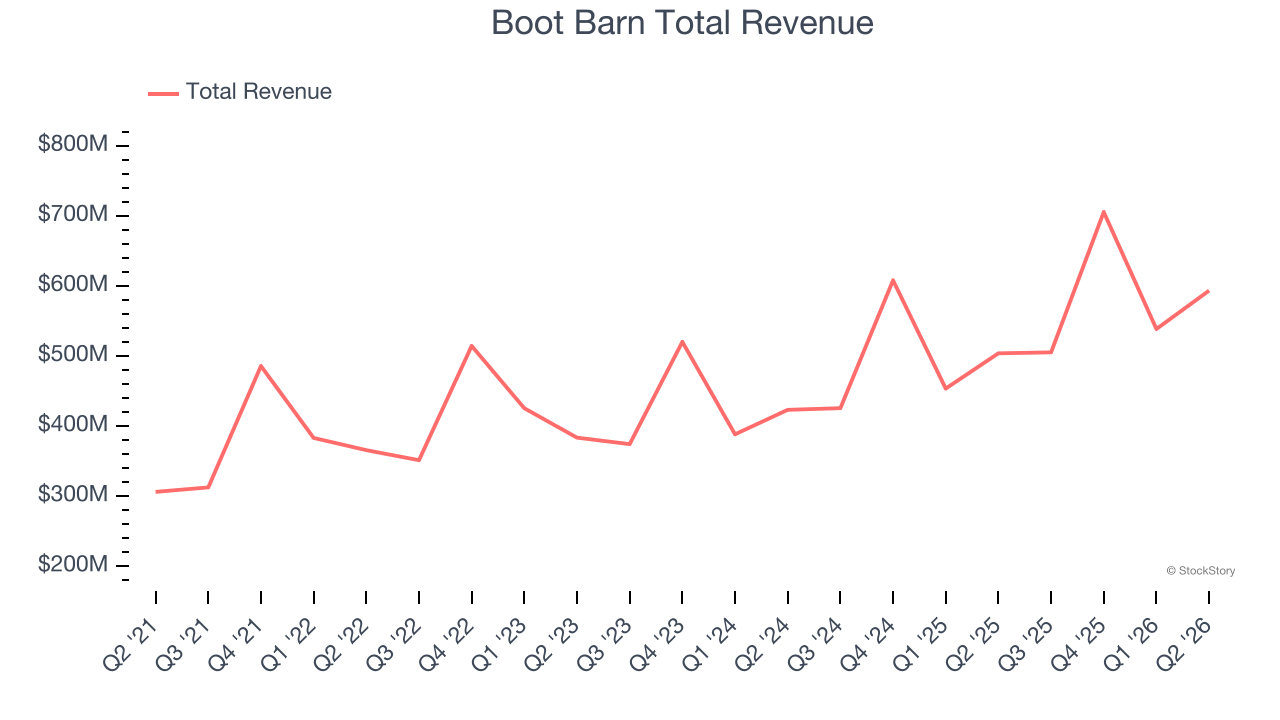
Boot Barn scored the fastest revenue growth of the whole group. Even though it had a relatively good quarter, the market seems discontent with the results. The stock is down 4.2% since reporting and currently trades at $144.57.
Is now the time to buy Boot Barn? Access our full analysis of the earnings results here, it’s free.
Best Q2: Tilly's (NYSE: TLYS)
With an emphasis on skate and surf culture, Tilly’s (NYSE: TLYS) is a specialty retailer that sells clothing, footwear, and accessories geared towards fashion-forward teens and young adults.
Tilly's reported revenues of $163.5 million, up 8.1% year on year, outperforming analysts’ expectations by 4.1%. The business had an incredible quarter with EPS guidance for next quarter exceeding analysts’ expectations and a beat of analysts’ EPS estimates.
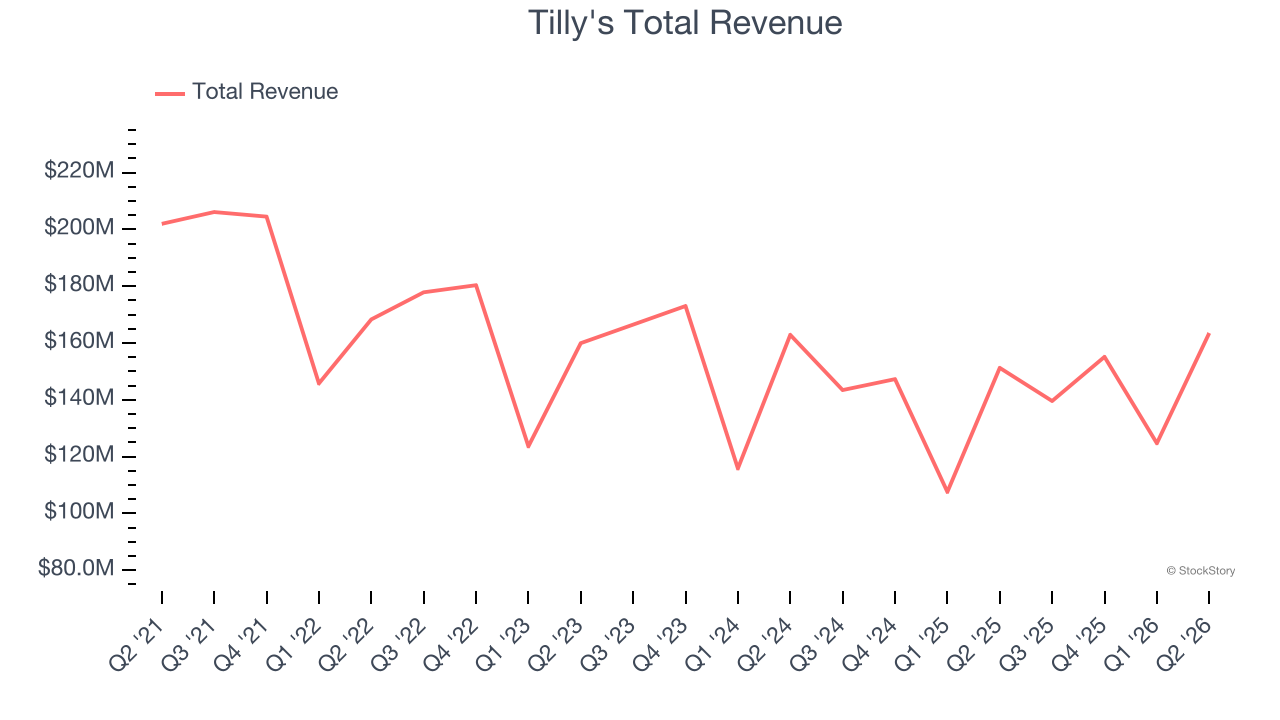
Tilly's achieved the biggest analyst estimate beat and highest guidance raise in the group. The market seems happy with the results as the stock is up 28% since reporting. It currently trades at $4.88.
Is now the time to buy Tilly's? Access our full analysis of the earnings results here, it’s free.
Weakest Q2: Zumiez (NASDAQ: ZUMZ)
With store associates called “Zumiez Stash Members”, Zumiez (NASDAQ: ZUMZ) is a specialty retailer of street and skate apparel, footwear, and accessories.
Zumiez reported revenues of $209 million, down 2.5% year on year, falling short of analysts’ expectations by 1.5%. It was a disappointing quarter as it posted revenue guidance for next quarter missing analysts’ expectations significantly and EPS guidance for next quarter missing analysts’ expectations significantly.
As expected, the stock is down 13.9% since the results and currently trades at $14.38.
Read our full analysis of Zumiez’s results here.
Lululemon (NASDAQ: LULU)
Originally serving yogis and hockey players, Lululemon (NASDAQ: LULU) is a designer, distributor, and retailer of athletic apparel for men and women.
Lululemon reported revenues of $2.42 billion, down 4.3% year on year. This print came in 1.7% below analysts’ expectations. Overall, it was a softer quarter as it also recorded full-year EPS guidance missing analysts’ expectations significantly and revenue guidance for next quarter missing analysts’ expectations significantly.
Lululemon had the weakest performance against analyst estimates, weakest guidance update, and slowest revenue growth among its peers. The stock is down 17.6% since reporting and currently trades at $100.28.
Read our full, actionable report on Lululemon here, it’s free.
Victoria's Secret (NYSE: VSXY)
Spun off from L Brands in 2020, Victoria’s Secret (NYSE: VSXY) is an intimate clothing and beauty retailer that sells its own brands of lingerie, undergarments, and personal fragrances.
Victoria's Secret reported revenues of $1.61 billion, up 10.4% year on year. This number missed analysts’ expectations by 0.6%. More broadly, it was a mixed quarter as it also produced a beat of analysts’ EPS estimates but full-year EPS guidance missing analysts’ expectations.
Victoria's Secret scored the highest full-year guidance raise of the whole group. The stock is down 12.2% since reporting and currently trades at $74.50.
Read our full, actionable report on Victoria's Secret here, it’s free.
Market Update
Over the past year, investors have been forced to repeatedly answer the same question: what is the market’s biggest risk? The answer has changed several times, and each shift has reshaped market leadership.
Late in 2025 and early 2026, artificial intelligence became the market’s primary uncertainty. Investors questioned whether AI would erode software pricing power and weaken competitive moats as AI made it easier to replicate once-differentiated products.
By the spring, technology took a back seat to geopolitics. The U.S. conflict with Iran briefly became the market’s dominant narrative, raising concerns about oil prices, inflation, and global growth. But as energy markets remained orderly and fears of a prolonged supply disruption faded, investors quickly turned their focus back to fundamentals.
Want to invest in winners with rock-solid fundamentals? Check out our 9 Best Market-Beating Stocks and add them to your watchlist. These companies are poised for growth regardless of the political or macroeconomic climate.