Electronics retailer Best Buy (NYSE: BBY) reported revenue ahead of Wall Street’s expectations in Q2 CY2026, with sales up 3.6% year on year to $9.78 billion. The company’s full-year revenue guidance of $42.55 billion at the midpoint came in 1.2% above analysts’ estimates. Its non-GAAP profit of $1.47 per share was 6.5% above analysts’ consensus estimates.
Is now the time to buy Best Buy? Find out by accessing our full research report, it’s free.
Best Buy (BBY) Q2 CY2026 Highlights:
- Revenue: $9.78 billion vs analyst estimates of $9.58 billion (3.6% year-on-year growth, 2.1% beat)
- Adjusted EPS: $1.47 vs analyst estimates of $1.38 (6.5% beat)
- The company lifted its revenue guidance for the full year to $42.55 billion at the midpoint from $41.65 billion, a 2.2% increase
- Management raised its full-year Adjusted EPS guidance to $6.80 at the midpoint, a 5.4% increase
- Operating Margin: 4.3%, up from 2.7% in the same quarter last year
- Free Cash Flow Margin: 7.5%, up from 6.1% in the same quarter last year
- Same-Store Sales rose 4.1% year on year (1.6% in the same quarter last year)
- Market Capitalization: $18.43 billion
Company Overview
With humble beginnings as a stereo equipment seller, Best Buy (NYSE: BBY) now sells a broad selection of consumer electronics, appliances, and home office products.
Revenue Growth
A company’s long-term performance is an indicator of its overall quality. Any business can put up a good quarter or two, but the best consistently grow over the long haul.
With $42.2 billion in revenue over the past 12 months, Best Buy is larger than most consumer retail companies and benefits from economies of scale, enabling it to gain more leverage on its fixed costs than smaller competitors. This also gives it the flexibility to offer lower prices. However, its scale is a double-edged sword because there is only so much real estate to build new stores, placing a ceiling on its growth. To accelerate sales, Best Buy likely needs to optimize its pricing or lean into international expansion.
As you can see below, Best Buy’s demand was weak over the last three years. Its sales fell by 1.7% annually as it closed stores.
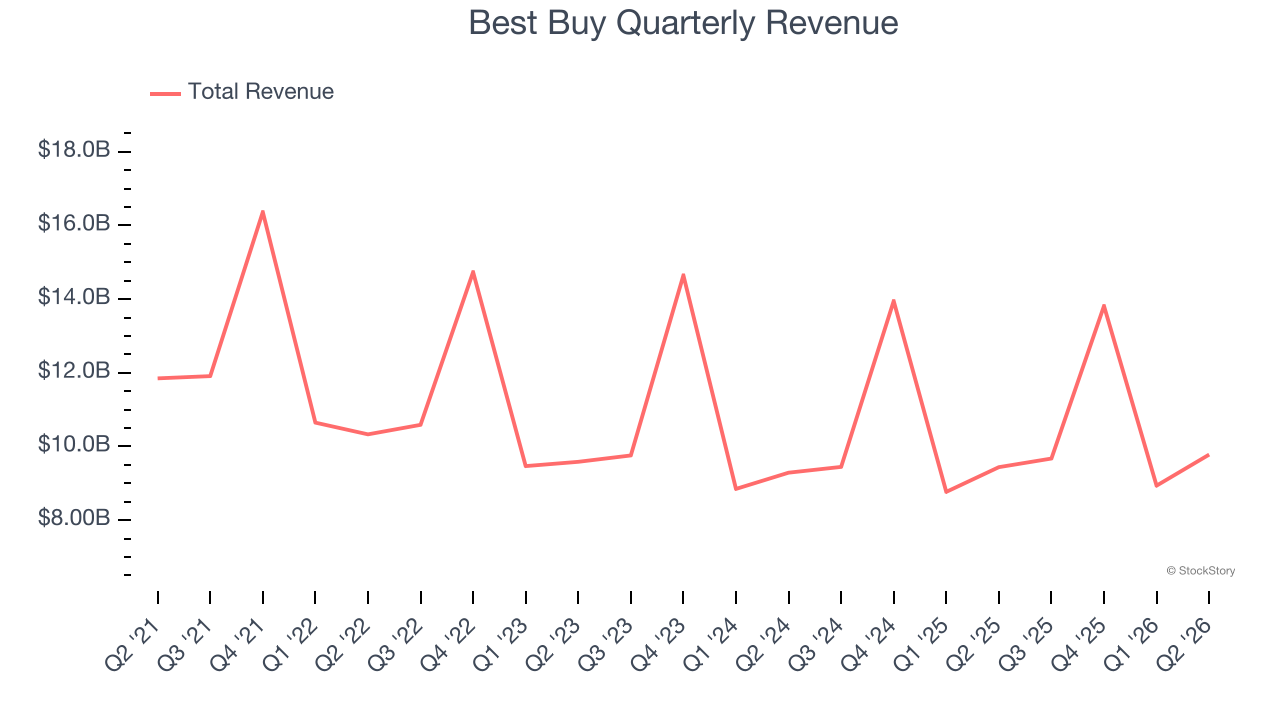
This quarter, Best Buy reported modest year-on-year revenue growth of 3.6% but beat Wall Street’s estimates by 2.1%.
Looking ahead, sell-side analysts expect revenue to remain flat over the next 12 months. While this projection indicates its newer products will spur better top-line performance, it is still below average for the sector.
WHILE YOU’RE HERE: The Next Palantir? One satellite company captures images of every point on Earth. Every single day. The Pentagon wants it. Hedge funds are using it to beat earnings. You’ve probably never heard of it.
This is what the early days of Palantir looked like before it became a giant. Same playbook. Different technology. If you missed Palantir, you need to see this. Claim The Stock Ticker for Free HERE.
Store Performance
Number of Stores
A retailer’s store count influences how much it can sell and how quickly revenue can grow.
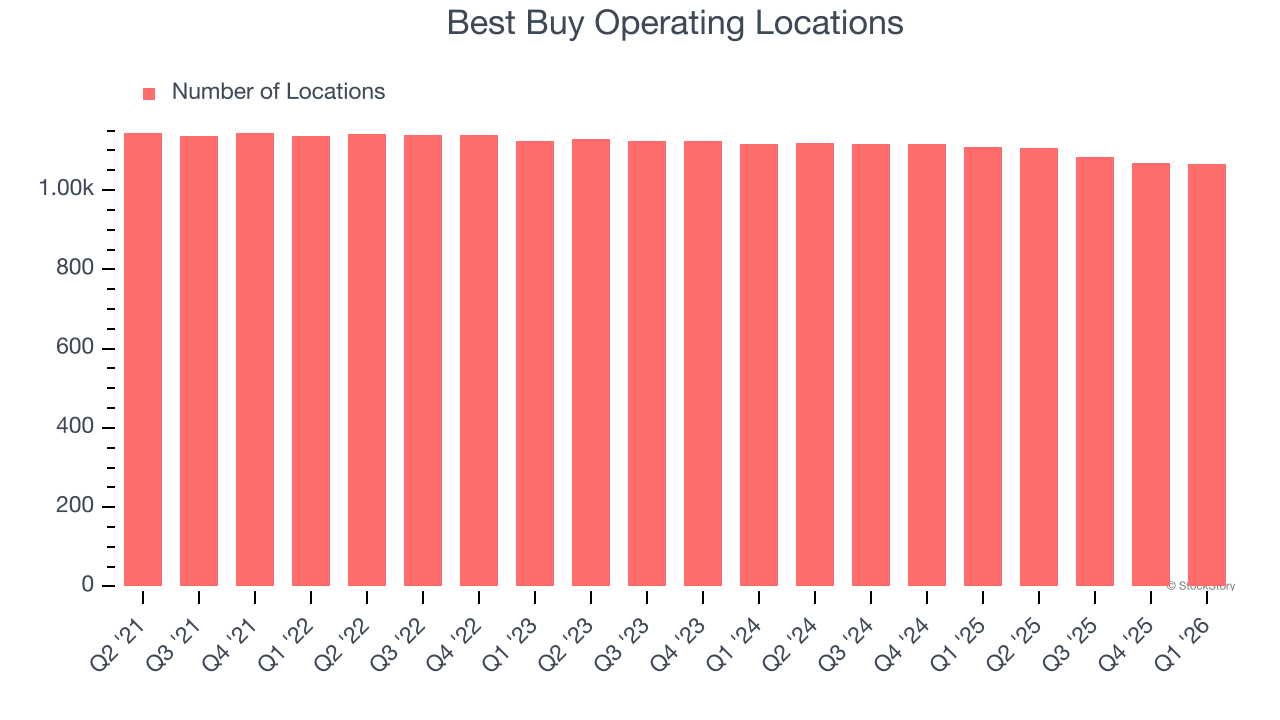
Best Buy has generally closed its stores over the last two years, averaging 2.1% annual declines.
When a retailer shutters stores, it usually means that brick-and-mortar demand is less than supply, and it is responding by closing underperforming locations to improve profitability.
Note that Best Buy reports its store count intermittently, so some data points are missing in the chart below.
Same-Store Sales
The change in a company’s store base only tells one side of the story. The other is the performance of its existing locations and e-commerce sales, which informs management teams whether they should expand or downsize their physical footprints. Same-store sales gives us insight into this topic because it measures organic growth for a retailer’s e-commerce platform and brick-and-mortar shops that have existed for at least a year.
Best Buy’s demand within its existing locations has barely increased over the last two years as its same-store sales were flat. This performance isn’t ideal, and Best Buy is attempting to boost same-store sales by closing stores (fewer locations sometimes lead to higher same-store sales).
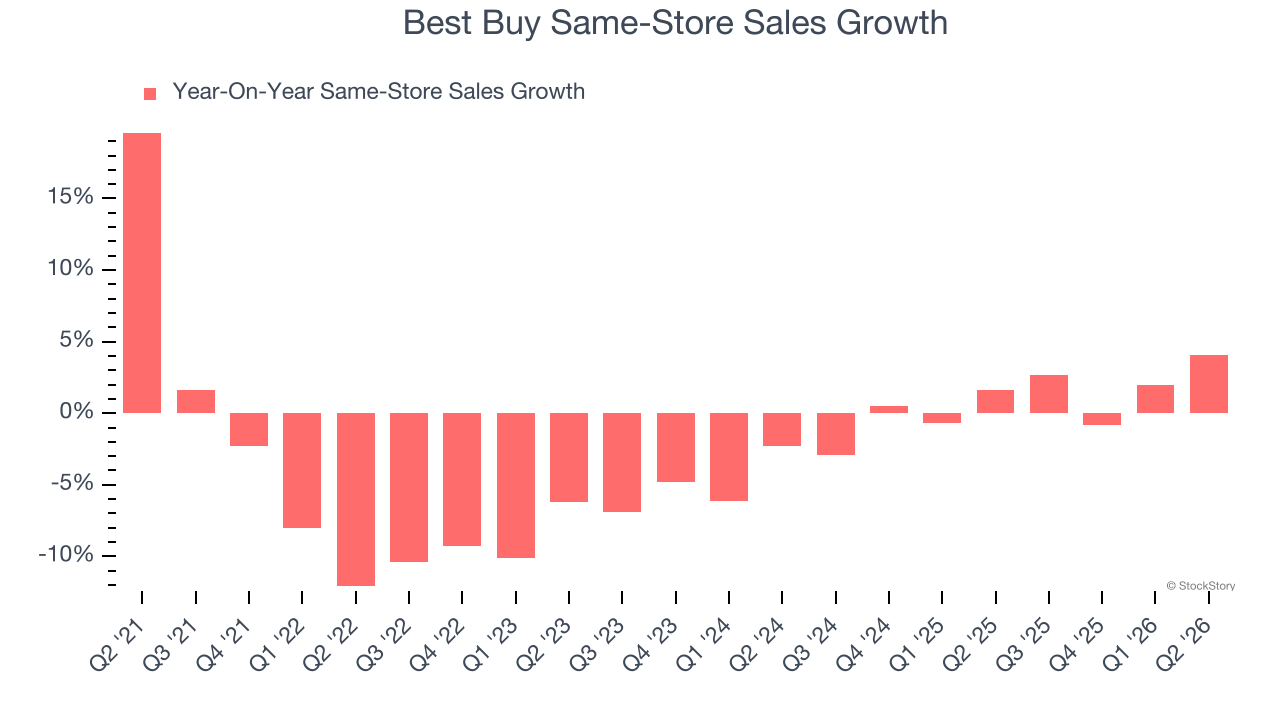
In the latest quarter, Best Buy’s same-store sales rose 4.1% year on year. This growth was an acceleration from its historical levels, which is always an encouraging sign.
Key Takeaways from Best Buy’s Q2 Results
It was great to see Best Buy’s full-year EPS guidance top analysts’ expectations. We were also glad its revenue outperformed Wall Street’s estimates. Overall, we think this was a decent quarter with some key metrics above expectations. Investors were likely hoping for more, and shares traded down 1.3% to $86.29 immediately after reporting.
So should you invest in Best Buy right now? What happened in the latest quarter matters, but not as much as longer-term business quality and valuation, when deciding whether to invest in this stock. We cover that in our actionable full research report which you can read here (it’s free).