Membership-only discount retailer Costco (NASDAQ: COST) reported Q2 CY2026 results exceeding the market’s revenue expectations, with sales up 11.6% year on year to $70.53 billion. Its GAAP profit of $4.93 per share was in line with analysts’ consensus estimates.
Is now the time to buy Costco? Find out by accessing our full research report, it’s free.
Costco (COST) Q2 CY2026 Highlights:
- Revenue: $70.53 billion vs analyst estimates of $69.47 billion (11.6% year-on-year growth, 1.5% beat)
- EPS (GAAP): $4.93 vs analyst estimates of $4.92 (in line)
- Operating Margin: 4%, in line with the same quarter last year
- Free Cash Flow Margin: 2.9%, similar to the same quarter last year
- Locations: 931 at quarter end, up from 905 in the same quarter last year
- Same-Store Sales rose 9.8% year on year (5.7% in the same quarter last year)
- Market Capitalization: $445.3 billion
Company Overview
Designed to be a one-stop shop for the suburban consumer, Costco (NASDAQ: COST) is a membership-only retail chain that sells groceries, apparel, toys, and household items, often in bulk quantities.
Revenue Growth
Examining a company’s long-term performance can provide clues about its quality. Any business can experience short-term success, but top-performing ones enjoy sustained growth for years.
With $293.6 billion in revenue over the past 12 months, Costco is a behemoth in the consumer retail sector and benefits from economies of scale, giving it an edge in distribution. This also enables it to gain more leverage on its fixed costs than smaller competitors and the flexibility to offer lower prices. However, its scale is a double-edged sword because it’s harder to find incremental growth when you’ve penetrated most of the market. For Costco to boost its sales, it likely needs to adjust its prices or lean into foreign markets.
As you can see below, Costco grew its sales at a mediocre 7.6% compounded annual growth rate over the last three years, but to its credit, it opened new stores and increased sales at existing, established locations.
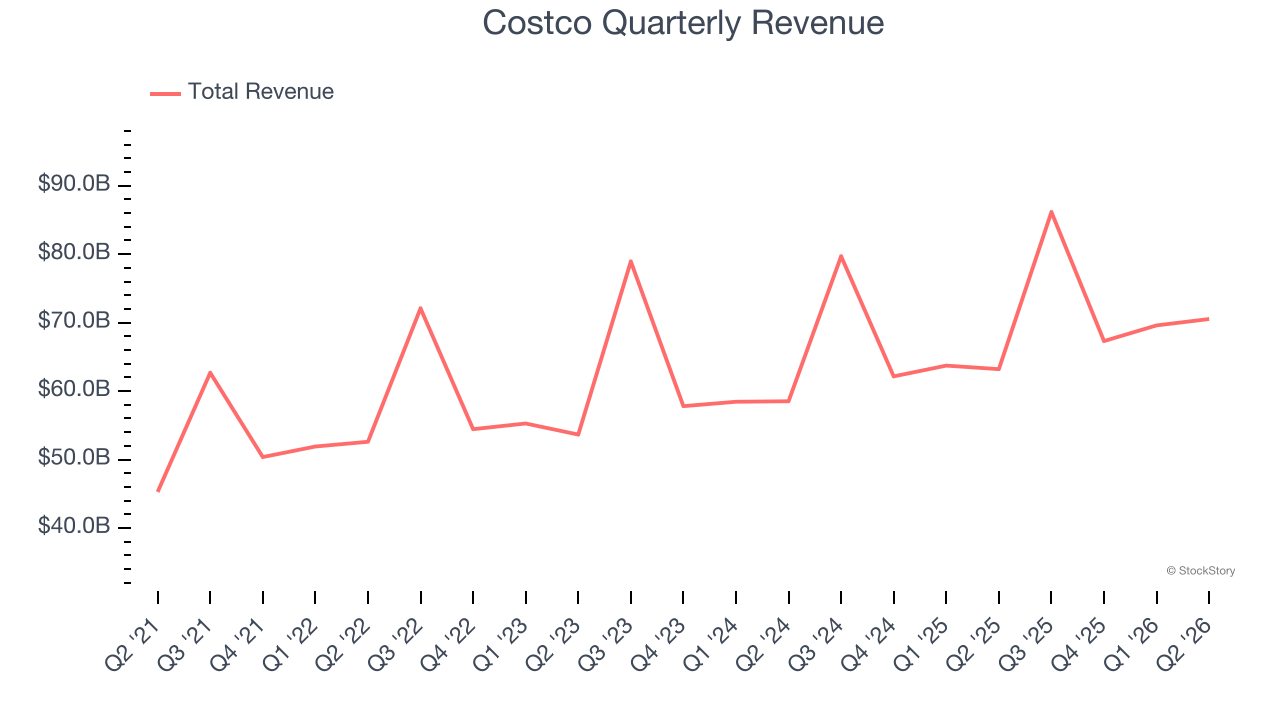
This quarter, Costco reported year-on-year revenue growth of 11.6%, and its $70.53 billion of revenue exceeded Wall Street’s estimates by 1.5%.
Looking ahead, sell-side analysts expect revenue to grow 7.8% over the next 12 months, similar to its three-year rate. This projection is particularly healthy for a company of its scale and implies the market is baking in success for its products.
ONE MORE THING: The $21 AI Application Stock Wall Street Forgot. While Wall Street obsesses over who’s building AI, one company is already using it to print money. And nobody’s paying attention.
AI chip stocks trade at ridiculous valuations. This company processes a trillion consumer signals monthly using AI and trades at a third of the price. The gap won’t last. The institutions will figure it out. You need to see this first. Read the FREE Report Before They Notice.
Store Performance
Number of Stores
The number of stores a retailer operates is a critical driver of how quickly company-level sales can grow.
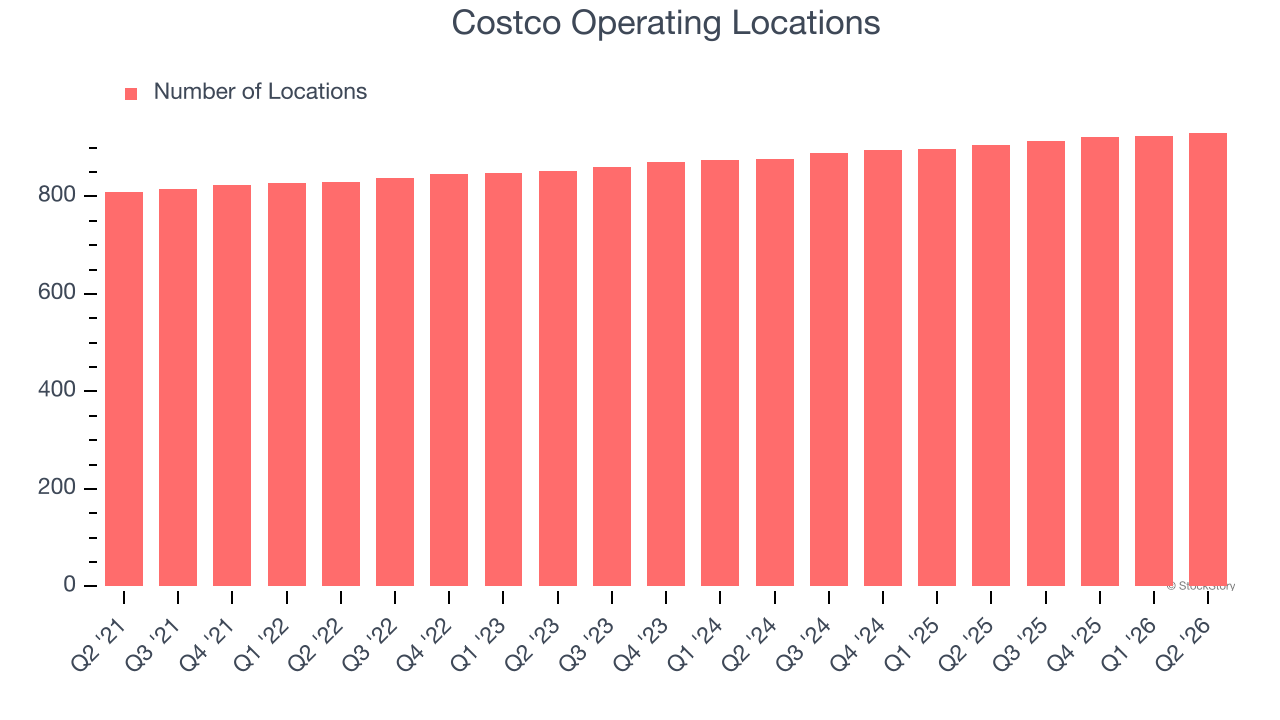
Costco operated 931 locations in the latest quarter. It has opened new stores quickly over the last two years, averaging 3% annual growth, faster than the broader consumer retail sector.
When a retailer opens new stores, it usually means it’s investing for growth because demand is greater than supply, especially in areas where consumers may not have a store within reasonable driving distance.
Same-Store Sales
A company’s store base only paints one part of the picture. When demand is high, it makes sense to open more. But when demand is low, it’s prudent to close some locations and use the money in other ways. Same-store sales is an industry measure of whether revenue is growing at those existing stores and is driven by customer visits (often called traffic) and the average spending per customer (ticket).
Costco has been one of the most successful retailers over the last two years thanks to skyrocketing demand within its existing locations. On average, the company has posted exceptional year-on-year same-store sales growth of 6.6%. This performance suggests its rollout of new stores is beneficial for shareholders. We like this backdrop because it gives Costco multiple ways to win: revenue growth can come from new stores, e-commerce, or increased foot traffic and higher sales per customer at existing locations.
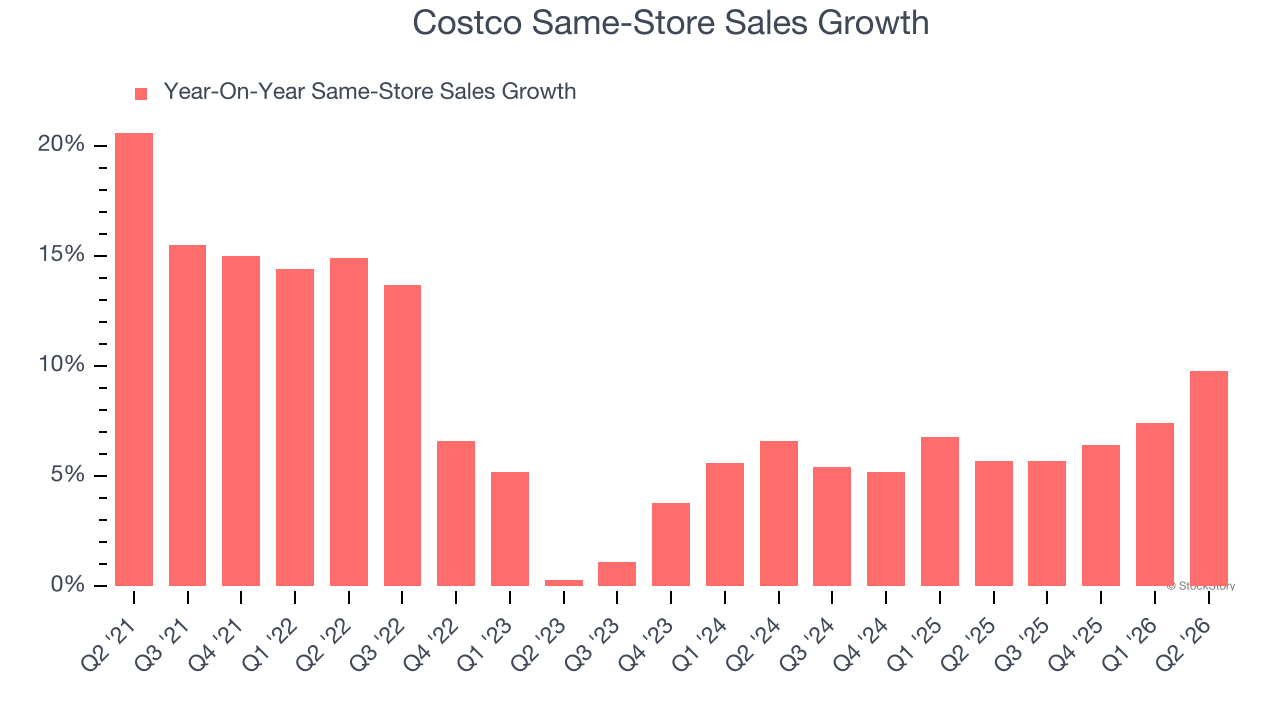
In the latest quarter, Costco’s same-store sales rose 9.8% year on year. This growth was an acceleration from its historical levels, which is always an encouraging sign.
Key Takeaways from Costco’s Q2 Results
We were impressed by how significantly Costco blew past analysts’ gross margin expectations this quarter. We were also happy its revenue outperformed Wall Street’s estimates. On the other hand, its EBITDA missed. Zooming out, we think this was a mixed quarter. The stock remained flat at $998.05 immediately after reporting.
So should you invest in Costco right now? The latest quarter does matter, but not nearly as much as longer-term fundamentals and valuation, when deciding if the stock is a buy. We cover that in our actionable full research report which you can read here (it’s free).