As the Q4 earnings season comes to a close, it’s time to take stock of this quarter’s best and worst performers in the cybersecurity industry, including CrowdStrike (NASDAQ: CRWD) and its peers.
Cybersecurity continues to be one of the fastest-growing segments within software for good reason. Almost every company is slowly finding itself becoming a technology company and facing rising cybersecurity risks. Businesses are accelerating adoption of cloud-based software, moving data and applications into the cloud to save costs while improving performance. This migration has opened them to a multitude of new threats, like employees accessing data via their smartphone while on an open network, or logging into a web-based interface from a laptop in a new location.
The 9 cybersecurity stocks we track reported a mixed Q4. As a group, revenues beat analysts’ consensus estimates by 1.5% while next quarter’s revenue guidance was in line.
Amidst this news, share prices of the companies have had a rough stretch. On average, they are down 13.6% since the latest earnings results.
Best Q4: CrowdStrike (NASDAQ: CRWD)
Known for detecting the massive SolarWinds hack in 2020 that compromised numerous government agencies, CrowdStrike (NASDAQ: CRWD) provides cloud-based cybersecurity solutions that protect endpoints, cloud workloads, identity, and data through its Falcon platform.
CrowdStrike reported revenues of $1.31 billion, up 23.3% year on year. This print exceeded analysts’ expectations by 0.6%. Overall, it was a strong quarter for the company with an impressive beat of analysts’ billings estimates and a solid beat of analysts’ EBITDA estimates.
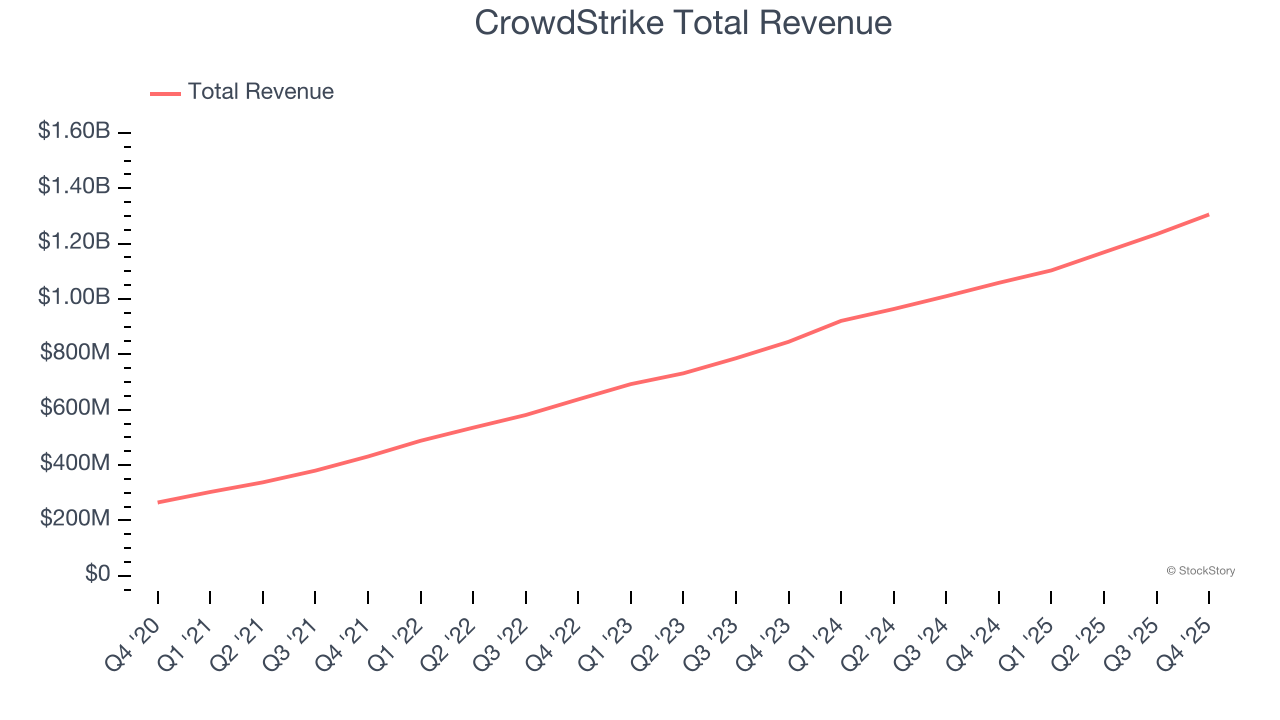
The market was likely pricing in the results, and the stock is flat since reporting. It currently trades at $394.82.
Read why we think that CrowdStrike is one of the best cybersecurity stocks, our full report is free.
Zscaler (NASDAQ: ZS)
Pioneering the "zero trust" approach that has fundamentally changed enterprise network security, Zscaler (NASDAQ: ZS) provides a cloud-based security platform that connects users, devices, and applications securely without traditional network-based security hardware.
Zscaler reported revenues of $815.8 million, up 25.9% year on year, outperforming analysts’ expectations by 2.1%. The business had a strong quarter with EPS guidance for next quarter exceeding analysts’ expectations and full-year EPS guidance exceeding analysts’ expectations.
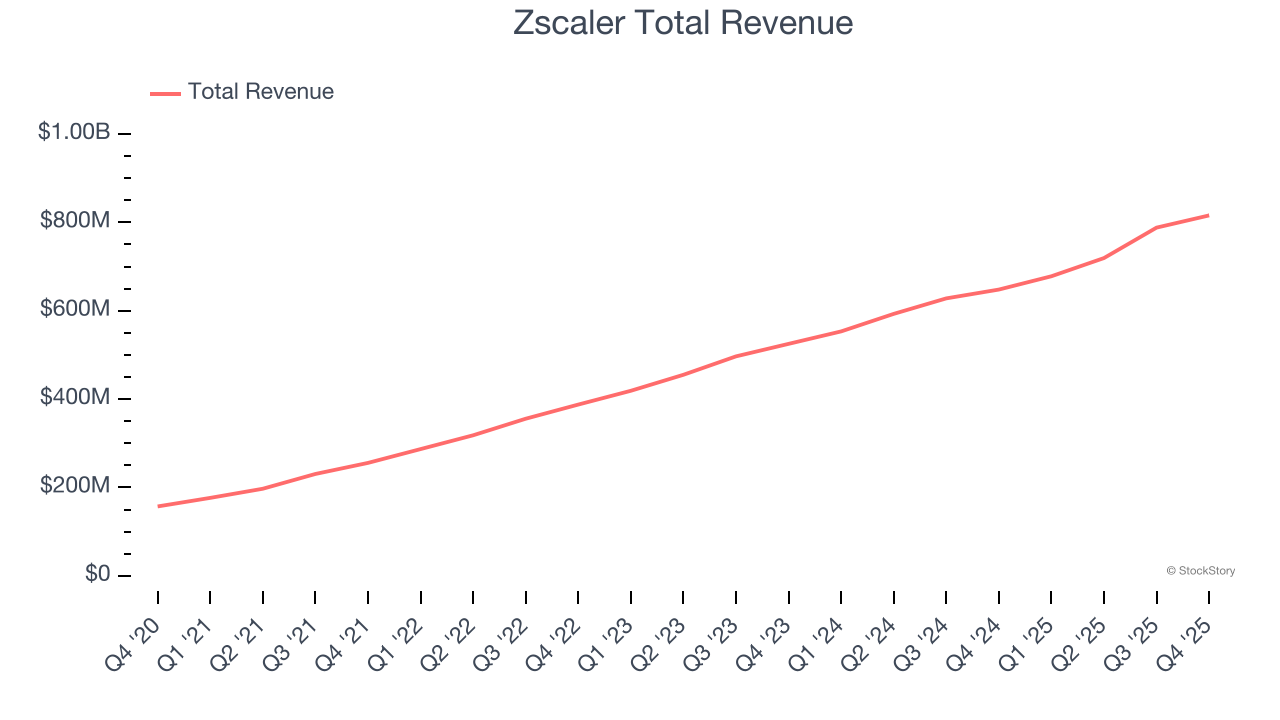
Zscaler pulled off the fastest revenue growth among its peers. Although it had a fine quarter compared its peers, the market seems unhappy with the results as the stock is down 15.3% since reporting. It currently trades at $141.72.
Is now the time to buy Zscaler? Access our full analysis of the earnings results here, it’s free.
Weakest Q4: Rapid7 (NASDAQ: RPD)
With its name inspired by the need for quick responses to cyber threats, Rapid7 (NASDAQ: RPD) provides cybersecurity software and services that help organizations detect vulnerabilities, monitor threats, and respond to security incidents.
Rapid7 reported revenues of $217.4 million, flat year on year, exceeding analysts’ expectations by 1.2%. Still, it was a softer quarter as it posted full-year guidance of slowing revenue growth and full-year revenue guidance missing analysts’ expectations significantly.
Rapid7 delivered the slowest revenue growth in the group. As expected, the stock is down 46.4% since the results and currently trades at $5.57.
Read our full analysis of Rapid7’s results here.
Okta (NASDAQ: OKTA)
Named after the meteorological measurement for cloud cover, Okta (NASDAQ: OKTA) provides cloud-based identity management solutions that help organizations securely connect their employees, partners, and customers to the right applications and services.
Okta reported revenues of $761 million, up 11.6% year on year. This result topped analysts’ expectations by 1.6%. Overall, it was a strong quarter as it also recorded a solid beat of analysts’ EBITDA estimates and full-year EPS guidance exceeding analysts’ expectations.
The stock is up 10% since reporting and currently trades at $78.91.
Read our full, actionable report on Okta here, it’s free.
Qualys (NASDAQ: QLYS)
Originally developed to address the growing complexity of IT security in the cloud era, Qualys (NASDAQ: QLYS) provides a cloud-based platform that helps organizations identify, manage, and protect their IT assets from cyber threats across on-premises, cloud, and mobile environments.
Qualys reported revenues of $175.3 million, up 10.1% year on year. This print surpassed analysts’ expectations by 1.2%. Aside from that, it was a mixed quarter as it also produced a solid beat of analysts’ EBITDA estimates but full-year EPS guidance slightly missing analysts’ expectations.
The stock is down 31.6% since reporting and currently trades at $87.42.
Read our full, actionable report on Qualys here, it’s free.
Market Update
Late in 2025 into early 2026, there was hand wringing around artificial intelligence. For software companies, the fear was that AI would erode pricing power and compress margins as new tools made it easier to replicate what once required expensive enterprise platforms. Crypto investors had their own version of the same anxiety: if AI agents could trade, allocate capital, and manage wallets autonomously, what exactly was the long-term value of today’s crypto infrastructure?
These concerns triggered a noticeable rotation away from these sectors and into safer havens. But markets rarely dwell on one narrative for long. Spring 2026 came, and the focus shifted abruptly from technological disruption to geopolitical risk. The US’ conflict with Iran became the dominant driver of market psychology, and when geopolitics takes center stage, the script changes quickly. Investors stop debating growth rates and start worrying about oil supply, inflation, and global stability.
Want to invest in winners with rock-solid fundamentals? Check out our Hidden Gem Stocks and add them to your watchlist. These companies are poised for growth regardless of the political or macroeconomic climate.
StockStory’s analyst team — all seasoned professional investors — uses quantitative analysis and automation to deliver market-beating insights faster and with higher quality.