Wireless chip maker Skyworks Solutions (NASDAQ: SWKS) reported calendar Q3 2026 (fiscal Q4 2026) results exceeding the market’s revenue expectations, but revenue fell by 5% year on year to $1.05 billion. On the other hand, next quarter’s revenue guidance of $1.85 million was less impressive, coming in 99.9% below analysts’ consensus estimates. Its non-GAAP profit of $1.28 per share was in line with analysts’ consensus estimates.
For more on Skyworks Solutions, read our free full research report.
Skyworks Solutions (SWKS) Q3 CY2026 highlights:
- Revenue $1.05 billion vs S&P analysts’ consensus estimates of $1.04 billion (5% year-on-year decline, 1% beat)
- Adjusted EPS $1.28 vs S&P analysts’ consensus estimates of $1.27 (in line)
- Adjusted operating income $227.2 million vs analysts’ consensus estimates of $220.9 million (21.7% margin, 2.8% beat)
- Revenue guidance $1.85 million at the midpoint for Q4 CY2026, below analysts’ consensus estimates of $1.99 billion
- Adjusted EPS guidance $1.25 at the midpoint for Q4 CY2026, below analysts’ consensus estimates of $1.57
- Operating margin 2.1%, down from 10.1% in the same quarter last year
- Free cash flow -$61 million, down from $144 million in the same quarter last year
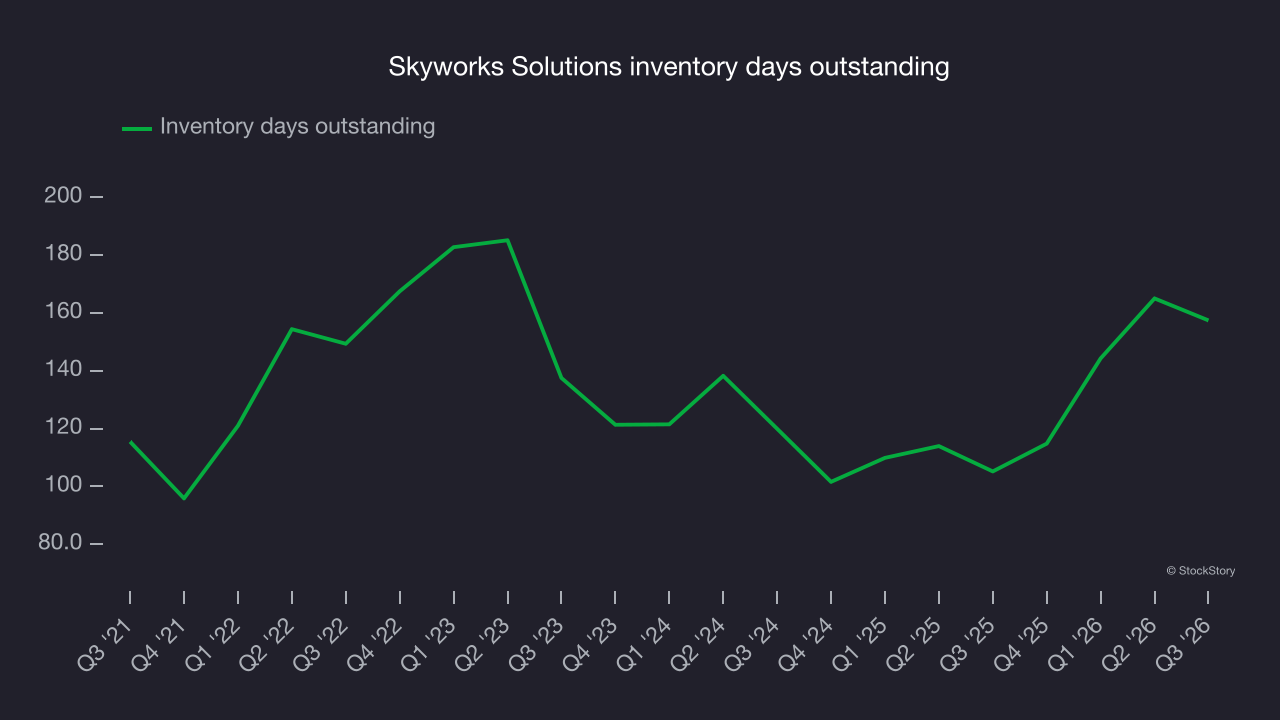
- Inventory days outstanding 157, down from 165 in the previous quarter
- Market capitalization $12.82 billion
“Today marks a new chapter for Skyworks,” said Phil Brace, chief executive officer and president of Skyworks. “Combining with Qorvo gives us the scale and the technology breadth to lead the next era of wireless, as AI moves from the infrastructure to the devices, vehicles and machines around us. In Smartphone, our portfolio now spans the RF front-end, from power management to the antenna, as 5G-Advanced and 6G drive a new cycle of RF complexity. In Diversified Growth Markets, our complementary RF GaN, power, and timing solutions expand our reach across Physical AI and Connected Edge, Defense and Aerospace, Infrastructure, and Automotive. Our focus now is execution: delivering for our customers, achieving $500 million or more of annual cost synergies and building a stronger, more diversified Skyworks.”
Revenue growth
A company’s long-term revenue performance can indicate its overall quality. Any business can report a good quarter or two, but the best consistently grow over the long term. Skyworks Solutions struggled to consistently generate demand over the last five years as its revenue dropped at a 5% annual rate. That underwhelming result suggests poor business quality. Semiconductors are a cyclical industry, and long-term investors should be prepared for periods of high growth followed by periods of revenue contractions.
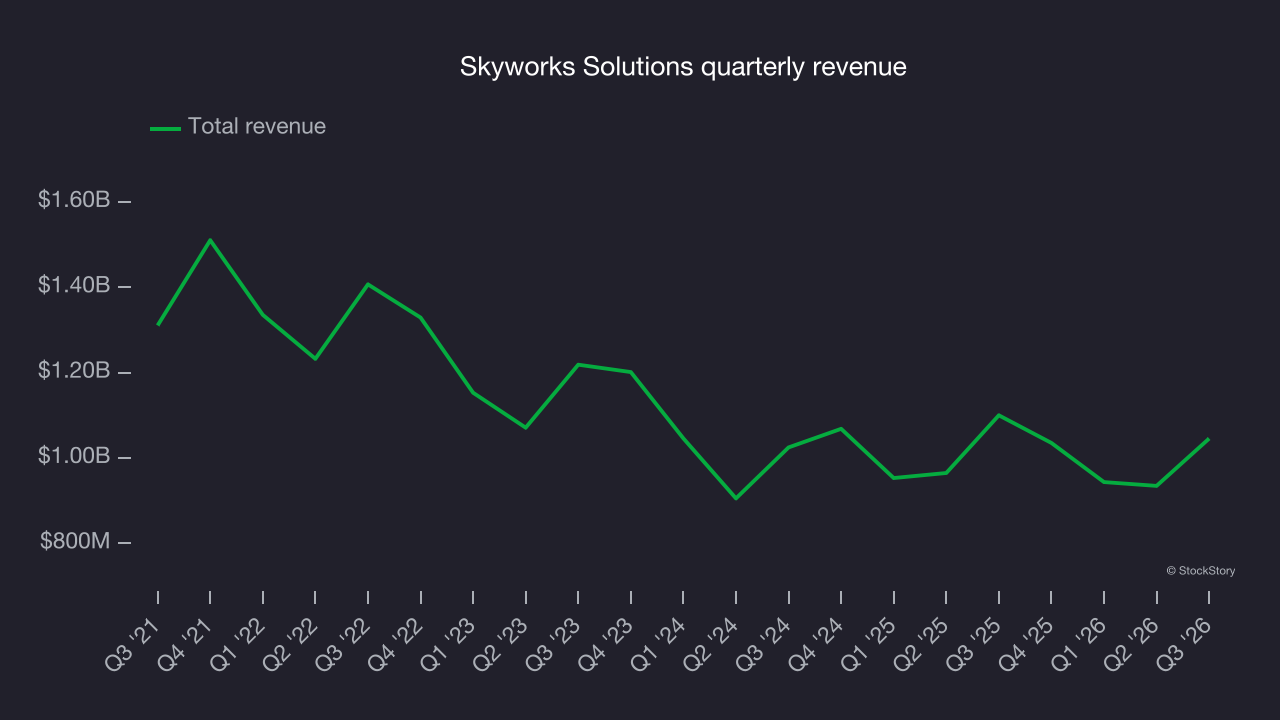
Long-term growth is the most important, but short-term results matter for semiconductors because the rapid pace of technological innovation (Moore’s Law) could make yesterday’s hit product obsolete today. Skyworks Solutions’s annualized revenue declines of 2.6% over the last two years suggest its demand continued shrinking. 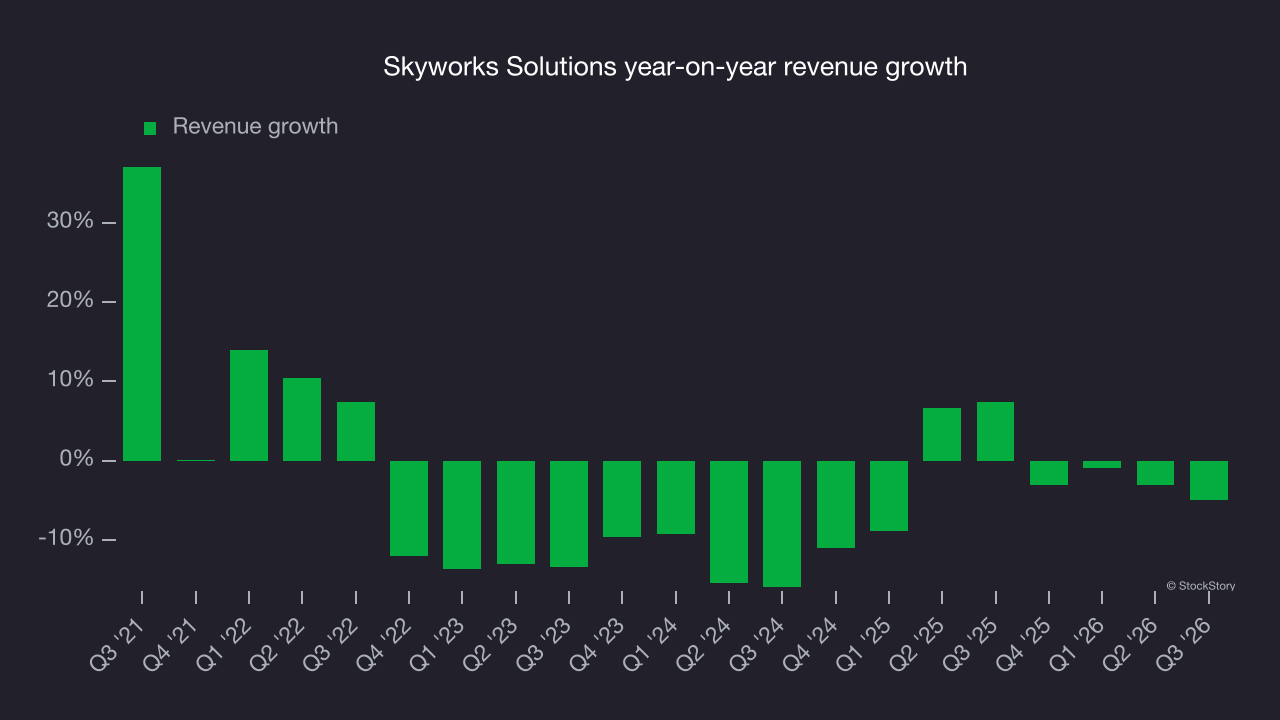
This quarter, Skyworks Solutions’s revenue fell by 5% year on year to $1.05 billion but beat Wall Street’s consensus estimates by 1%. Despite the beat, the drop in revenue could mean that the current downcycle is deepening. Company management is currently guiding for a 99.8% year-on-year decline in revenue next quarter.
Looking further ahead, sell-side analysts expect revenue to grow 91.2% over the next 12 months, according to S&P, an improvement versus the last two years. This substantial growth projection implies its newer products and services will spur better top-line performance.
Product demand & outstanding inventory
Days inventory outstanding, or DIO, is an important metric for chipmakers, as it reflects a business’s capital intensity and the cyclical nature of semiconductor supply and demand. In a tight supply environment, inventories tend to be stable, allowing chipmakers to exert pricing power. Steadily increasing DIO can be a warning sign that demand is weak, and if inventories continue to rise, the company may have to downsize production.
This quarter, Skyworks Solutions’s DIO came in at 157, which is 22 days above its five-year average. These numbers suggest that despite the recent decrease, the company’s inventory levels remain higher than in the past.
Key takeaways from Skyworks Solutions’s Q3 results
Skyworks Solutions had some positives in Q3: inventory levels improved and operating income topped Wall Street’s consensus estimates. But revenue guidance for next quarter missed expectations, leaving the quarter short of a better result. Shares plunged 14.5% to $72.86 immediately after the report.
Evaluating Skyworks Solutions as an investment means considering its valuation, business quality and latest quarterly results. For more on these factors, read the full research report here (it’s free).