Industrial technology solutions provider EnPro Industries (NYSE: NPO) reported Q3 2026 results exceeding the market’s revenue expectations, with revenue up 22.4% year on year to $350.8 million. The company’s full-year revenue guidance of $1.34 billion at the midpoint came in 1.5% above analysts’ consensus estimates. Its non-GAAP profit of $2.66 per share was 10.1% above analysts’ consensus estimates.
For more on Enpro, read our free full research report.
Enpro (NPO) Q3 2026 highlights:
- Revenue $350.8 million vs S&P analysts’ consensus estimates of $334 million (22.4% year-on-year growth, 5% beat)
- Adjusted EPS $2.66 vs S&P analysts’ consensus estimates of $2.42 (10.1% beat)
- Adjusted EBITDA $91.3 million vs analysts’ consensus estimates of $84.6 million (26% margin, 7.9% beat)
- Adjusted EPS guidance Management raised its full-year adjusted EPS guidance to $9.83 at the midpoint, a 2.9% increase
- EBITDA guidance $342.5 million at the midpoint for the full year, above analysts’ consensus estimates of $335.6 million
- Operating margin 18%, up from 14.9% in the same quarter last year
- Free cash flow margin 36.8%, up from 18.6% in the same quarter last year
- Market capitalization $5.65 billion
“Our strong third quarter performance reflects our disciplined execution and success of Enpro 3.0 as we continue to accelerate profitable growth across the organization," said Eric Vaillancourt, President and Chief Executive Officer. Increased semiconductor industry demand drove AST sales up nearly 26%, while Sealing Technologies delivered nearly 12% organic sales growth — and more than 20% including acquisitions. We are raising our outlook for the balance of the year to reflect robust demand across the portfolio and our strong momentum as we head into 2027."
Revenue growth
Reviewing a company’s long-term revenue performance reveals insights into its quality. Even a bad business can perform well for one or two quarters, but a high-quality one grows for years. Enpro’s 4.4% annualized revenue growth over the last five years was sluggish and underwhelming compared with the rest of the industrials sector, but there are still things to like about Enpro.
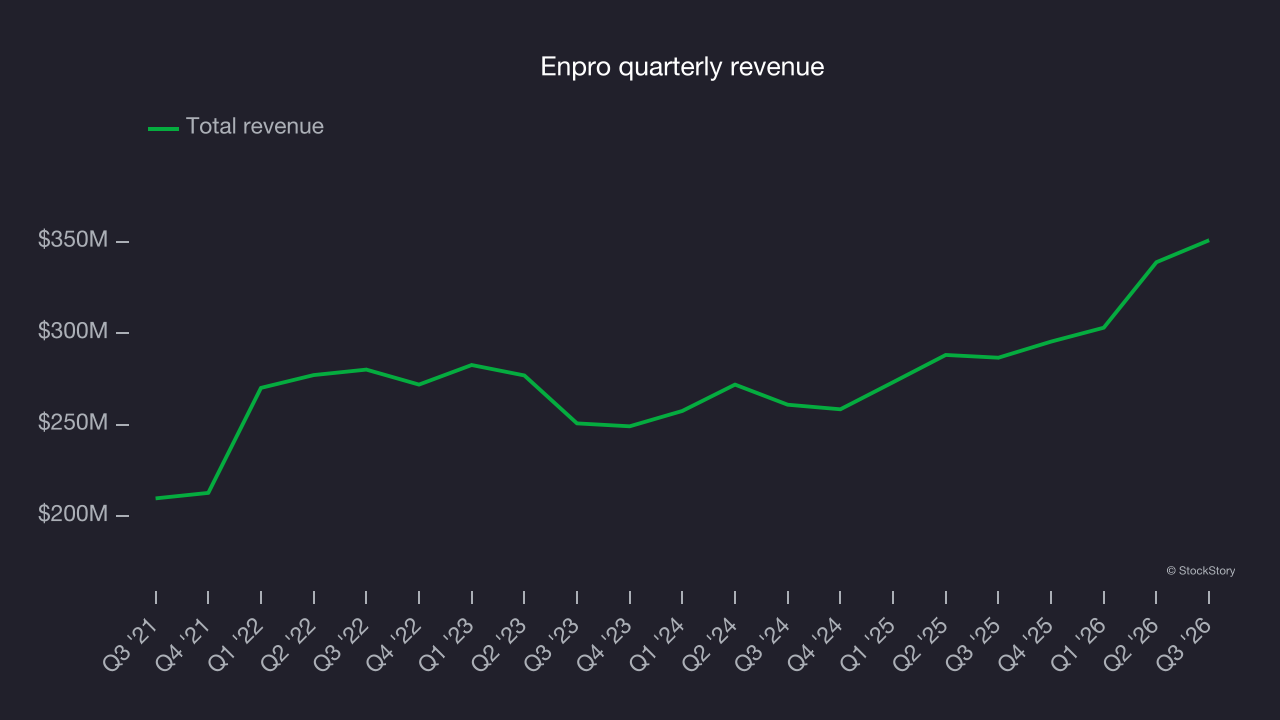
Long-term growth is the most important, but within industrials, a half-decade historical view may miss new industry trends or demand cycles. Enpro’s annualized revenue growth of 11.3% over the last two years is above its five-year trend, suggesting its demand recently accelerated. 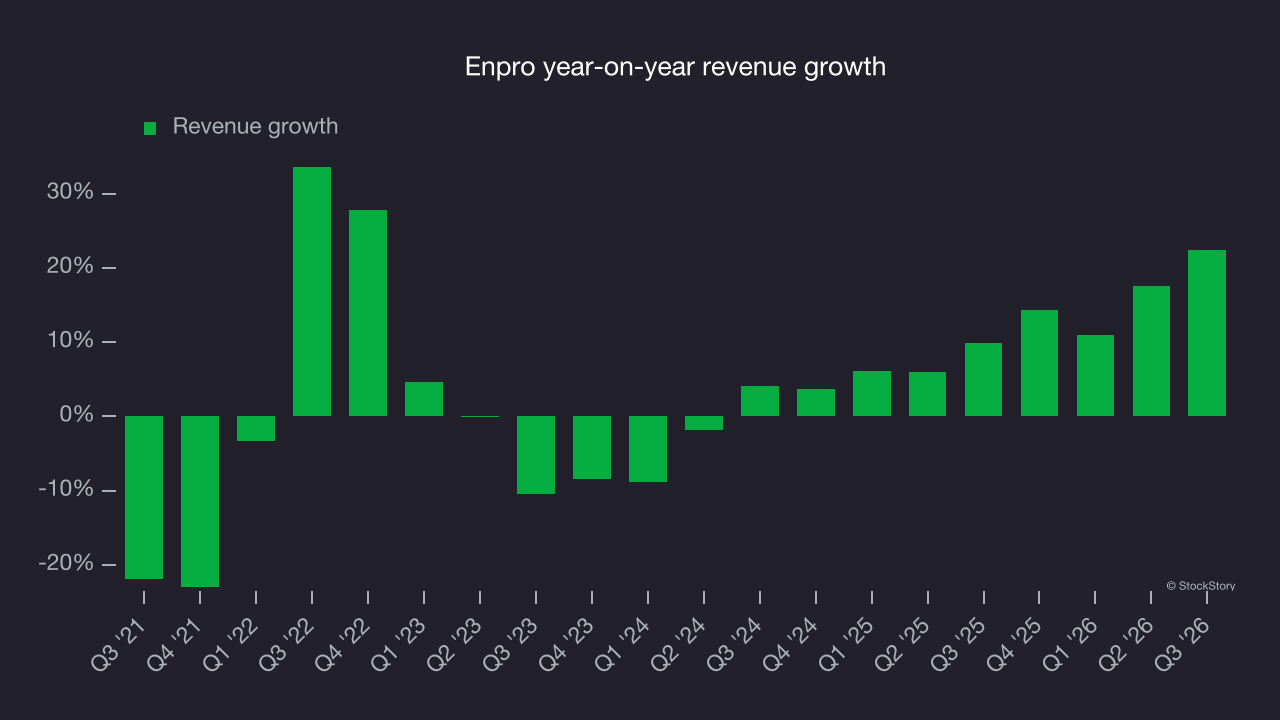
This quarter, Enpro reported strong year-on-year revenue growth of 22.4%, and its $350.8 million of revenue topped Wall Street’s consensus estimates by 5%.
Looking ahead, sell-side analysts expect revenue to grow 9.2% over the next 12 months, according to S&P, a slight deceleration versus the last two years. Despite the slowdown, this projection is healthy and suggests the market sees success for its products and services.
Operating margin
Enpro has been an efficient company over the last five years. It was one of the more profitable businesses in the industrials sector, with an average operating margin of 14.4%. This result is unsurprising given its favorable gross margin baseline.
Analyzing the trend in its profitability, Enpro’s operating margin rose by 3.2 percentage points over the last five years, as its revenue growth gave it operating leverage.
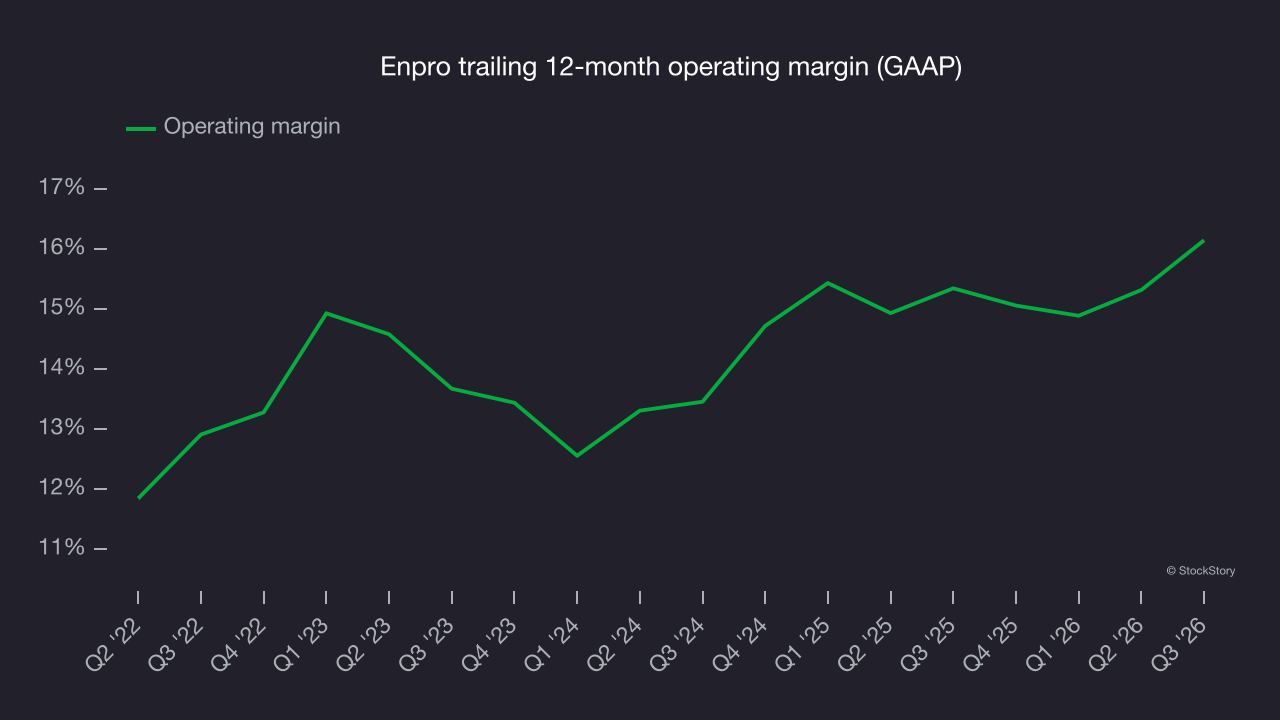
In Q3, Enpro generated an operating margin of 18%, up 3.1 percentage points year on year. The increase was a positive sign, and operating margin rose more than gross margin, suggesting greater efficiency with expenses such as marketing, R&D and administrative overhead.
Earnings per share
We track the long-term change in earnings per share (EPS) for the same reason as long-term revenue growth. Compared to revenue, however, EPS highlights whether a company’s growth is profitable.
Enpro’s EPS grew at a 10.8% compounded annual growth rate over the last five years, higher than its 4.4% annualized revenue growth. This tells us the company became more profitable on a per-share basis as it expanded.
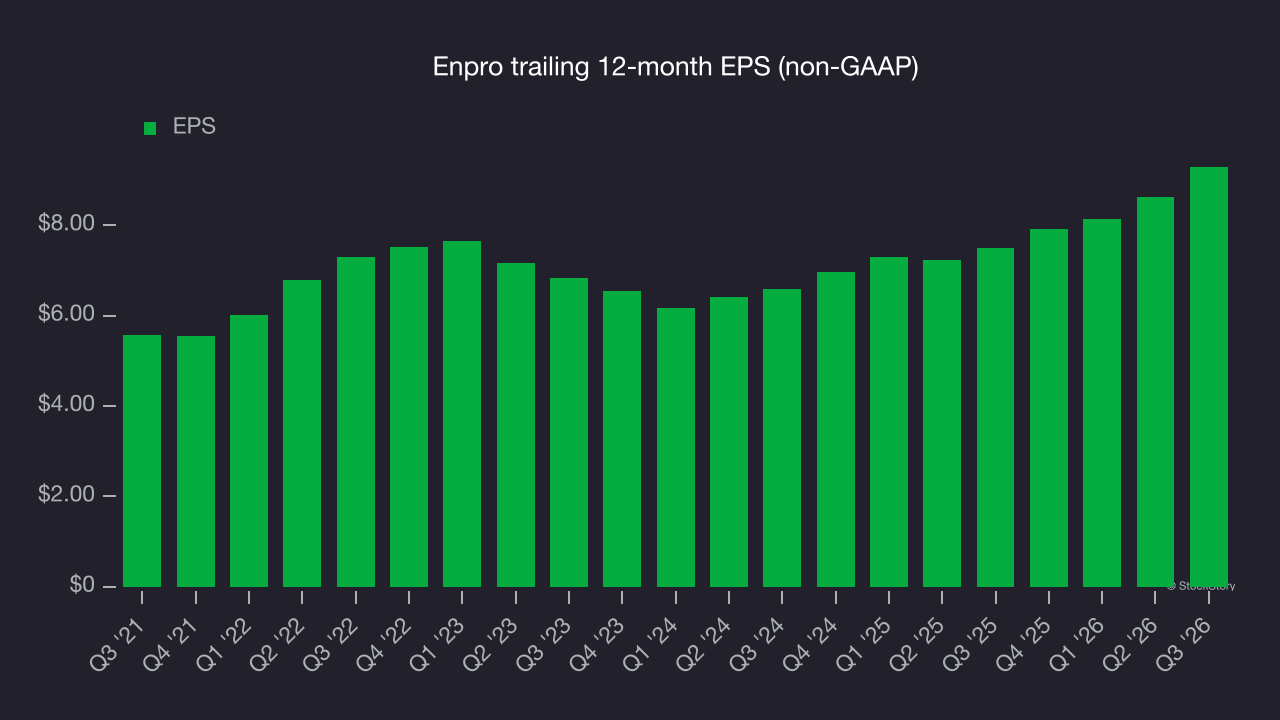
Diving into Enpro’s quality of earnings can give us a better understanding of its performance. As we mentioned earlier, Enpro’s operating margin expanded by 3.2 percentage points over the last five years. This was the most relevant factor (aside from the revenue impact) behind its higher earnings; interest expenses and taxes can also affect EPS but don’t tell us as much about a company’s fundamentals.
Like with revenue, we analyze EPS over a more recent period because it can provide insight into an emerging theme or development for the business.
For Enpro, its two-year annual EPS growth of 18.8% was higher than its five-year trend. That acceleration is a positive sign, especially given the already high base.
In Q3, Enpro reported adjusted EPS of $2.66, up from $1.99 in the same quarter last year. Adjusted EPS easily cleared analysts’ consensus estimates, a positive outcome for shareholders. Over the next 12 months, Wall Street expects Enpro’s full-year EPS to grow 15.7% from $9.29 to $10.75, according to S&P.
Key takeaways from Enpro’s Q3 results
Enpro delivered a strong Q3, with both EBITDA and revenue beating analysts’ consensus estimates by wide margins. Those were the quarter’s key positives. Shares rose 3.3% to $277.87 immediately after the results.
Enpro had a solid quarter, but one earnings result doesn’t necessarily make the stock a buy. When assessing it as an investment, consider the bigger picture of valuation and business quality alongside the latest earnings. For more on Enpro, read our full research report here (it’s free).