Regional banking company United Community Banks (NYSE: UCB) fell short of the market’s revenue expectations in Q3 2026, with sales falling 104% year on year to -$11.97 million. Its non-GAAP profit of $0.77 per share was in line with analysts’ consensus estimates.
Is now the time to buy United Community Banks? Find out by accessing our full research report, it’s free.
United Community Banks (UCB) Q3 2026 Highlights:
- Net Interest Income: $251.2 million vs analyst estimates of $243.7 million (7.5% year-on-year growth, 3.1% beat)
- Net Interest Margin: 3.7% vs analyst estimates of 3.6% (6.7 basis point beat)
- Revenue: -$11.97 million vs analyst estimates of $284.1 million (104% year-on-year decline, 104% miss)
- Adjusted EPS: $0.77 vs analyst estimates of $0.77 (in line)
- Tangible Book Value per Share: $20.80 vs analyst estimates of $21.44 (3.7% year-on-year decline, 3% miss)
- Market Capitalization: $4.07 billion
Chairman and CEO Lynn Harton stated, “Our third quarter results reflect key strategic actions that simplify our balance sheet, reduce risk, and strengthen future operating performance. We completed the acquisition of Peach State Bank on August 1, the sale of our Navitas equipment finance business on September 1, and the restructuring of our investment portfolio in early September. The restructuring shortened duration and significantly improved the yield on our portfolio. At the same time, we achieved high single-digit growth in both core loans and customer deposits in the quarter, reflecting strong momentum resulting from our investment in hiring top talent. New loan production exceeded $1 billion for the second consecutive quarter. The strategies executed in the third quarter position us very well for the future, as demonstrated by improvements in operating return on assets, return on tangible common equity, and operating efficiency ratio.”
Company Overview
Starting as a small community bank in 1950 and expanding through strategic acquisitions across the Southeast, United Community Banks (NYSE: UCB) is a regional bank holding company that provides financial services including loans, deposits, wealth management, and merchant services across the southeastern United States.
Sales Growth
In general, banks make money from two primary sources. The first is net interest income, which is interest earned on loans, mortgages, and investments in securities minus interest paid out on deposits. The second source is non-interest income, which can come from bank account, credit card, wealth management, investment banking, and trading fees. Over the last five years, United Community Banks grew its revenue at a mediocre 9% compounded annual growth rate. This fell short of our benchmark for the banking sector and is a rough starting point for our analysis.
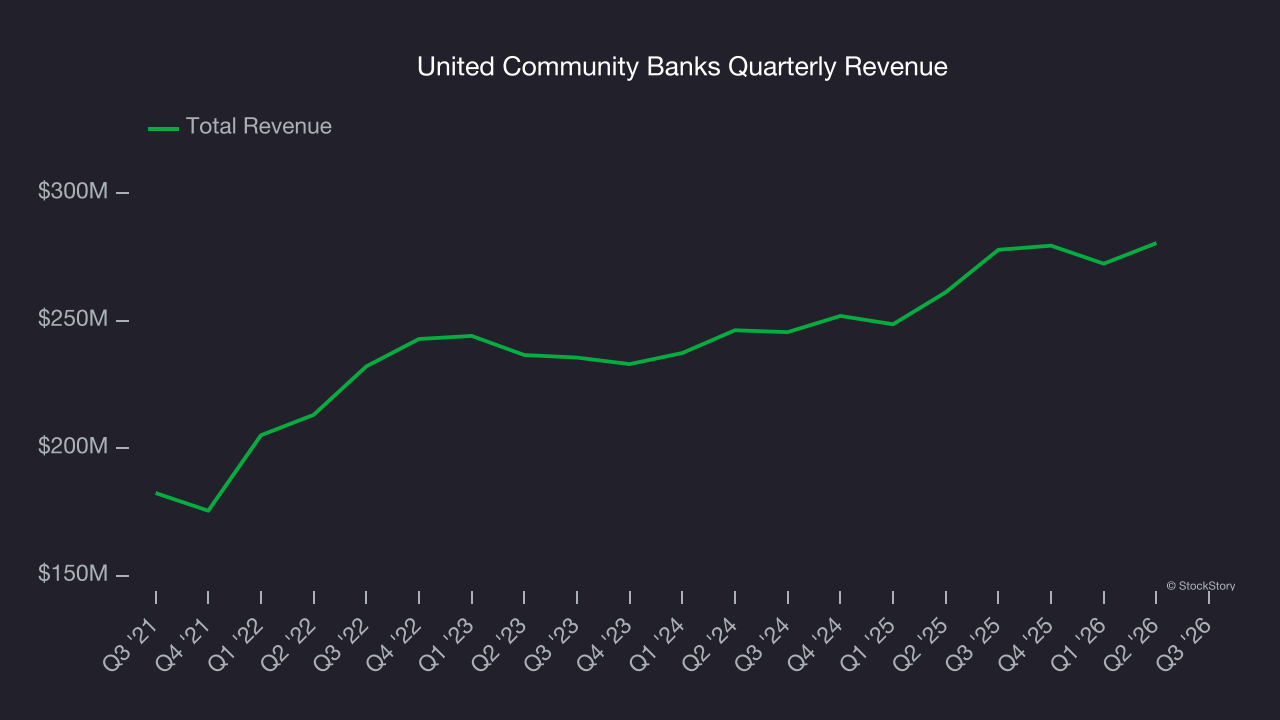 Note: Quarters not shown were determined to be outliers because they were impacted by outsized investment gains/losses that are not indicative of the recurring fundamentals of the business.
Long-term growth is the most important, but within financials, a half-decade historical view may miss recent interest rate changes and market returns. United Community Banks’s recent performance shows its demand has slowed as its annualized revenue growth of 7.8% over the last two years was below its five-year trend. We’re wary when companies in the sector see decelerations in revenue growth, as it could signal changing consumer tastes aided by low switching costs. 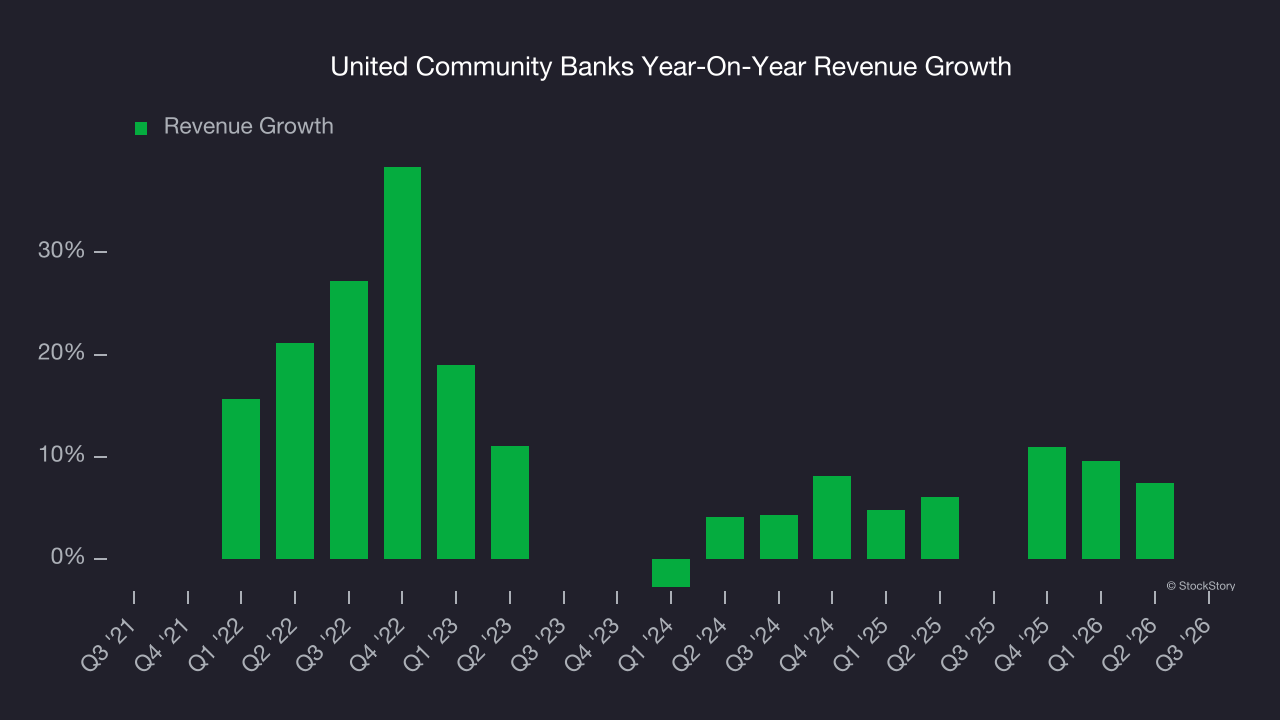 Note: Quarters not shown were determined to be outliers because they were impacted by outsized investment gains/losses that are not indicative of the recurring fundamentals of the business.
This quarter, United Community Banks missed Wall Street’s estimates and reported a rather uninspiring 104% year-on-year revenue decline, generating -$11.97 million of revenue.
Net interest income made up -22.1% of the company’s total revenue during the last five years, meaning United Community Banks is well diversified and has a variety of income streams driving its overall growth. Nevertheless, net interest income is critical to analyze for banks because they’re considered a higher-quality, more recurring revenue source by investors.
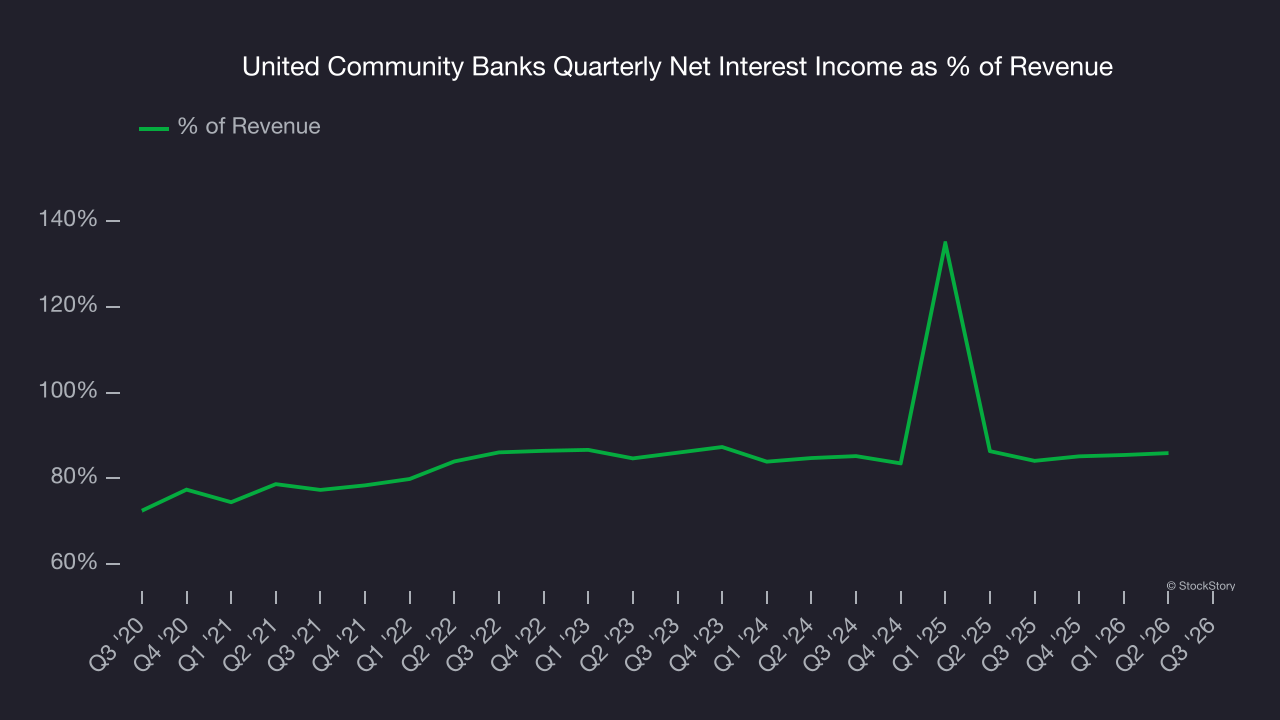 Note: Quarters not shown were determined to be outliers because they were impacted by outsized investment gains/losses that are not indicative of the recurring fundamentals of the business.
ONE MORE THING: The $21 AI Application Stock Wall Street Forgot. While Wall Street obsesses over who’s building AI, one company is already using it to print money. And nobody’s paying attention.
AI chip stocks trade at ridiculous valuations. This company processes a trillion consumer signals monthly using AI and trades at a third of the price. The gap won’t last. The institutions will figure it out. You need to see this first. Read the FREE Report Before They Notice.
Tangible Book Value Per Share (TBVPS)
Banks profit by intermediating between depositors and borrowers, making them fundamentally balance sheet-driven enterprises. Market participants emphasize balance sheet quality and sustained book value growth when evaluating these institutions.
This explains why tangible book value per share (TBVPS) stands as the premier banking metric. TBVPS strips away questionable intangible assets, revealing concrete per-share net worth that investors can trust. Other (and more commonly known) per-share metrics like EPS can sometimes be murky due to M&A or accounting rules allowing for loan losses to be spread out.
United Community Banks’s TBVPS grew at a sluggish 2.1% annual clip over the last five years. The last two years show a similar trajectory as TBVPS grew by 2.9% annually from $19.64 to $20.80 per share.
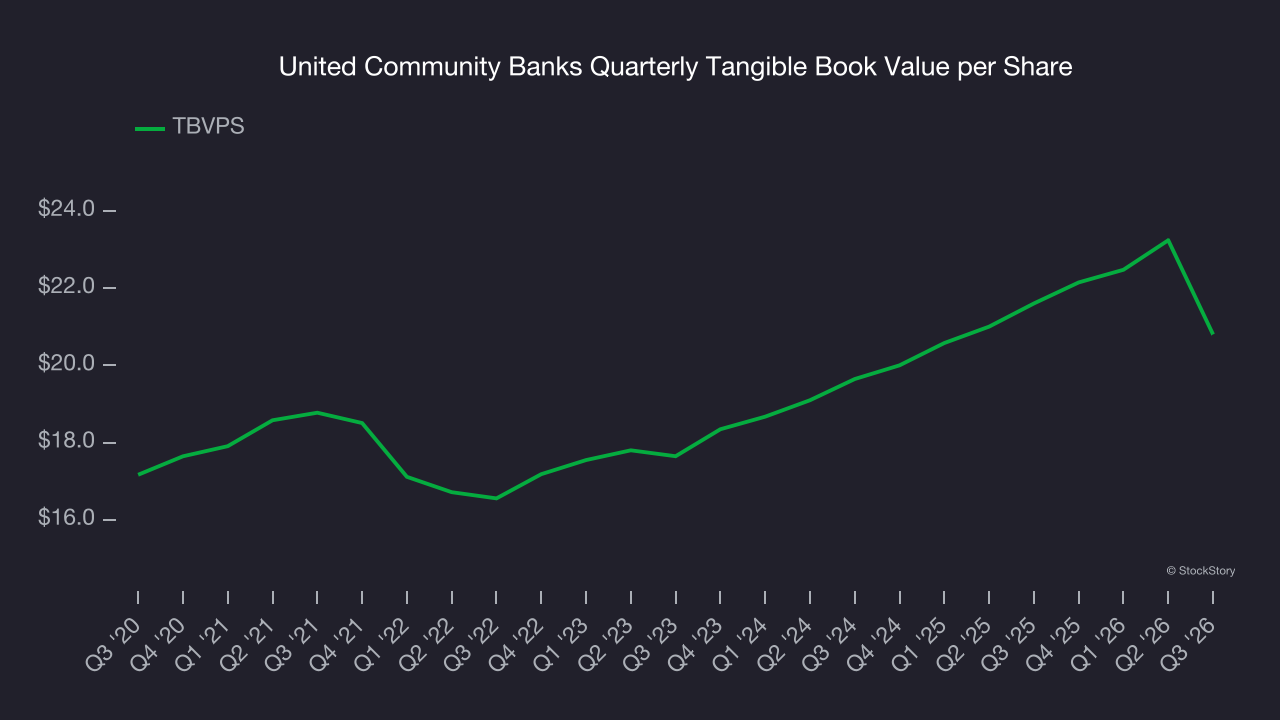
Over the next 12 months, Consensus estimates call for United Community Banks’s TBVPS to grow by 12.7% to $23.44, decent growth rate.
Key Takeaways from United Community Banks’s Q3 Results
We enjoyed seeing United Community Banks beat analysts’ net interest income expectations this quarter. On the other hand, its revenue missed and its tangible book value per share fell short of Wall Street’s estimates. Overall, this quarter could have been better. The stock remained flat at $33.84 immediately following the results.
So should you invest in United Community Banks right now? What happened in the latest quarter matters, but not as much as longer-term business quality and valuation, when deciding whether to invest in this stock. We cover that in our actionable full research report which you can read here (it’s free).