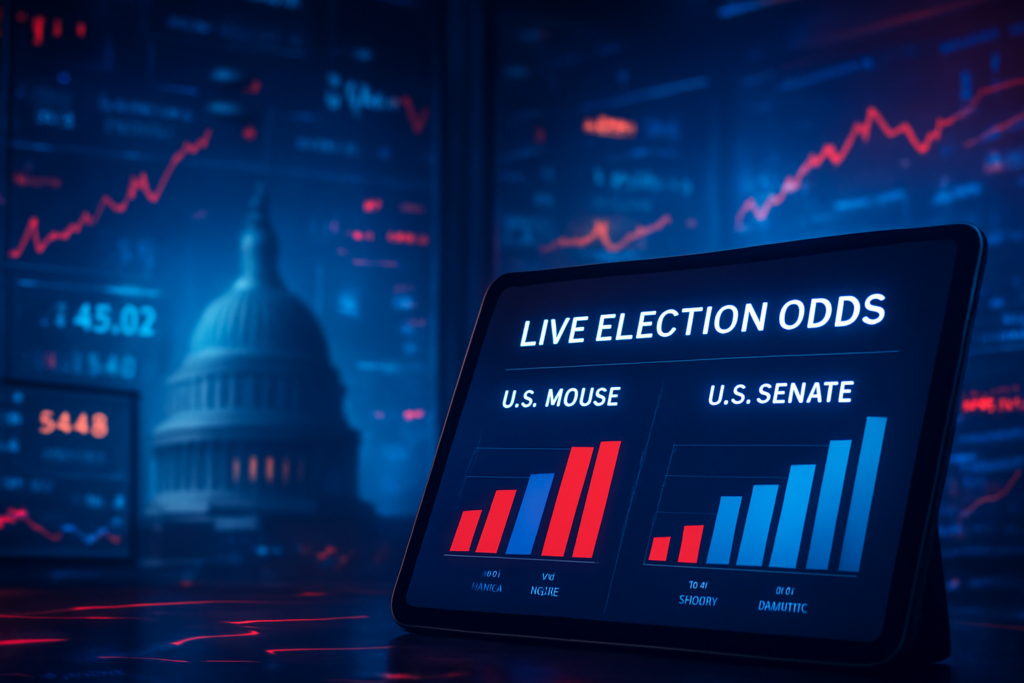
As the calendar turns to January 30, 2026, the global financial eye has shifted from the traditional exchanges of Wall Street to the high-stakes digital arenas of prediction markets. The primary catalyst is the 2026 U.S. Midterm Elections, which have rapidly ascended to become the most significant volume driver in the history of the forecasting industry. With the first year of the second Trump administration in the rearview mirror, traders are now aggressively pricing the likelihood of a "midterm correction," with current odds on major platforms like Polymarket showing a 78% probability of Democrats flipping the House of Representatives, while Republicans maintain a 66% chance of holding the Senate.
This surge in activity isn't just a political curiosity; it is a financial phenomenon. The prediction market sector has transformed into a $44 billion powerhouse, representing a staggering 130-fold growth in monthly volume compared to the same point in the 2024 cycle. Driven by institutional entry and a newfound regulatory "green light" from the Commodity Futures Trading Commission (CFTC), the 2026 midterms are serving as the ultimate stress test and growth engine for a burgeoning asset class that treats political outcomes as tradable commodities.
The Market: What's Being Predicted
The 2026 midterm markets are characterized by unprecedented liquidity and a diverse array of contract types. On Polymarket, the primary contract for House control has already surpassed $2 million in trading volume, an unheard-of figure for a race still nine months away. Similarly, Kalshi—a regulated U.S. exchange—has seen its political event contracts contribute to a record-breaking 2025 where it processed over $23.8 billion in total volume. These platforms have moved beyond simple "who will win" bets to offer more granular instruments, such as the number of seats gained or lost, the performance of specific incumbents, and even the margin of victory in key swing districts.
Currently, the most liquid market across all platforms is the "Congressional Control" parlay. On Kalshi, the "Split Congress" outcome (Democratic House, Republican Senate) is trading at 46%, making it the consensus favorite among high-volume traders. Meanwhile, PredictIt, which remains a staple for retail political enthusiasts, shows Republican shares for "Winning 192 or fewer House seats" trading at 26¢, suggesting a significant portion of the market expects a substantial "blue wave" in the lower chamber.
The resolution criteria for these markets are strictly defined by the certification of election results by the respective state secretaries of state and the convening of the 119th Congress in January 2027. This long lead time has allowed for the development of complex hedging strategies, where institutional investors use these markets to offset potential policy risks associated with shifts in legislative power.
Why Traders Are Betting
The primary driver of the current odds is the historical "midterm penalty" that typically plagues the party holding the White House. However, traders are also reacting to specific 2026 variables, most notably the public response to the second Trump administration’s economic and trade policies. The potential for renewed trade tensions has led many to bet on a Democratic House as a legislative "brake" on executive action. Sentiment is also closely tied to macro indicators; when the Consumer Price Index (CPI) shows signs of cooling or heating, the odds for the incumbent party fluctuate in real-time.
Another major factor is the upcoming appointment of a new Federal Reserve Chair. With names like Kevin Warsh and Kevin Hassett circulating, the market is pricing in how a more hawkish or dovish Fed will impact the electoral prospects of Republicans. Significant "whale" activity has been spotted on Polymarket, where large positions—some exceeding $500,000—have been taken on a Democratic House flip, often coinciding with major policy announcements from the White House regarding government spending and a narrow brush with a government shutdown earlier this month.
Furthermore, these markets are increasingly viewed as more reliable than traditional polling. While polls have struggled with non-response bias and the "shy voter" effect, prediction markets require participants to put capital at risk, creating a "wisdom of the crowds" effect that many institutional players now prefer. The inclusion of institutional capital, such as the reported $2 billion investment from Intercontinental Exchange (NYSE: ICE) into the prediction market infrastructure, has provided the depth necessary for these markets to reflect nuanced political realities faster than a telephone survey ever could.
Broader Context and Implications
The 2026 cycle marks a turning point in the regulatory status of prediction markets. In late January 2026, the new CFTC Chairman, Michael Selig, announced a major policy reversal, withdrawing the previous year's proposal to ban political event contracts. By treating these contracts as legitimate derivatives rather than gambling, the federal government has opened the floodgates for mainstream adoption. This shift has been bolstered by partnerships with major data providers like Yahoo Finance, owned by Apollo Global Management (NYSE: APO), which now integrates prediction market odds alongside traditional stock tickers.
However, the rapid growth has not been without friction. State-level regulators remain cautious; Nevada recently launched enforcement actions against certain decentralized platforms, and Massachusetts has sought to maintain a temporary ban on specific event markets. Additionally, the industry is grappling with integrity concerns. Allegations of "insider trading" involving the timing of White House press conferences led to a brief period of volatility in mid-January, sparking calls for the "Torres Bill," a legislative proposal aimed at establishing strict non-public information rules for political staffers.
Historically, prediction markets have shown a remarkable ability to predict midterm outcomes, often outperforming the "generic ballot" polls in the final months of a campaign. In 2022 and 2024, these markets correctly identified key shifts in the Senate long before mainstream media outlets updated their projections. The 2026 cycle is proving that political cycles are not just a distraction for these platforms—they are their lifeblood, providing the high-stakes, binary outcomes that drive the liquidity needed to sustain a global exchange.
What to Watch Next
The immediate future of the 2026 markets hinges on several key milestones. The upcoming primary season will be the next major volatility event, particularly in districts where "MAGA" incumbents face challenges from more moderate wings of the party, or vice versa for the Democrats. Traders will be looking for signs of candidate quality, as "electability" often shifts the odds in the Senate more than national trends.
Economic data releases in the second and third quarters of 2026 will also be pivotal. If the "trade war" dynamics lead to a noticeable spike in consumer prices, expect the odds for a Democratic House flip to climb into the 85-90% range. Conversely, if the administration manages to secure a significant legislative win or a major foreign policy breakthrough—such as a resolution to tensions in Venezuela—the "Republican Sweep" odds, currently at 21%, could see a rapid resurgence.
Finally, the progress of the "Torres Bill" in Congress will be a significant indicator for the industry's health. If the market can move toward a more transparent, regulated framework for handling political information, it will likely attract even more conservative institutional capital that has so far remained on the sidelines.
Bottom Line
The 2026 U.S. Midterm Elections have solidified prediction markets as the "new polling," providing a real-time, capital-backed pulse on the American electorate. As platforms like Polymarket and Kalshi continue to shatter volume records, it is clear that political cycles are the essential engine of growth for this sector. The markets currently tell a story of a nation leaning toward a divided government, with a clear preference for a Democratic House to act as a check on the current administration.
For the prediction market industry, 2026 is the year of maturity. The combination of massive liquidity, regulatory softening at the federal level, and institutional backing from giants like Intercontinental Exchange (NYSE: ICE) has moved these platforms from the fringes of the internet to the center of the global financial conversation. Whether the markets' current 78% certainty regarding a House flip holds true remains to be seen, but one thing is certain: the world is watching the odds, not the polls.
This article is for informational purposes only and does not constitute financial or betting advice. Prediction market participation may be subject to legal restrictions in your jurisdiction.
PredictStreet focuses on covering the latest developments in prediction markets.
Visit the PredictStreet website at https://www.predictstreet.ai/.