Yttrium, a critical mineral used in semiconductors and aerospace, is subject to Chinese export licensing; yttrium results for 914 surface samples are reported for the first time
Vancouver, British Columbia--(Newsfile Corp. - October 20, 2026) - Spark Energy Minerals Inc. (CSE: SPRK) (OTC Pink: SPARF) (FSE: 8PC) ("Spark" or the "Company") presents a yttrium-focused review of previously published drilling and road-cut results from its 100% owned Arapaima Project in Minas Gerais, Brazil, together with newly disclosed yttrium results for surface samples. The results highlight yttrium within Cruzeta's rare earth zone and in deeper intervals interpreted as weathered granite. This release reports yttrium results for 914 surface samples for the first time; it does not report new drilling.
Used in semiconductor manufacturing and aerospace coatings, yttrium has been subject to Chinese export licensing since April 2025. Spark is examining its distribution at Arapaima alongside the project's other rare earths.
Highlights
28 m at 200 ppm Y₂O₃ from 62 to 90 m in ARA-RC-003 at Cruzeta, and 201 ppm Y₂O₃ over the final 24 m of the hole (70 to 94 m), interpreted as weathered granite; the two intervals overlap and are not separate intersections. The hole ended in mineralization at 94 m.
12 composites at 100 ppm Y₂O₃ or more in 10 of the 28 Cruzeta holes, including 8 m at 226 ppm (ARA-RC-033), 4 m at 209 ppm (ARA-RC-005), 8 m at 198 ppm (ARA-RC-001) and 10 m at 150 ppm (ARA-RC-018). The two highest drill values are 460 ppm Y₂O₃ (ARA-RC-003, 70 to 72 m) and 455 ppm Y₂O₃ (ARA-RC-033, 42 to 44 m).
22 m at 188 ppm Y₂O₃ along the Cruzeta road cut (channel CN-009, reported October 8, 2026), with 16 of the 22 samples at 100 ppm or more and a maximum of 428 ppm.
1,614 ppm Y₂O₃ in grab sample ARA-CN-008-05, the lightly weathered granite from the base of the road cut that returned more than 2.00% TREO (a minimum value): yttrium accounts for up to 8% of its rare earth oxides, alongside 333 ppm Dy₂O₃ and 68 ppm Tb₄O₇.
30 composites at 50 ppm Y₂O₃ or more in 24 of the 33 reported holes, including all five holes at Boa Vista, 7 to 8 km south of Cruzeta, where ARA-RC-031 returned 20 m at 80 ppm Y₂O₃ from 28 m.
Yttrium results for 914 surface samples reported for the first time, including 507 ppm Y₂O₃ in soil sample ARA-SL-219 at Boa Vista and 349 ppm Y₂O₃ in stream-sediment sample ARA-SS-410 at Cruzeta; across the complete 1,038-sample surface dataset, 48 samples returned 100 ppm Y₂O₃ or more.
Comment from the Chairman and Chief Executive Officer
"Yttrium is the quiet dependency of the semiconductor age. China refines more than ninety percent of the world's supply and has licensed every export since April 2025, and the industries that depend on it, from chipmaking to jet engines, are looking for sources outside China before the end of this decade. At Arapaima, yttrium runs through the whole rare earth system: our previously reported drilling shows it within the rare earth zone and in the deeper intervals we interpret as weathered granite, the granite sample from the road cut carries 1,614 ppm, and the surface results we release today show the same signature at several targets. That gives us a clear reason to drill beneath the weathered profile. Our task is to move Arapaima from discovery to a resource and an economic study as quickly as capital allows, with the partners who need the product," said Dr. Fernando Tallarico, Chairman and Chief Executive Officer of Spark.
Yttrium Follows the Rare Earth Zone at Cruzeta
Arapaima is a gallium and rare earth discovery in the weathering profile developed over the Caladão Granite in Brazil's Lithium Valley, which the Company interprets as ionic adsorption clay-style mineralization (Figure 2 shows the targets and the surface sampling). The profile is layered: a gallium-rich horizon from surface to about 20 m overlies a rare earth zone that typically extends to 50 or 60 m (news releases of August 13 and October 8, 2026). The yttrium values compiled here follow that zone. At Cruzeta, the median Y₂O₃ of the 843 primary samples is 15 to 19 ppm in each 10 m interval of the upper 30 m, rises to 27 ppm between 30 and 40 m and to 38 to 44 ppm between 40 and 60 m, and one sample in ten between 30 and 60 m grades more than 100 ppm (Table A2 and Figure 1). Of the 843 samples, 150 (18%) grade 50 ppm or more and 57 grade 100 ppm or more; samples of 100 ppm or more occur in 16 of the 33 reported holes, and Y₂O₃ was detected in all 951 primary drill samples.
Yttrium behaves as a heavy rare earth at Cruzeta. Across the 843 samples it correlates closely with dysprosium (correlation coefficient 0.96) and terbium (0.91) and more loosely with total rare earths (0.76), and its share of TREO is stable, with a median of 3.9% and a middle range of 2.8% to 6.1%. Where yttrium is high, the heavy magnet rare earths are high too: the 28 m yttrium composite in ARA-RC-003 averages 3,535 ppm TREO, and the 8 m composite in ARA-RC-033 averages 3,014 ppm TREO (Table A1).
Twelve composites grade 100 ppm Y₂O₃ or more in 10 of the 28 Cruzeta holes (Table A1), including 8 m at 226 ppm (ARA-RC-033), 4 m at 209 ppm (ARA-RC-005), 8 m at 198 ppm (ARA-RC-001), 6 m at 191 ppm (ARA-RC-004) and 10 m at 150 ppm (ARA-RC-018). The two highest drill values are 460 ppm Y₂O₃ (ARA-RC-003, 70 to 72 m) and 455 ppm Y₂O₃ (ARA-RC-033, 42 to 44 m), and the 28 m composite in ARA-RC-003 includes 4 m at 354 ppm Y₂O₃ (70 to 74 m) and 4 m at 294 ppm (86 to 90 m).
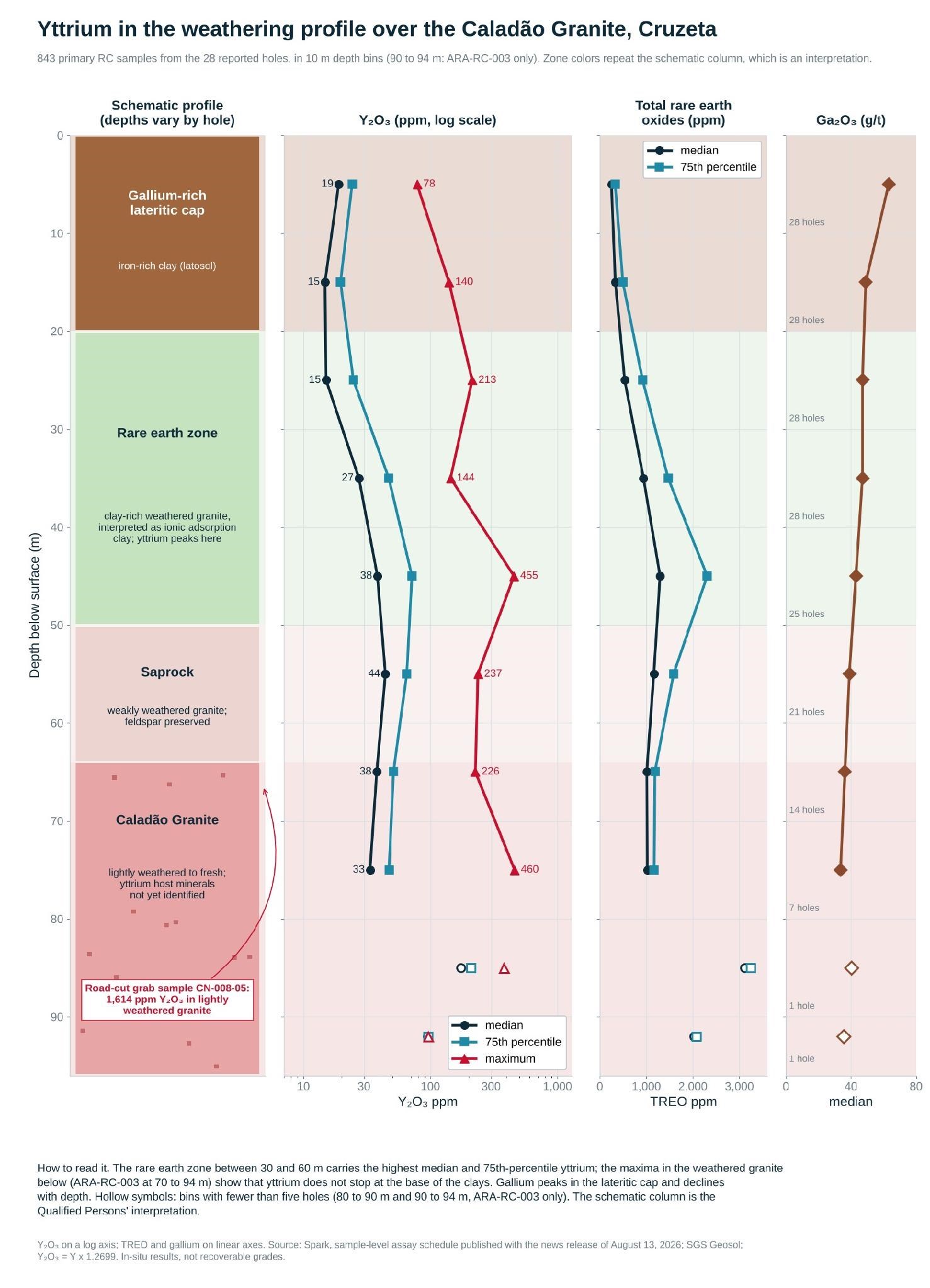
Figure 1. Yttrium in the weathering profile over the Caladão Granite at Cruzeta: schematic column (gallium-rich lateritic cap, rare earth zone, saprock, granite) next to the depth statistics of Y₂O₃, total rare earth oxides and gallium in the 843 primary samples from the 28 reported holes (10 m bins; the 90 to 94 m bin is ARA-RC-003 only). Yttrium rises with the rare earth zone at 30 to 60 m and stays elevated in the weathered granite below. The column is the Qualified Persons' interpretation; depths vary from hole to hole; yttrium host minerals have not been identified. Source: sample-level assay schedule published with the news release of August 13, 2026.
To view an enhanced version of this graphic, please visit:
https://images.newsfilecorp.com/files/10093/319891_360b255404f8a91d_002full.jpg
Grade Rises with Depth and Continues into the Granite
The highest yttrium values at Cruzeta are at the base of the clay profile and below it. Hole ARA-RC-003 carries 100 ppm Y₂O₃ or more in 15 of its 46 samples and returned 28 m at 200 ppm from 62 to 90 m; its final 24 m (70 to 94 m), which the Company interprets as weathered granite below the clay profile, average 201 ppm Y₂O₃ and 3,261 ppm TREO, and the hole ended in mineralization. Hole ARA-RC-004 ended at 46 m in 6 m at 191 ppm Y₂O₃. At the Cruzeta road cut, yttrium rises down the 4 m vertical channel CN-008 from 24 ppm in the red clay at the top to 66 ppm in the saprolitized granite at its base, and the grab sample of lightly weathered granite collected directly below the channel returned 1,614 ppm Y₂O₃ with more than 19,991 ppm TREO (a minimum value), 333 ppm Dy₂O₃ and 68 ppm Tb₄O₇. Along the face, the 22 m horizontal channel CN-009 averages 188 ppm Y₂O₃ and 2,392 ppm TREO (Table A5).
Taken together, the drill holes that ended in mineralization, the rising grade down the road-cut profile and the granite grab sample point to a second, rock-hosted style of rare earth mineralization beneath the clays, as first reported on October 8, 2026. The minerals that host the yttrium and the other rare earths in the granite have not been identified; the heavy rare earth pattern of the grab sample, in which yttrium accounts for as much as 8% of TREO against 4% in the clays, is consistent with a phosphate host such as xenotime, and mineralogical work is planned to test this. The grab sample is a single selected sample with no measured length, is not comparable to channel or drill results and is not representative of the granite; nothing has yet been sampled below the base of the road-cut face.
Boa Vista Repeats the Pattern; Nine Holes Await Reporting
The Boa Vista target, 7 to 8 km south of Cruzeta and selected from the same surface signature, repeats the vertical zoning. All five holes reported on August 27, 2026 carry a yttrium-bearing rare earth zone at 50 ppm Y₂O₃ or more, led by 20 m at 80 ppm from 28 m in ARA-RC-031 (maximum 120 ppm), 20 m at 57 ppm in ARA-RC-006 and 22 m at 55 ppm in ARA-RC-007 (Table A3). Nine further holes drilled in 2026 at Cruzeta and Boa Vista remain to be reported once quality-control review is complete; yttrium will be reported with them.
Surface Results Extend the Yttrium Dataset
The complete surface dataset accompanying this release contains 1,038 unique samples: 477 stream sediments, 311 soils, 214 rock chips and 36 channel-coded samples (including the road-cut grab sample). Yttrium is disclosed for the first time for 914 of these samples; 124 were reported previously, among them the 27 road-cut samples, which are part of the 1,038 total and not additional to it. Across this mixed sample population, 117 samples returned at least 50 ppm Y₂O₃ and 48 returned at least 100 ppm Y₂O₃. These counts describe the sampled material, not the size or continuity of mineralization.
Newly disclosed results include 507 ppm Y₂O₃ in soil sample ARA-SL-219 at Boa Vista, 349 ppm Y₂O₃ in stream-sediment sample ARA-SS-410 at Cruzeta and 325 ppm Y₂O₃ in stream-sediment sample ARA-SS-233B. The surface map (Figure 2) provides geographic context from an earlier extract of 918 results; the supporting schedule presents the complete 1,038-sample dataset with sample type, coordinates, Y₂O₃ and the laboratory certificate for every sample.
Yttrium values were previously published for 18 soils and 14 stream sediments on May 9, 2025 (then reported under the Caladão Target, with yttrium given as Y), 30 stream sediments and 35 rock chips on October 17, 2025, and the 27 road-cut samples on October 8, 2026. Outside the road cut, the highest previously published value is stream sediment ARA-SS-207 at Cruzeta, with 532 ppm Y₂O₃ (reported as 419 ppm Y on May 9, 2025) and 6,417 ppm TREO as reported; stream sediment ARA-SS-271 at Boa Vista returned 208 ppm Y₂O₃ with 10,016 ppm TREO, and five rock chips at Cruzeta returned 113 to 153 ppm Y₂O₃ (Table A6). The 18 soils reported from Boa Vista range from 12 to 80 ppm Y₂O₃. Stream-sediment and soil values are geochemical indicators of yttrium-bearing material in a catchment or soil profile, not grades of any mineralization; rock-chip samples are selective and may not be representative.
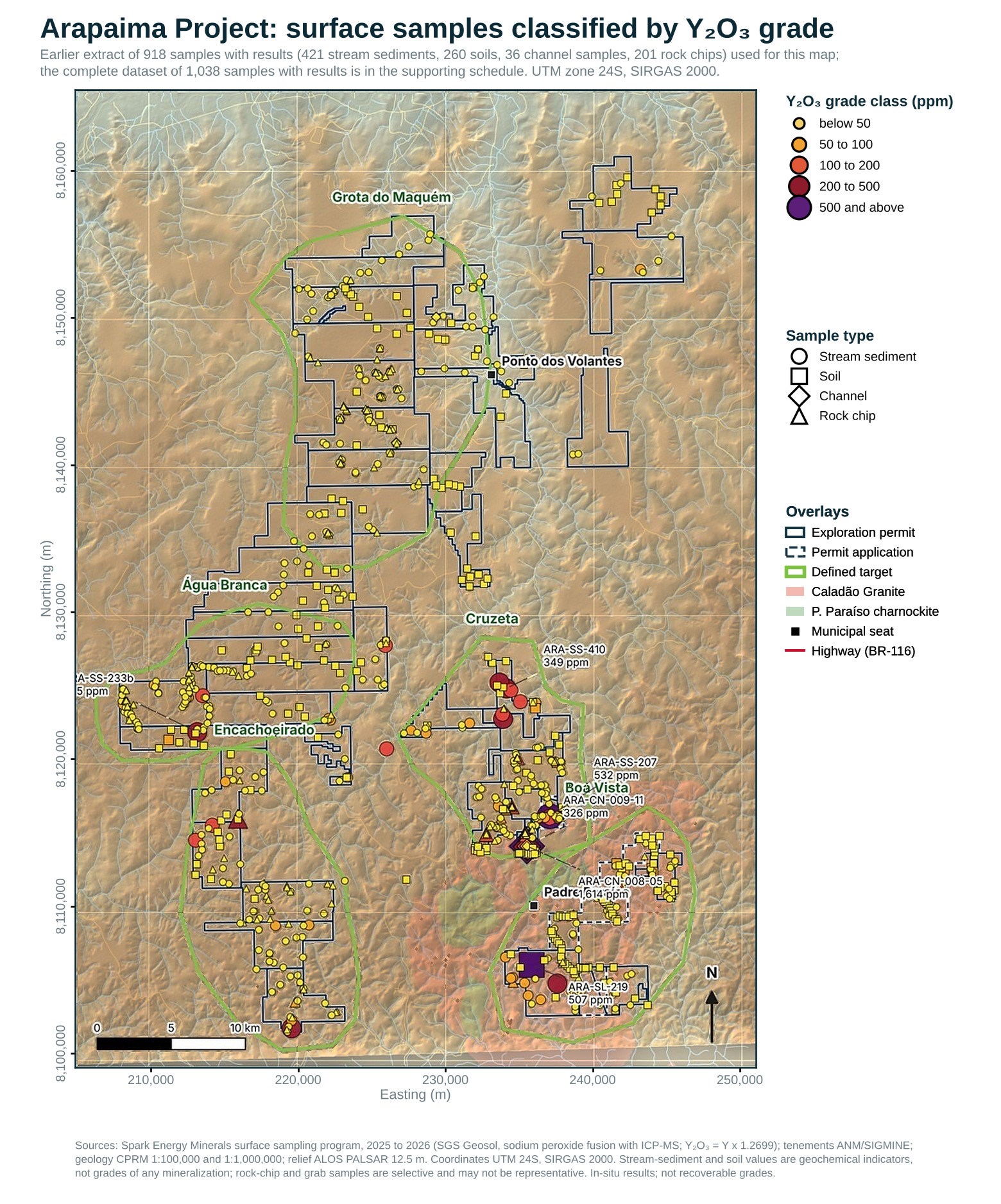
Figure 2. Arapaima Project: surface samples classified by Y₂O₃ grade, with the defined targets, tenements and the mapped Caladão Granite. The map was prepared from an earlier extract of the surface database (918 samples with results; 239 then pending) and is shown for geographic context; the complete dataset of 1,038 samples with results, including 120 samples not shown here, is in the supporting schedule. Stream-sediment and soil values are geochemical indicators, not grades of mineralization; rock-chip and grab samples are selective and may not be representative. UTM zone 24S, SIRGAS 2000.
To view an enhanced version of this graphic, please visit:
https://images.newsfilecorp.com/files/10093/319891_360b255404f8a91d_003full.jpg
Why Yttrium Matters: a Small Market at the Center of the Semiconductor Supply Chain
High-purity yttria is the plasma-resistant ceramic and coating used in the etch and deposition chambers that make advanced semiconductors; yttria-stabilized zirconia is the thermal-barrier coating of jet engines and gas turbines; yttrium aluminum garnet is the host crystal of YAG lasers; and yttrium is also used in advanced ceramics, solid oxide fuel cells, phosphors and, as yttrium-90, in cancer therapy. Yttrium is on the United States list of critical minerals and on the European Union's list of critical raw materials.
Supply is concentrated. China mines most of the world's yttrium and refines more than 90% of the world's yttrium oxide (U.S. Geological Survey, Mineral Commodity Summaries 2026). On April 4, 2025, China placed yttrium and six other medium and heavy rare earths under case-by-case export licensing; the measure was not among those suspended after the October 2025 trade understanding between Washington and Beijing and remains in force. Chinese exports of yttrium compounds fell from about 3,100 tonnes in 2024 to about 1,600 tonnes in 2025, and shipments to the United States fell to zero in May and June 2026 (customs data compiled by Silverado Policy Accelerator). Yttrium oxide (99.999%) sells for about US$8 per kilogram in China (Shanghai Metals Market, October 2026) and has traded at US$420 to 1,175 per kilogram outside China in 2026 (Rotterdam assessments and offers reported by Materials Dispatch); Benchmark Mineral Intelligence put the North American price at about 196 times the Chinese price at the end of the third quarter. The International Energy Agency lists yttrium among the minerals with the highest supply risk (Global Critical Minerals Outlook 2026). Arapaima is 100% owned by Spark and is not subject to any offtake or partnership agreement.
Next Steps
The Company plans to collar a drill hole at the top of the Cruzeta road cut, where access allows, to test the granite below the sampled face, as announced on October 8, 2026. This work is subject to financing.
Mineralogical and metallurgical test work on the clay and granite mineralization, including the deportment and recoverability of yttrium, is planned; none on yttrium has been reported to date.
Yttrium will be reported with every future drill and surface result at Arapaima and carried into any mineral resource estimation when that work begins; no resource estimation has begun.
The Company's applications under the European Union's Critical Raw Materials Act and to the U.S. Trade and Development Agency (disclosed September 23, 2026) remain under evaluation; no decision has been made by either body and no funding has been awarded.
The supporting assay schedule is available online and includes all 951 primary drill samples, the complete 1,038-sample surface yttrium dataset (including the 124 previously reported surface samples and the 27 road-cut samples), the composites, the highest value in each reported hole and the depth statistics. The schedules of August 13, August 27 and October 8, 2026 remain available through the links in those releases.
Technical Notes and Reporting Basis
The drill and road-cut yttrium results are compiled from the sample-level assay schedules published with the Company's news releases of August 13, 2026 (28 Cruzeta holes, 843 primary samples, 1,688 m, all two meters long except one four-meter sample in ARA-RC-003), August 27, 2026 (five Boa Vista holes, 108 primary samples, 216 m) and October 8, 2026 (26 one-meter channel samples and one grab sample at the Cruzeta road cut). Y₂O₃ is calculated from the yttrium assay as Y x 1.2699 (the surface compilation uses 1.269932, a difference below reporting precision); TREO is the sum of 14 lanthanide oxides (La₂O₃ to Lu₂O₃) and Y₂O₃. Composites are length-weighted averages of consecutive two-meter samples at or above 50 or 100 ppm Y₂O₃, with a minimum length of 4 m and no internal dilution; channel averages are arithmetic means of consecutive one-meter samples. Statistics are computed on primary samples only; quality-control samples are excluded. The 124 previously reported surface-sample yttrium values are from the news releases of May 9, 2025 (as Y, converted here with the same factor), October 17, 2025 and October 8, 2026. The 914 surface-sample Y₂O₃ values disclosed for the first time are from the SGS Geosol certificates compiled in the Company's surface database and are listed with their certificate numbers in the supporting schedule. Surface counts use unique sample IDs and include the road-cut samples only once; stream-sediment and soil values are geochemical indicators, not grades. TREO is quoted as published in the source schedules, in which a lanthanide below detection was left out of the sum; this affects 15 drill samples by at most 0.12 ppm, and none of them is in a composite. Lengths are down-hole or sampled lengths, and true widths are not known. The 50 and 100 ppm thresholds are geochemical criteria used to describe the distribution of yttrium; they are not economic cut-off grades, and no economic significance should be attached to them. All results are in-situ analytical results and do not represent recoverable grades. The division of the profile into a gallium-rich horizon and a rare earth zone, the interpretation of the deepest samples in some holes as weathered granite and the possible mineral hosts of yttrium are interpretations of the Qualified Persons that may change with further work.
Sampling, Analytical Procedures and QA/QC
Reverse circulation drill samples were collected at two-meter intervals and split for analysis; blanks, field duplicates and certified reference materials were inserted into the sample stream and were reported with the August 13 and August 27, 2026 releases. Channel samples at the road cut were collected continuously in one-meter lengths by Company geologists, and grab sample ARA-CN-008-05 was collected by hand; for the channel and grab samples quality control relied on the laboratory's internal program of preparation blanks, duplicates, replicates and certified reference materials, as disclosed on October 8, 2026, and the rare earth reference material was not run in every batch. All stream-sediment, soil and rock-chip samples, including those whose yttrium values are disclosed here for the first time, were collected by Company geologists under the procedures described in the releases of May 9 and October 17, 2025; the quality-control procedures described above for the drilling do not extend to the surface samples, for which quality control relied on the laboratory's internal program of preparation blanks, duplicates, replicates and certified reference materials. All samples were analyzed by SGS Geosol Laboratórios (Vespasiano, Minas Gerais, Brazil), an independent laboratory certified to ISO 9001:2015 and ISO 14001:2015, by sodium peroxide fusion with ICP-OES and ICP-MS finish (method ICM90A), as recorded on the laboratory certificates listed in the supporting schedule. Praseodymium in the grab sample exceeded the upper limit of the method and was taken at the limit, so the TREO of that sample is a minimum value; an over-limit determination is pending.
Data Verification
The Qualified Persons verified the data disclosed in this release as follows. The yttrium and rare earth results of all 951 primary drill samples and the 27 road-cut samples were compared, element by element, with the 24 SGS Geosol laboratory certificates that report them, with the Company's assay database and with the schedules published on August 13, August 27 and October 8, 2026, and no differences were found. The composites, the highest value in each hole and the depth statistics were recalculated independently from the primary samples and reproduce the values in this release; in this check the 90 to 94 m interval of ARA-RC-003, omitted from an earlier draft of the depth table, was restored. The 124 surface-sample yttrium values reported previously were compared with the releases that first reported them, with the Company's database and with the nine SGS Geosol certificates that report them (GQ2501730, GQ2501999, GQ2502001, GQ2504539, GQ2509810, GQ2509812, GQ2509815, GQ2608071 and GQ2608072), with no differences. All 1,038 surface samples were compared with the 33 SGS Geosol certificates that report them and with the Company's assay database; the yttrium and rare earth values match the certificates and their laboratory batch references. No independent re-sampling or re-assaying was undertaken. The quality-control results and the collar information reported with the source releases were reviewed. The results are not a mineral resource estimate, and the limitations described in this release apply to them.
Exploration-Stage Property; No Mineral Resource or Economic Analysis
Arapaima is an exploration-stage property. No mineral resource or mineral reserve has been estimated at Arapaima, and no preliminary economic assessment, pre-feasibility study or feasibility study has been completed or disclosed. The results reported here are not in any resource or reserve category, and there is no certainty that further exploration will result in the delineation of a mineral resource or that any mineralization will prove to be economically or technically viable to extract. No recovery of yttrium, gallium, scandium or rare earths from Arapaima material has been demonstrated, and no mineralogical or metallurgical test work on yttrium has been reported.
Cautionary Statement Regarding Exploration Results
The exploration results in this release are preliminary. The composites, channel averages and statistics describe the geochemical distribution of yttrium in the samples analyzed; they are not evidence of continuity, of grade over any volume or of economic potential. Stream-sediment and soil samples indicate the presence of yttrium-bearing material in a catchment or soil profile and are not grades of any mineralization; channel, grab and rock-chip samples are surface samples and are not drill intercepts; grab and rock-chip samples are selected samples that may not be representative of the mineralization. Composite and channel lengths are down-hole or sampled lengths and not true widths. The correlation between yttrium and the heavy rare earths is a statistical relationship in the samples analyzed and does not establish the form in which these elements occur or how they would be recovered. Market information in this release is third-party information and is not an indication of the value of any Arapaima mineralization.
Qualified Persons
The scientific and technical information in this news release has been reviewed and approved by Jonathan Victor Hill, BSc (Hons), FAusIMM, Vice President Exploration, Country Manager and Director of the Company, and by Dr. Fernando Tallarico, P.Geo., FSEG, Chief Executive Officer and Chairman of the Company, each of whom is a Qualified Person as defined in National Instrument 43-101 Standards of Disclosure for Mineral Projects. Neither is independent of the Company.
About Spark Energy Minerals Inc.
Spark Energy Minerals Inc. is a Canadian critical minerals exploration company whose principal asset, the Arapaima Project, comprises approximately 91,900 hectares across several municipalities in the Lithium Valley region of Minas Gerais, Brazil. The Company has made gallium and rare earth element discoveries at Cruzeta and, more recently, at Boa Vista, in a weathering profile over the Caladão Granite, which it interprets as ionic adsorption clay-style mineralization. Lithium-bearing pegmatites are a secondary target on the property. The Company also holds the Seridó tungsten project in Rio Grande do Norte and the Solonópole tantalum and lithium project in Ceará, Brazil.
For Additional Information, Please Contact
Spark Energy Minerals Inc.
Attention: Dr. Fernando Tallarico, P.Geo., FSEG, Chief Executive Officer and Chairman
Telephone: +1-877-272-9226
Email: connect@sparkminerals.co
Website: www.sparkminerals.co
On behalf of the Board of Directors of Spark Energy Minerals Inc.
Dr. Fernando Tallarico, Chief Executive Officer and Chairman
Neither the Canadian Securities Exchange nor its Regulation Services Provider accepts responsibility for the adequacy or accuracy of this release.
Cautionary Statement Regarding Forward-Looking Information
This news release contains "forward-looking statements" and "forward-looking information" within the meaning of applicable Canadian securities laws, including National Instrument 51-102, and of the United States Private Securities Litigation Reform Act of 1995 (together, "forward-looking information"). Forward-looking information in this release includes, without limitation, statements regarding: the interpretation of the yttrium and rare earth results and of the weathering profile at Cruzeta and Boa Vista; the possible existence of a second, rock-hosted style of rare earth mineralization and the possible mineral hosts of yttrium; the planned drill test below the Cruzeta road cut and the reporting of further drill holes; planned mineralogical and metallurgical test work; the inclusion of yttrium in any future mineral resource estimation; the Company's objectives, exploration program and financing; the outcome of the Company's applications under the European Union's Critical Raw Materials Act and to the U.S. Trade and Development Agency; and the uses of, demand for, supply of, prices of and trade policy affecting yttrium and other rare earths. Forward-looking information is generally identified by words such as "plans", "expects", "intends", "may", "will", "potential" and similar expressions.
Forward-looking information is based on the opinions, estimates and assumptions of management as of the date of this release, including assumptions regarding the geological interpretation of the results, the accuracy of assay data and the reliability of the laboratory, the continuity of mineralization, the timing and results of future exploration and test work, the availability of financing on acceptable terms, commodity prices and trade conditions, including export-control policies, the maintenance of mineral tenure and the receipt of permits and approvals. Although management believes these assumptions are reasonable, forward-looking information is subject to known and unknown risks, uncertainties and other factors that may cause actual results to differ materially, including: the preliminary nature of exploration results and the possibility that further work will not confirm the interpretations in this release; the possibility that no mineral resource will be delineated and that no metallurgical recovery of yttrium or any other element will be demonstrated; geological, sampling and analytical uncertainty, including the selective nature of grab and rock-chip samples and the difference between down-hole lengths and true widths; the volatility of rare earth prices and changes in export-control, trade and industrial policy in China and elsewhere; the Company's limited financial resources, its need for additional financing and the dilution or inability to proceed that may result; title, permitting, environmental, community, regulatory and political risks in Brazil; and the other risks described in the Company's public filings on SEDAR+.
No mineral resource or mineral reserve has been estimated at Arapaima and no economic study has been completed; exploration results are not a statement of a mineral resource, a mineral reserve or a mineable deposit, and discovery or commercial viability is not assured. Market, price, supply and industry information in this release is from third-party sources believed to be reliable (U.S. Geological Survey, International Energy Agency, Benchmark Mineral Intelligence, Shanghai Metals Market, Silverado Policy Accelerator, Materials Dispatch and company disclosures); the Company has not independently verified it, does not guarantee its accuracy or completeness, and makes no forecast of yttrium prices or demand. No funding decision has been made by any government agency in respect of the Company, and no offtake agreement exists. Readers are cautioned not to place undue reliance on forward-looking information, which speaks only as of the date of this release. The Company undertakes no obligation to update or revise any forward-looking information except as required by applicable securities laws.
Appendix A. Yttrium at Arapaima: supporting tables
All values compiled from the sample-level assay schedules published with the news releases of August 13, August 27 and October 8, 2026 and, for Table A6, from the news releases of May 9 and October 17, 2025 (SGS Geosol, method ICM90A). In-situ analytical results; not recoverable grades. Down-hole or sampled lengths; true widths unknown. Y₂O₃ = Y x 1.2699. Thresholds are geochemical criteria, not cut-off grades.
Table A1. Yttrium composites at 100 ppm Y₂O₃ or more (minimum 4 m, no internal dilution), Cruzeta
| Hole | From (m) | To (m) | Length (m) | Y₂O₃ (ppm) | TREO (ppm) | Maximum Y₂O₃ in composite (ppm) |
| ARA-RC-033 | 42 | 50 | 8 | 226 | 3,014 | 455 |
| ARA-RC-005 | 44 | 48 | 4 | 209 | 3,359 | 267 |
| ARA-RC-003 | 62 | 90 | 28 | 200 | 3,535 | 460 |
| ARA-RC-001 | 46 | 54 | 8 | 198 | 3,194 | 290 |
| ARA-RC-004 | 40 | 46 | 6 | 191 | 3,087 | 204 |
| ARA-RC-023 | 22 | 26 | 4 | 187 | 3,631 | 213 |
| ARA-RC-002 | 38 | 42 | 4 | 157 | 1,689 | 170 |
| ARA-RC-018 | 40 | 50 | 10 | 150 | 3,317 | 195 |
| ARA-RC-021 | 60 | 66 | 6 | 127 | 1,812 | 144 |
| ARA-RC-013 | 34 | 38 | 4 | 120 | 5,040 | 138 |
| ARA-RC-005 | 38 | 42 | 4 | 120 | 3,724 | 126 |
| ARA-RC-005 | 28 | 32 | 4 | 114 | 4,381 | 116 |
Composites are length-weighted. ARA-RC-003 ended in mineralization at 94 m: the composite is closed at 90 m by the 100 ppm criterion, and the samples from 90 to 94 m grade 94 and 96 ppm Y₂O₃.
Table A2. Y₂O₃ by depth, Cruzeta (843 primary samples, 28 holes; 10 m intervals by sample mid-point)
| Depth interval | Samples | Holes | Median (ppm) | Mean (ppm) | 75th percentile (ppm) | Maximum (ppm) | Samples ≥ 100 ppm (%) |
| 0 to 10 m | 139 | 28 | 19 | 21 | 24 | 78 | 0 |
| 10 to 20 m | 140 | 28 | 15 | 17 | 20 | 140 | 1 |
| 20 to 30 m | 140 | 28 | 15 | 23 | 25 | 213 | 2 |
| 30 to 40 m | 137 | 28 | 27 | 35 | 47 | 144 | 5 |
| 40 to 50 m | 114 | 25 | 38 | 63 | 72 | 455 | 18 |
| 50 to 60 m | 94 | 21 | 44 | 54 | 65 | 237 | 9 |
| 60 to 70 m | 51 | 14 | 38 | 52 | 51 | 226 | 16 |
| 70 to 80 m | 21 | 7 | 33 | 80 | 47 | 460 | 24 |
| 80 to 90 m | 5 | 1 | 174 | 206 | 208 | 380 | 100 |
| 90 to 94 m | 2 | 1 | 95 | 95 | 95 | 96 | 0 |
Intervals from 70 m down are represented by fewer than ten holes; the 80 to 90 m and 90 to 94 m intervals are ARA-RC-003 only, which ended in mineralization at 94 m. The ten intervals hold all 843 samples. Hole depths range from 36 to 94 m.
Table A3. Yttrium composites at 50 ppm Y₂O₃ or more (minimum 4 m, no internal dilution), Cruzeta and Boa Vista
| Hole | Target | From (m) | To (m) | Length (m) | Y₂O₃ (ppm) | TREO (ppm) | Maximum Y₂O₃ in composite (ppm) |
| ARA-RC-004 | Cruzeta | 40 | 46 | 6 | 191 | 3,087 | 204 |
| ARA-RC-003 | Cruzeta | 50 | 94 | 44 | 160 | 3,588 | 460 |
| ARA-RC-002 | Cruzeta | 38 | 42 | 4 | 157 | 1,689 | 170 |
| ARA-RC-001 | Cruzeta | 44 | 58 | 14 | 141 | 2,718 | 290 |
| ARA-RC-033 | Cruzeta | 42 | 60 | 18 | 140 | 2,123 | 455 |
| ARA-RC-005 | Cruzeta | 34 | 54 | 20 | 125 | 3,046 | 267 |
| ARA-RC-018 | Cruzeta | 36 | 54 | 18 | 117 | 3,137 | 195 |
| ARA-RC-023 | Cruzeta | 22 | 34 | 12 | 105 | 2,267 | 213 |
| ARA-RC-012 | Cruzeta | 42 | 60 | 18 | 99 | 2,653 | 237 |
| ARA-RC-021 | Cruzeta | 54 | 66 | 12 | 99 | 2,208 | 144 |
| ARA-RC-019 | Cruzeta | 46 | 52 | 6 | 97 | 2,330 | 166 |
| ARA-RC-020 | Cruzeta | 36 | 40 | 4 | 96 | 2,225 | 103 |
| ARA-RC-011 | Cruzeta | 46 | 54 | 8 | 90 | 4,609 | 183 |
| ARA-RC-005 | Cruzeta | 24 | 32 | 8 | 85 | 2,992 | 116 |
| ARA-RC-028 | Cruzeta | 58 | 62 | 4 | 79 | 414 | 103 |
| ARA-RC-023 | Cruzeta | 46 | 54 | 8 | 77 | 1,719 | 125 |
| ARA-RC-022 | Cruzeta | 28 | 32 | 4 | 76 | 1,959 | 97 |
| ARA-RC-013 | Cruzeta | 26 | 42 | 16 | 75 | 2,824 | 138 |
| ARA-RC-010 | Cruzeta | 36 | 40 | 4 | 73 | 1,248 | 82 |
| ARA-RC-009 | Cruzeta | 0 | 6 | 6 | 71 | 1,558 | 78 |
| ARA-RC-021 | Cruzeta | 48 | 52 | 4 | 67 | 3,828 | 79 |
| ARA-RC-010 | Cruzeta | 30 | 34 | 4 | 63 | 1,147 | 65 |
| ARA-RC-017 | Cruzeta | 40 | 44 | 4 | 62 | 3,529 | 68 |
| ARA-RC-022 | Cruzeta | 36 | 46 | 10 | 62 | 1,681 | 81 |
| ARA-RC-017 | Cruzeta | 58 | 62 | 4 | 53 | 1,393 | 54 |
| ARA-RC-031 | Boa Vista | 28 | 48 | 20 | 80 | 1,849 | 120 |
| ARA-RC-030 | Boa Vista | 32 | 36 | 4 | 60 | 1,452 | 63 |
| ARA-RC-006 | Boa Vista | 26 | 46 | 20 | 57 | 1,416 | 67 |
| ARA-RC-007 | Boa Vista | 24 | 46 | 22 | 55 | 1,232 | 62 |
| ARA-RC-008 | Boa Vista | 30 | 40 | 10 | 52 | 1,565 | 54 |
Table A4. Highest Y₂O₃ value in each reported hole
| Hole | Target | Hole depth (m) | Primary samples | Maximum Y₂O₃ (ppm) | Interval of maximum (m) | TREO at maximum (ppm) | Mean Y₂O₃ (ppm) | Samples ≥ 50 ppm | Samples ≥ 100 ppm |
| ARA-RC-001 | Cruzeta | 58 | 29 | 290 | 48 to 50 | 2,896 | 50 | 8 | 4 |
| ARA-RC-002 | Cruzeta | 44 | 22 | 170 | 40 to 42 | 1,294 | 33 | 2 | 2 |
| ARA-RC-003 | Cruzeta | 94 | 46 | 460 | 70 to 72 | 6,708 | 88 | 22 | 15 |
| ARA-RC-004 | Cruzeta | 46 | 23 | 204 | 40 to 42 | 3,458 | 45 | 3 | 3 |
| ARA-RC-005 | Cruzeta | 54 | 27 | 267 | 44 to 46 | 4,224 | 71 | 14 | 8 |
| ARA-RC-009 | Cruzeta | 64 | 32 | 78 | 2 to 4 | 1,727 | 26 | 3 | 0 |
| ARA-RC-010 | Cruzeta | 40 | 20 | 82 | 36 to 38 | 1,358 | 34 | 4 | 0 |
| ARA-RC-011 | Cruzeta | 58 | 29 | 183 | 46 to 48 | 12,039 | 28 | 4 | 1 |
| ARA-RC-012 | Cruzeta | 66 | 33 | 237 | 52 to 54 | 4,579 | 42 | 10 | 2 |
| ARA-RC-013 | Cruzeta | 44 | 22 | 138 | 36 to 38 | 5,108 | 40 | 8 | 2 |
| ARA-RC-014 | Cruzeta | 44 | 22 | 53 | 38 to 40 | 2,358 | 19 | 1 | 0 |
| ARA-RC-015 | Cruzeta | 80 | 40 | 97 | 32 to 34 | 2,682 | 25 | 1 | 0 |
| ARA-RC-016 | Cruzeta | 76 | 38 | 87 | 54 to 56 | 1,681 | 24 | 1 | 0 |
| ARA-RC-017 | Cruzeta | 74 | 37 | 68 | 42 to 44 | 3,217 | 31 | 5 | 0 |
| ARA-RC-018 | Cruzeta | 64 | 32 | 195 | 42 to 44 | 6,007 | 49 | 10 | 5 |
| ARA-RC-019 | Cruzeta | 66 | 33 | 166 | 50 to 52 | 2,930 | 28 | 5 | 1 |
| ARA-RC-020 | Cruzeta | 56 | 28 | 103 | 38 to 40 | 2,305 | 28 | 4 | 1 |
| ARA-RC-021 | Cruzeta | 74 | 37 | 144 | 60 to 62 | 1,716 | 37 | 8 | 3 |
| ARA-RC-022 | Cruzeta | 60 | 30 | 97 | 28 to 30 | 2,339 | 40 | 8 | 0 |
| ARA-RC-023 | Cruzeta | 56 | 28 | 213 | 22 to 24 | 4,001 | 58 | 12 | 4 |
| ARA-RC-024 | Cruzeta | 36 | 18 | 50 | 24 to 26 | 1,868 | 18 | 0 | 0 |
| ARA-RC-025 | Cruzeta | 56 | 28 | 80 | 42 to 44 | 355 | 22 | 1 | 0 |
| ARA-RC-026 | Cruzeta | 66 | 33 | 49 | 48 to 50 | 418 | 23 | 0 | 0 |
| ARA-RC-027 | Cruzeta | 38 | 19 | 72 | 30 to 32 | 759 | 31 | 1 | 0 |
| ARA-RC-028 | Cruzeta | 74 | 37 | 110 | 52 to 54 | 1,818 | 23 | 3 | 2 |
| ARA-RC-029 | Cruzeta | 74 | 37 | 62 | 34 to 36 | 409 | 26 | 1 | 0 |
| ARA-RC-033 | Cruzeta | 64 | 32 | 455 | 42 to 44 | 4,668 | 55 | 10 | 4 |
| ARA-RC-034 | Cruzeta | 62 | 31 | 51 | 38 to 40 | 2,170 | 23 | 1 | 0 |
| ARA-RC-006 | Boa Vista | 46 | 23 | 67 | 36 to 38 | 1,797 | 37 | 10 | 0 |
| ARA-RC-007 | Boa Vista | 46 | 23 | 62 | 36 to 38 | 1,327 | 34 | 11 | 0 |
| ARA-RC-008 | Boa Vista | 40 | 20 | 54 | 38 to 40 | 1,584 | 24 | 5 | 0 |
| ARA-RC-030 | Boa Vista | 36 | 18 | 63 | 34 to 36 | 1,567 | 19 | 2 | 0 |
| ARA-RC-031 | Boa Vista | 48 | 24 | 120 | 32 to 34 | 1,758 | 44 | 10 | 1 |
Hole depths are the depths of the last primary sample. Means are arithmetic means of all primary samples in the hole. Collar coordinates are given in the source schedules; all holes are vertical. The maximum in ARA-RC-024 (49.9 ppm) rounds to 50 but is below the 50 ppm threshold.
Table A5. Cruzeta road cut: channel samples (1 m) and grab sample, from the schedule of October 8, 2026
| Sample | Position | Y₂O₃ (ppm) | TREO (ppm) | Y₂O₃/TREO (%) | Dy₂O₃ (ppm) | Tb₄O₇ (ppm) |
| ARA-CN-008-01 | CN-008, 0 to 1 m | 24 | 1,358 | 1.8 | 5.4 | 1.2 |
| ARA-CN-008-02 | CN-008, 1 to 2 m | 51 | 1,695 | 3.0 | 12.8 | 2.6 |
| ARA-CN-008-03 | CN-008, 2 to 3 m | 51 | 1,796 | 2.8 | 12.9 | 2.7 |
| ARA-CN-008-04 | CN-008, 3 to 4 m | 66 | 2,051 | 3.2 | 17.5 | 3.8 |
| ARA-CN-008-05 | Grab sample, base of face | 1,614 | >19,991* | <8.1* | 333.4 | 67.5 |
| ARA-CN-009-01 | CN-009, 0 to 1 m | 114 | 2,974 | 3.8 | 26.7 | 5.7 |
| ARA-CN-009-02 | CN-009, 1 to 2 m | 123 | 1,983 | 6.2 | 23.3 | 4.7 |
| ARA-CN-009-03 | CN-009, 2 to 3 m | 85 | 2,098 | 4.0 | 20.9 | 4.4 |
| ARA-CN-009-04 | CN-009, 3 to 4 m | 124 | 1,882 | 6.6 | 21.5 | 4.2 |
| ARA-CN-009-05 | CN-009, 4 to 5 m | 91 | 2,198 | 4.1 | 21.1 | 4.4 |
| ARA-CN-009-06 | CN-009, 5 to 6 m | 58 | 1,642 | 3.5 | 15.0 | 3.2 |
| ARA-CN-009-07 | CN-009, 6 to 7 m | 195 | 2,585 | 7.6 | 32.1 | 5.8 |
| ARA-CN-009-08 | CN-009, 7 to 8 m | 256 | 2,329 | 11.0 | 37.6 | 6.6 |
| ARA-CN-009-09 | CN-009, 8 to 9 m | 428 | 2,773 | 15.4 | 58.3 | 9.8 |
| ARA-CN-009-10 | CN-009, 9 to 10 m | 248 | 2,385 | 10.4 | 37.5 | 6.4 |
| ARA-CN-009-11 | CN-009, 10 to 11 m | 326 | 1,973 | 16.5 | 41.3 | 6.6 |
| ARA-CN-009-12 | CN-009, 11 to 12 m | 163 | 1,843 | 8.9 | 26.0 | 4.9 |
| ARA-CN-009-13 | CN-009, 12 to 13 m | 280 | 2,558 | 10.9 | 47.6 | 9.2 |
| ARA-CN-009-14 | CN-009, 13 to 14 m | 176 | 2,795 | 6.3 | 36.4 | 7.2 |
| ARA-CN-009-15 | CN-009, 14 to 15 m | 120 | 2,462 | 4.9 | 24.8 | 5.1 |
| ARA-CN-009-16 | CN-009, 15 to 16 m | 141 | 2,012 | 7.0 | 25.3 | 4.8 |
| ARA-CN-009-17 | CN-009, 16 to 17 m | 360 | 2,733 | 13.2 | 55.2 | 9.7 |
| ARA-CN-009-18 | CN-009, 17 to 18 m | 195 | 2,301 | 8.5 | 33.8 | 6.4 |
| ARA-CN-009-19 | CN-009, 18 to 19 m | 393 | 4,765 | 8.3 | 87.3 | 17.2 |
| ARA-CN-009-20 | CN-009, 19 to 20 m | 82 | 2,185 | 3.7 | 21.3 | 4.6 |
| ARA-CN-009-21 | CN-009, 20 to 21 m | 95 | 2,240 | 4.3 | 23.9 | 5.0 |
| ARA-CN-009-22 | CN-009, 21 to 22 m | 75 | 1,914 | 3.9 | 19.9 | 4.0 |
CN-009 (horizontal, along the face): 22 m at 188 ppm Y₂O₃ and 2,392 ppm TREO; CN-008 (vertical): 4 m at 48 ppm Y₂O₃ and 1,725 ppm TREO (arithmetic means of consecutive 1 m samples). *TREO of ARA-CN-008-05 is a minimum value and its Y₂O₃/TREO a maximum: praseodymium exceeded the upper limit of the method and is carried at the limit, as in the release of October 8, 2026. The grab sample is not part of any channel average.
Table A6. Highest Y₂O₃ among surface samples reported before this release (excluding the road cut)
| Sample | Sample type | Target | Y₂O₃ (ppm) | First reported |
| ARA-SS-207 | Stream sediment | Cruzeta | 532 | May 9, 2025 (as Y) |
| ARA-SS-271 | Stream sediment | Boa Vista | 208 | October 17, 2025 |
| ARA-CR-220 | Rock chip | Cruzeta | 153 | October 17, 2025 |
| ARA-CR-212 | Rock chip | Cruzeta | 137 | October 17, 2025 |
| ARA-CR-216 | Rock chip | Cruzeta | 118 | October 17, 2025 |
| ARA-CR-132 | Rock chip | Cruzeta | 118 | October 17, 2025 |
| ARA-CR-219 | Rock chip | Cruzeta | 113 | October 17, 2025 |
Values as first reported; ARA-SS-207 was reported as 418.74 ppm Y, converted here as Y x 1.2699. All 124 surface samples with yttrium already reported are listed in the supporting schedule. Stream-sediment values are geochemical indicators, not grades; rock chips are selected samples and may not be representative. Targets are named as currently used by the Company.

To view the source version of this press release, please visit https://www.newsfilecorp.com/release/319891