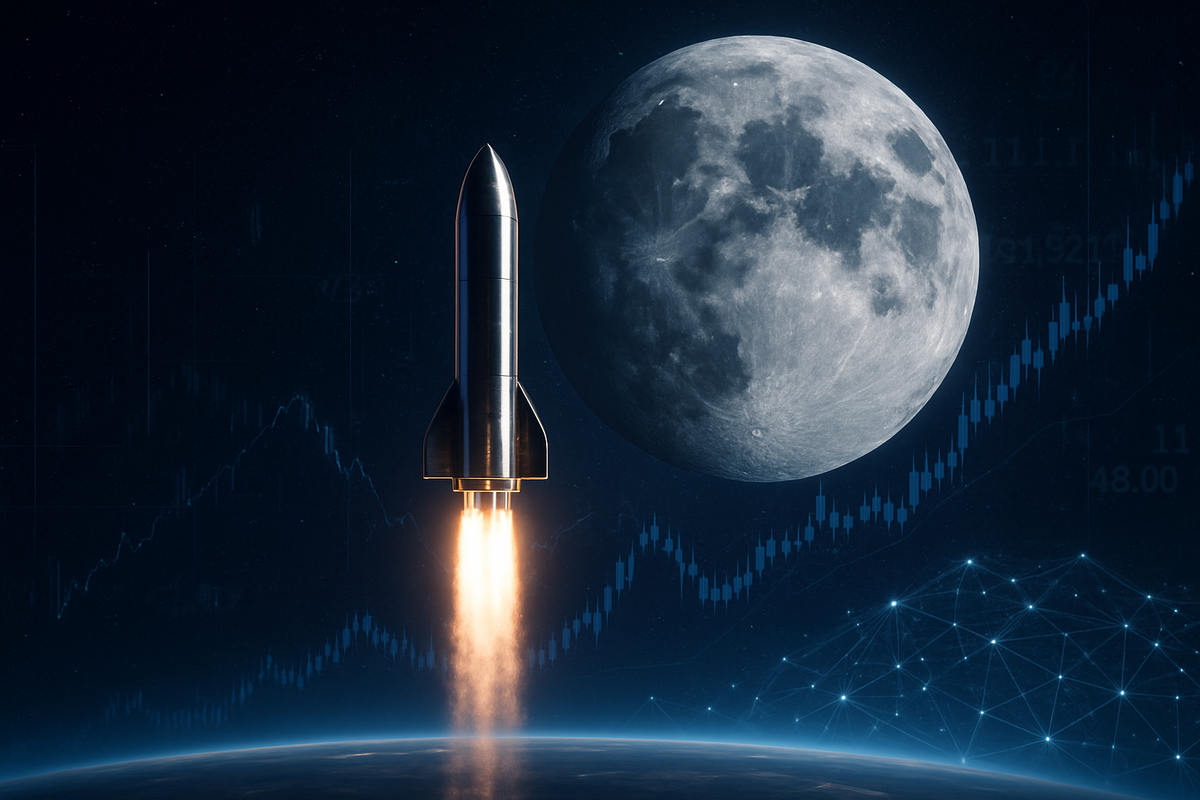
In a move that has sent shockwaves through global financial markets, SpaceX has officially submitted a confidential draft registration to the Securities and Exchange Commission (SEC) for what is projected to be the largest initial public offering (IPO) in history. Dubbed "Project Apex" by internal stakeholders, the offering aims for a staggering valuation of $1.75 trillion, a figure that would instantly place the aerospace titan among the top five most valuable companies on the planet. The filing comes at a moment of peak cultural and scientific significance, coinciding with the successful launch of NASA’s Artemis II mission, which is currently carrying the first human crew toward the Moon in over half a century.
The timing of the IPO is not merely coincidental; it represents the culmination of a transformative year for the company, marked by its recent finalized merger with xAI, Elon Musk’s artificial intelligence venture. By combining its massive Starlink satellite constellation with advanced AI compute capabilities, SpaceX is positioning itself not just as a transportation company, but as the backbone of a new "orbital intelligence" economy. As the world watches the Artemis II crew navigate the stars, Wall Street is preparing for a financial event of equal magnitude, led by a powerhouse syndicate of underwriters including Goldman Sachs (NYSE: GS) and JPMorgan Chase & Co. (NYSE: JPM).
The Path to a $1.75 Trillion Listing
The confidential filing follows a series of private funding rounds that had already pushed SpaceX’s valuation to nearly $250 billion. However, the $1.75 trillion target reflects a radical reassessment of the company’s revenue potential following the February 2026 merger with xAI. The merger created a unique synergy: xAI’s "Grok" infrastructure is being integrated into the Starlink network to provide low-latency, space-based AI processing. This "compute-in-orbit" model is designed to bypass terrestrial infrastructure bottlenecks, providing a dual-revenue stream from global internet connectivity and AI-as-a-Service.
The timeline leading to this historic filing was accelerated by the performance of the Starlink division, which reportedly ended 2025 with over 9 million subscribers and approximately $10 billion in revenue. The successful orbital tests of the Starship heavy-lift rocket throughout 2025 also played a pivotal role, proving that the company could drastically reduce the cost per kilogram of launching cargo and satellites. With lead underwriters like Morgan Stanley (NYSE: MS), Bank of America (NYSE: BAC), and Citigroup (NYSE: C) joining Goldman and JPMorgan, the institutional support for the deal is unprecedented. Initial market reactions have been euphoric, with secondary market shares of SpaceX—previously traded on private platforms—surging as investors scramble for exposure before the public listing, which is rumored for June 2026.
Winners and Losers in the New Space Race
The primary winner of this IPO is undoubtedly the "Musk Ecosystem." The massive influx of capital—estimated at $75 billion to $80 billion—will provide SpaceX with the liquidity needed to fund its Mars colonization goals and the full-scale production of Starship. Furthermore, the retail-friendly nature of the offering, with a proposed 30% allocation to individual investors, is expected to drive massive engagement from the same base that supported Tesla (NASDAQ: TSLA) during its meteoric rise. Companies within the SpaceX supply chain, including specialized material and component manufacturers, are also expected to see a significant "halo effect" as the company scales its launch frequency.
Conversely, traditional aerospace and defense giants like Boeing (NYSE: BA) and Lockheed Martin (NYSE: LMT) may find themselves in a precarious position. While these firms remain integral to government contracts, SpaceX’s move to go public with a trillion-dollar valuation highlights the widening gap in innovation and cost-efficiency. Boeing, in particular, has struggled to match the pace of SpaceX’s reusable rocket technology. Additionally, terrestrial telecommunications providers may view the massive capital infusion into Starlink as a direct threat to their long-term infrastructure investments, as satellite-based internet becomes increasingly competitive in both speed and price on a global scale.
A Paradigm Shift for the Global Space Economy
The SpaceX IPO marks a turning point where space exploration shifts from a government-funded endeavor to a commercially driven market. Historically, the largest IPOs have been held by energy or tech giants, such as Saudi Aramco or Alibaba. SpaceX’s $1.75 trillion valuation signifies that "Space" is now being treated as a foundational sector of the global economy, comparable to energy or finance. This event is likely to trigger a ripple effect, encouraging other private space firms like Blue Origin or Sierra Space to accelerate their own public listing plans, creating a new "Space" sub-index on major exchanges.
From a regulatory standpoint, the SEC and the Federal Aviation Administration (FAA) will face new challenges. The sheer size of the SpaceX-xAI entity will likely invite antitrust scrutiny, particularly regarding the control of global data flows and orbital real estate. Comparisons are already being drawn to the early days of the railroad or oil industries, where a single entity controlled the vital infrastructure of the era. However, the success of Artemis II, which utilizes SpaceX-developed technology for certain mission components, underscores a deepening partnership between the private sector and the public interest, potentially smoothing the path for regulatory approvals.
The Horizon: Mars and Beyond
In the short term, the market will be hyper-focused on the release of the public prospectus, which will provide the first detailed look at SpaceX’s finances. Strategic pivots are already underway; the company is expected to use a portion of the IPO proceeds to build a fleet of "Starship Tankers" for orbital refueling, a critical step for deep-space travel. The integration of xAI also suggests a move toward autonomous space manufacturing and mining, where AI-driven robots could process materials on the lunar surface or asteroids without human intervention.
The long-term scenario for SpaceX is nothing less than the multi-planetary expansion of the human species. If the IPO is successful, the company will have the financial runway to operate independently of government contracts for decades. Challenges remain, including the inherent risks of space flight and the technical hurdles of the Starship program. However, if the Artemis II mission concludes with a successful splashdown later this month, it will serve as the ultimate "marketing campaign" for the IPO, proving that the vacuum of space is the next great frontier for capital.
Closing Thoughts for the Modern Investor
The SpaceX IPO is more than just a financial milestone; it is a signal that the 21st-century economy is no longer bound to the Earth's surface. The combination of a $1.75 trillion valuation, a merger with xAI, and the historic backdrop of the Artemis II mission creates a narrative that is irresistible to both institutional and retail investors. While the risks of such a massive valuation are real—particularly in a sector where hardware failure is always a possibility—the growth of Starlink and the potential of Starship provide a tangible foundation for the company's lofty ambitions.
As the June listing date approaches, investors should closely monitor the performance of the Artemis II mission and any further SEC disclosures regarding the SpaceX-xAI integration. The involvement of major banks like Goldman Sachs and JPMorgan indicates that the financial "establishment" is fully on board with the commercialization of space. In the coming months, the focus will shift from the "if" of SpaceX’s dominance to the "how" of its impact on our global—and interplanetary—future.
This content is intended for informational purposes only and is not financial advice.