
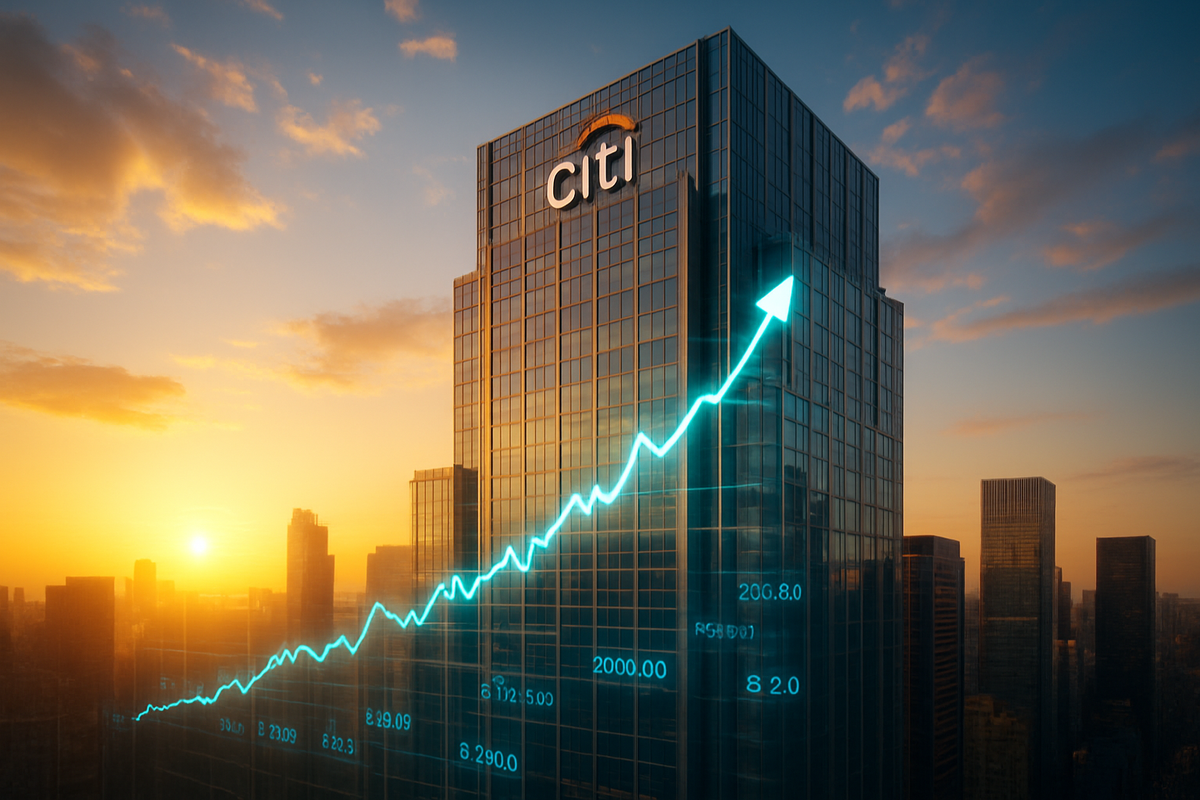
On April 14, 2026, Citigroup (NYSE: C) solidified its remarkable comeback as its share price surged to a 20-year high, closing up 1.5% at $131.42. The rally was ignited by a stellar first-quarter earnings report that saw the bank comfortably outpace Wall Street’s expectations, signaling that CEO Jane Fraser’s aggressive multi-year restructuring has finally moved the needle on profitability and operational efficiency.
The stock’s performance is not just a win for Citigroup but a bellwether for a rejuvenated banking sector. Coming on the heels of robust earnings from other industry titans, Citi’s breakout suggests a period of sustained strength for big-cap lenders. For investors, the "20-year high" milestone marks the end of a long, often painful journey for the bank as it successfully transitions from a sprawling, complex global entity into a leaner, high-margin institutional powerhouse.
The quarterly results released early Tuesday morning showcased a bank that is hitting its stride across all core divisions. Citigroup (NYSE: C) reported earnings per share (EPS) of $3.06, far exceeding the analyst consensus of $2.65. Revenue for the quarter reached $24.63 billion, driven by a 19% surge in trading revenue and double-digit growth in its "crown jewel" Services segment. This performance marks the successful conclusion of "Project Bora Bora," the bank's internal code name for its massive reorganization that slashed management layers and exited low-growth international markets.
The timeline leading to today’s record began in late 2023 when Jane Fraser initiated the most significant overhaul of the bank since the 2008 financial crisis. Over the last 24 months, Citi has reduced its headcount by nearly 20,000, eliminated over 60 internal committees, and simplified its reporting structure into five core businesses. The market's reaction today—pushing the stock to levels not seen in two decades—reflects a growing confidence that the bank can consistently meet its target of an 11% to 12% Return on Tangible Common Equity (RoTCE) by the end of 2026.
Stakeholders, including major institutional investors who had long remained skeptical of Citi’s "perpetual turnaround" status, are now pivoting. Market analysts pointed to the bank's massive $20 billion share repurchase program, authorized in early 2025, as a key driver of the stock's momentum. Initial industry reactions were overwhelmingly bullish, with several top-tier brokerage firms raising their price targets to the $145–$150 range following the earnings call.
While Citigroup (NYSE: C) is today’s standout performer, the broader banking sector is experiencing a rising tide. JPMorgan Chase & Co. (NYSE: JPM) and Goldman Sachs Group Inc. (NYSE: GS) both reported better-than-expected Q1 results last week, creating a positive feedback loop for financial stocks. JPMorgan reported a net income of $16.5 billion, while Goldman Sachs saw its equities trading revenue soar, benefiting from the same market volatility that bolstered Citi's results. This collective "earnings beat" has restored faith in the large-scale banking model after years of regulatory and interest-rate uncertainty.
However, the "winners" in this scenario extend beyond the banks themselves. Asset managers and institutional investors holding large positions in financial ETFs, such as the Financial Select Sector SPDR Fund (NYSE: XLF), have seen significant portfolio gains. On the flip side, smaller regional banks may feel the pressure as the "Big Four" continue to consolidate their grip on the market, leveraging their massive scale to invest in AI-driven services and high-margin wealth management—areas where Citi and JPMorgan (NYSE: JPM) are currently leading.
The "losers" in this environment may be the short-sellers who bet against Citi's turnaround. For years, Citigroup was the "value trap" of the banking world, trading at a steep discount to its book value. Today’s 20-year high represents a painful "short squeeze" for those who doubted the bank’s ability to shed its legacy costs and bureaucratic inefficiencies. Furthermore, competitors that haven't kept pace with Citi's streamlining, such as Wells Fargo & Co. (NYSE: WFC), may face renewed pressure from shareholders to accelerate their own internal cost-cutting measures.
The significance of Citigroup (NYSE: C) reaching a 20-year high on April 14, 2026, cannot be overstated in a historical context. It represents the final closing of the chapter on the 2008 financial crisis era for the bank. For two decades, Citi was often the laggard of the industry, bogged down by regulatory "consent orders" and a sprawling international footprint that was difficult to manage. Today's price action confirms that the "SIFI" (Systemically Important Financial Institution) model can be both safe and highly profitable when managed with precision.
This event also signals a broader shift in industry trends toward "Services" and institutional fees rather than a reliance solely on Net Interest Income (NII). As the Federal Reserve maintains a stable but moderate interest rate environment (3.5% to 3.75% in 2026), banks are no longer able to rely on rising rates to pad their margins. Citi’s success in its Services and Treasury and Trade Solutions (TTS) divisions highlights a new industry blueprint: focus on recurring, fee-based revenue from global corporations.
From a regulatory standpoint, the success of Citi’s simplification plan may actually ease some of the pressure from the Federal Reserve and the Office of the Comptroller of the Currency (OCC). By becoming a simpler, more transparent bank, Citi has arguably lowered its systemic risk profile. This could lead to lower capital requirements in the future, potentially freeing up even more billions for dividends and buybacks, a prospect that has competitors and partners watching closely.
Looking ahead, the short-term outlook for Citigroup (NYSE: C) is focused on execution. While the restructuring is largely complete, the bank must now prove that it can maintain these margins in the face of any potential economic cooling. The remainder of 2026 will be a test of whether the 12% RoTCE target is a temporary peak or a sustainable new floor. Strategic pivots are expected to continue in the wealth management sector, where Citi still trails competitors like Morgan Stanley (NYSE: MS) and JPMorgan (NYSE: JPM).
Market opportunities are also emerging in the digital and AI space. With the "Bora Bora" restructuring freeing up billions in annual expenses, Citigroup is expected to aggressively ramp up its technology spending. Investors should watch for potential acquisitions or partnerships in the fintech space as Citi looks to modernize its retail presence without the need for a massive, expensive branch network. The challenge will be to ensure that this new "lean" model remains agile enough to respond to the next generation of digital-native competitors.
In summary, April 14, 2026, marks a historic milestone for Citigroup (NYSE: C). The bank has successfully shed its reputation as a troubled legacy lender to become a top-performing institutional powerhouse. With a 20-year high in its stock price and a blowout Q1 earnings report, the bank has provided a masterclass in corporate turnaround, proving that even the largest and most complex institutions can be reformed with the right leadership and a disciplined strategy.
As the market moves forward, the focus will shift from "can they fix it?" to "how high can they grow?" The broader banking sector appears robust, buoyed by the strong performance of Citi and its peers. For investors, the key takeaways are the resilience of large-cap financials and the importance of operational efficiency in a moderate-rate environment. In the coming months, all eyes will be on the bank’s capital return plans and its ability to capture further market share in the booming M&A and wealth management sectors.
This content is intended for informational purposes only and is not financial advice.