ANN ARBOR, Mich. — As of March 9, 2026, the primary engine of the American economy—consumer spending—is showing signs of a significant sputter. The University of Michigan’s preliminary consumer sentiment index for early March has stagnated in the mid-50s, a reading that underscores a growing sense of fatigue among U.S. households. Despite a resilient stock market and headline inflation figures that are lower than the peaks of years past, a combination of a sudden spike in gasoline prices and the stubborn persistence of high costs for essentials has left the American public increasingly pessimistic about their financial futures.
The immediate implications are stark: with sentiment roughly 20% below levels seen just 14 months ago, retailers and service providers are bracing for a pullback. The "wealth gap" has widened significantly; while high-income households continue to spend, buoyed by the performance of mega-cap tech stocks, the broader middle and lower-income tiers are feeling the cumulative weight of years of elevated prices. This divergence is creating a "K-shaped" consumer landscape that threatens to undermine the Federal Reserve's hopes for a smooth economic glide path through the remainder of 2026.
Fueling the Fire: The 2026 Sentiment Crisis
The University of Michigan index, a critical barometer of the national mood, edged only slightly to 56.6 in February before flattening out in the first week of March. This stagnation follows a volatile 2025, which saw sentiment battered by a series of trade-related "policy shocks" and a cooling labor market. The timeline leading to today’s malaise began in late 2024, when sentiment hit a temporary high of 70.1. However, the introduction of widespread tariffs in early 2025 and a steady rise in the unemployment rate—now hovering near 4.7%—gradually eroded that optimism.
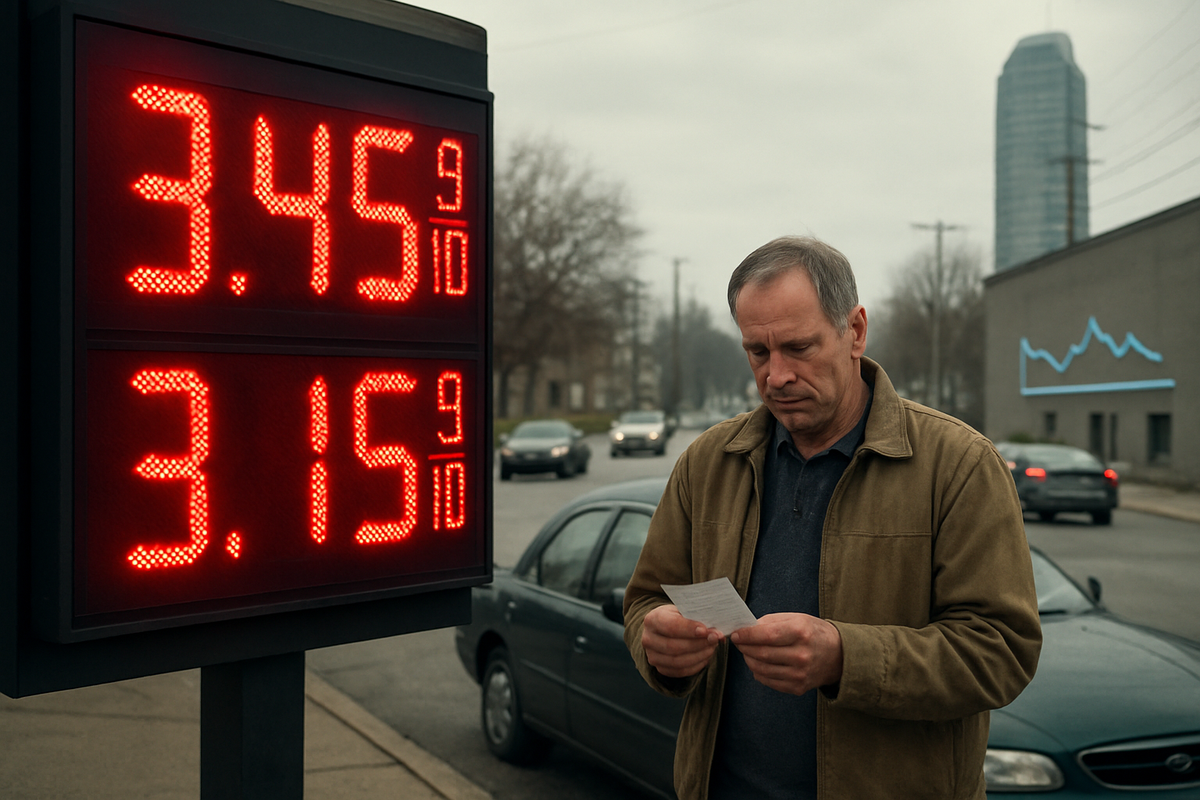
The most recent blow to consumer confidence has come from the energy sector. On the morning of March 9, 2026, national gasoline averages surged past the $3.15 per gallon mark, a sharp 10% increase in a single week. This spike is largely attributed to renewed geopolitical tensions in the Middle East that have disrupted shipping lanes in the Strait of Hormuz. For many Americans, who had seen prices dip toward $2.90 earlier in the year, this sudden reversal serves as a painful reminder of the volatility that defined the early 2020s.
Key stakeholders, including Federal Reserve officials and retail executives, are watching these developments with growing alarm. Initial market reactions on March 9 saw a divergence in performance: energy stocks rallied as crude prices climbed, while consumer discretionary sectors faced a broad sell-off. Traders are now pricing in a higher probability that the Fed will be forced to keep interest rates "higher for longer" to combat the "second wave" of inflation, even as the broader economy slows.
Retailers in the Crosshairs: Winners and Losers
The current environment is creating a clear divide among public companies. Low-cost retailers and those catering to budget-conscious shoppers are seeing a surge in "trade-down" traffic, but even they are not immune to the rising costs of logistics. Walmart Inc. (NYSE: WMT) continues to gain market share as middle-class families hunt for value, though the company has warned that freight costs associated with rising fuel prices could squeeze margins in the coming quarters. Conversely, Dollar General Corporation (NYSE: DG) has struggled as its core low-income customer base reaches a breaking point, leading to a visible decline in discretionary unit sales.
In the discretionary space, the impact is more pronounced. Companies like Starbucks Corporation (NASDAQ: SBUX) and The Walt Disney Company (NYSE: DIS) are facing headwinds as consumers prioritize "needs" over "wants." Analysts have noted a 40-46% drop in reported consumer intentions for holiday travel and luxury dining compared to the same period in 2024. Meanwhile, traditional department stores like Target Corporation (NYSE: TGT) are caught in the middle, attempting to balance price hikes on imported goods with the need to keep foot traffic from cratering.
On the winning side, the "energy shock" has provided a tailwind for major oil producers. Exxon Mobil Corporation (NYSE: XOM) and Chevron Corporation (NYSE: CVX) have seen their share prices climb in early March as the commodity spike translates directly to higher refinery margins. Additionally, the top-tier of the tech sector, led by Apple Inc. (NASDAQ: AAPL) and NVIDIA Corporation (NASDAQ: NVDA), remains somewhat insulated; their consumer base is more likely to belong to the "upper arm" of the K-shaped recovery, where household wealth has been preserved by robust equity gains over the last two years.
The Sticky Trap: A Wider Significance
The "sticky" inflation of 2026 represents a complex policy challenge that differs from the post-pandemic surge. While the 2022-2023 inflation was driven by supply chain snarls and stimulus-fueled demand, the current pressure is rooted in structural shifts. Universal tariffs implemented in 2025 have permanently raised the floor for durable goods prices, making it difficult for the consumer price index (CPI) to return to the Fed’s 2% target. Core PCE inflation is currently projected to reaccelerate toward 2.7% by the end of 2026, a trend that historical precedents suggest can lead to "stagflation" if not handled carefully.
This event fits into a broader trend of deglobalization, where trade barriers and geopolitical instability create persistent inflationary "echoes." The current situation mirrors the late 1970s, where multiple energy shocks prevented inflation from normalizing, forcing a more aggressive monetary response. Regulatory and policy implications are looming large; there is increasing pressure on the administration to consider strategic petroleum reserve releases or temporary tariff waivers to provide relief to the American consumer before the mid-year economic assessments.
Furthermore, the ripple effects are extending to the housing and automotive markets. With the Federal Funds rate stuck at approximately 4.6%, the cost of financing big-ticket items remains prohibitive for the average buyer. This has led to a stagnation in housing turnover and a buildup of inventory for auto manufacturers, who are now facing the dual threat of high interest rates and cautious buyers.
The Road Ahead: Forecasts and Strategic Pivots
Looking toward the summer of 2026, the short-term outlook remains clouded. If gasoline prices continue to hover above $3.20 per gallon, economists predict a "shallow recession" could begin as early as the third quarter. The primary challenge for businesses will be the "pivot to value." Companies that have relied on brand loyalty may find that price is the only factor that matters in the current climate. We expect to see a surge in loyalty program incentives and "shrinkflation" as manufacturers attempt to hide rising costs.
Market opportunities may emerge in the defensive sectors—healthcare, utilities, and consumer staples—which typically outperform during periods of low sentiment. However, the real test will be for the Federal Reserve. If they choose to cut rates to support the flagging consumer, they risk unanchoring inflation expectations, which currently sit at a precarious 3.4% for the year ahead. Conversely, staying the course could accelerate the downturn in consumer spending.
Potential scenarios range from a "Soft Landing 2.0," where energy prices stabilize and sentiment recovers, to a more severe "Stagflationary Slump" where costs continue to rise despite slowing growth. Investors should prepare for heightened volatility in the consumer discretionary sector and look for companies with strong balance sheets that can weather a protracted period of low demand.
Navigating the Stagnation: A Wrap-Up
In summary, the state of the US consumer on March 9, 2026, is one of cautious retrenchment. The University of Michigan’s latest data paints a picture of a public that is weary of "sticky" inflation and increasingly sensitive to the volatile price of gasoline. The primary engine of the US economy is not failing, but it is certainly losing RPMs. The K-shaped nature of this economic cycle means that while the "indices" might look healthy thanks to tech giants, the average household is under significant pressure.
Moving forward, the market will be hyper-sensitive to any signs of labor market deterioration. If the "low-hire" environment shifts into a "high-fire" environment, the current stagnation in sentiment could quickly turn into a collapse. For now, the resilience of the high-income consumer is the only thing standing between the current slowdown and a broader economic contraction.
Investors should watch for the upcoming retail earnings season and the next round of PCE data. These will be the ultimate indicators of whether the "energy shock" of March 2026 was a temporary blip or the catalyst for a more significant economic shift. In this environment, caution is the watchword, and value is the only currency that counts.
This content is intended for informational purposes only and is not financial advice.