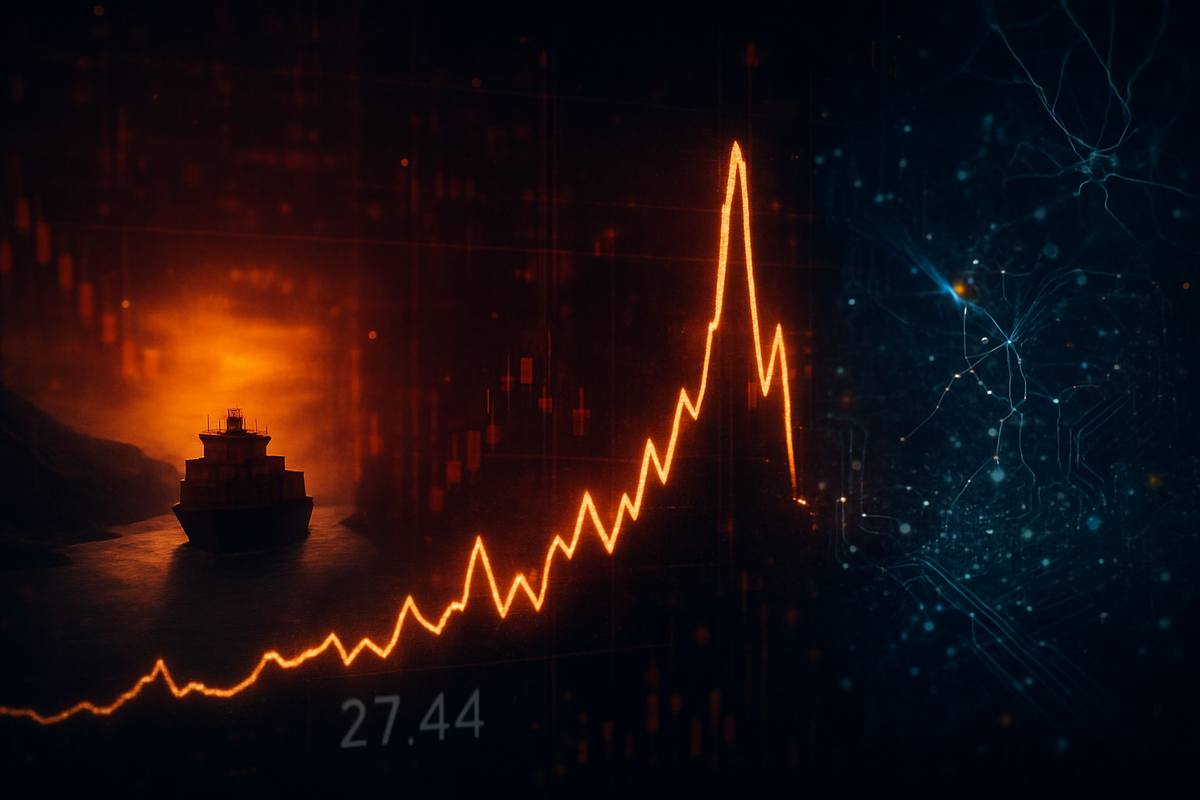
NEW YORK — The CBOE Volatility Index (VIX), often referred to as Wall Street’s “fear gauge,” surged to a critical level of 27.44 on March 26, 2026, marking a significant shift in investor sentiment from complacency to extreme caution. This spike represents the index's highest sustained level in over a year, signaling that the "regime of stability" dominated by the AI boom of 2024 and 2025 has officially fractured under the weight of geopolitical instability and a fundamental repricing of high-growth technology assets.
The move to 27.44 is not merely a technical fluctuation; it reflects a "perfect storm" of macroeconomic pressures. As of March 27, 2026, global markets are grappling with a blockade in the Strait of Hormuz and a cooling of the "AI-everywhere" narrative. With the VIX hovering well above its historical mean of 20, the immediate implication is a massive rotation out of speculative growth and into "hard" defensive assets, as traders brace for a period of prolonged stagflationary pressure and heightened regional conflict.
A Perfect Storm: From AI Euphoria to Geopolitical Reality
The ascent of the VIX began in earnest following "Operation Epic Fury," a series of targeted military strikes against Iranian infrastructure that commenced in late February 2026. By mid-March, the conflict escalated to a maritime blockade of the Strait of Hormuz, through which roughly 20% of the world’s petroleum passes. This geopolitical shock sent Brent crude prices screaming past $110 per barrel, reigniting inflation fears that many analysts believed were buried in the 2024 cooling cycle.
Simultaneously, the technology sector—the primary engine of market gains over the last two years—suffered a crisis of confidence. Following the GTC 2026 conference held by NVIDIA (NASDAQ: NVDA) in mid-March, investors began to express "ROI Fatigue." While NVIDIA unveiled its powerful "Vera Rubin" AI platform, the company’s roadmap for a $1 trillion infrastructure build-out was met with skepticism regarding the timeline for actual profitability for enterprise customers. This fundamental doubt, combined with a 10% global import tariff implemented by the U.S. administration in February, created a "fragile" technical environment for the "Magnificent Seven."
The timeline reached a boiling point on March 26. As news broke of a delayed trade summit between the U.S. and China, and fresh reports of supply chain disruptions in the semiconductor corridor hit the wires, the VIX spiked from the low 20s to its closing level of 27.44. Market participants, including major institutional stakeholders and pension funds, were seen aggressively purchasing VIX call options and shifting capital into short-term Treasuries, effectively ending the early-2026 rally.
The Performance Gap: AI Giants Stumble While Energy and Defense Surge
The spike in volatility has created a stark divide between the winners and losers of the 2026 landscape. The most notable laggard has been NVIDIA (NASDAQ: NVDA), which saw its stock price become increasingly volatile, trading in a tight but downward-trending range between $172 and $181. Similarly, Microsoft (NASDAQ: MSFT) has faced downward pressure, falling over 20% year-to-date as the "end of the regulatory honeymoon" for AI takes hold. The implementation of the EU AI Act’s second phase and new transparency laws in California have forced these tech titans to increase capital expenditures (CAPEX) for compliance, squeezing margins at a time when top-line growth is being questioned.
Conversely, the energy and defense sectors have emerged as the primary beneficiaries of the current chaos. ExxonMobil (NYSE: XOM) and Chevron (NYSE: CVX) have seen their valuations climb more than 30% since the start of the year, driven by the $100+ oil shock. These "old economy" stocks are once again serving as the market's ballast. In the defense space, Lockheed Martin (NYSE: LMT) and RTX Corporation (NYSE: RTX) are trading near all-time highs as NATO members accelerate procurement cycles in response to both the Middle East escalation and the ongoing structural instability in Eastern Europe.
Apple (NASDAQ: AAPL) has also proven surprisingly resilient, acting as a "tech shelter" for investors. Unlike its peers heavily dependent on raw AI infrastructure sales, Apple’s massive cash reserves and less aggressive AI CAPEX requirements have made it a preferred holding for those seeking safety within the technology sector. Meanwhile, volatility-linked products such as the 2x Long VIX Futures ETF (BATS: UVIX) have seen record-breaking inflows as retail and institutional traders alike seek to profit from the rising fear.
Shifts in the Global Financial Order
This VIX spike fits into a broader industry trend of "de-globalization" and the "securitization" of finance. We are moving away from the "efficiency-first" model of the early 2020s toward a "resilience-first" model. The 27.44 level is reminiscent of the mid-2022 period when the market was coming to terms with structural inflation and the start of the Russia-Ukraine war. However, the 2026 version of this volatility is complicated by the systemic integration of AI; a failure in the AI thesis doesn't just hurt tech stocks—it threatens the productivity gains the entire market was priced for.
The ripple effects are reaching beyond the stock market and into policy circles. The U.S. Federal Reserve now finds itself in a "policy box." With the Iran conflict driving energy prices higher, inflation is ticking up, yet the 10% global tariff and tech slowdown are threatening growth. This stagflationary threat echoes the 1970s more than the 2020 pandemic, suggesting that historical precedents of "buying the dip" may no longer apply in a world where geopolitical risk is a structural pillar rather than a temporary anomaly.
Furthermore, the delay of the Trump-Xi summit in mid-March has sent a clear signal to the markets: geopolitical priorities now supersede trade interests. This regulatory and policy uncertainty is what keeps the VIX elevated. Investors are no longer just looking at earnings; they are looking at shipping lanes, tariff schedules, and the regulatory cost of an AI model's compliance in the European Union.
Navigating the 'High-Fragility' Era
Looking ahead, the short-term outlook suggests the VIX could remain in the 25-30 range for the duration of the spring. The immediate "strategic pivot" required for investors is a shift toward quality and cash flow. Companies with high debt-to-equity ratios are likely to be punished further as the "cost of carry" for volatility-linked hedges remains expensive. The market is waiting for a resolution to the Strait of Hormuz blockade; any sign of a de-escalation could see a sharp "volatility crush," but current intelligence suggests a prolonged standoff.
In the long term, the "AI-ROI" debate will be the defining theme of the second half of 2026. If tech companies can demonstrate that the billions spent on infrastructure are translating into tangible enterprise productivity gains despite the new regulations, we could see a return to a low-volatility environment. However, if the "Vera Rubin" era fails to deliver immediate bottom-line results for the broader S&P 500, the VIX may establish a new "floor" near 20, representing a permanent increase in the risk premium for global equities.
Summary of the New Market Reality
The VIX’s climb to 27.44 serves as a stark reminder that the market is a fragile ecosystem sensitive to both the pulse of global conflict and the cold reality of corporate earnings. The "triple threat" of the Iran-linked oil shock, AI skepticism, and new trade barriers has effectively dismantled the low-volatility regime of 2025. Key takeaways for the coming months include the continued dominance of energy and defense sectors, the technical vulnerability of former AI darlings, and a renewed focus on "stagflation" as the primary macro risk.
Moving forward, the market will likely remain in a "high-fragility" state. Investors should closely watch for the monthly Consumer Price Index (CPI) readings to see the impact of current oil prices and monitor the 10-year Treasury yield as a gauge of total system risk. The "fear gauge" has spoken: the era of easy gains is over, and the era of risk management has begun.
This content is intended for informational purposes only and is not financial advice.