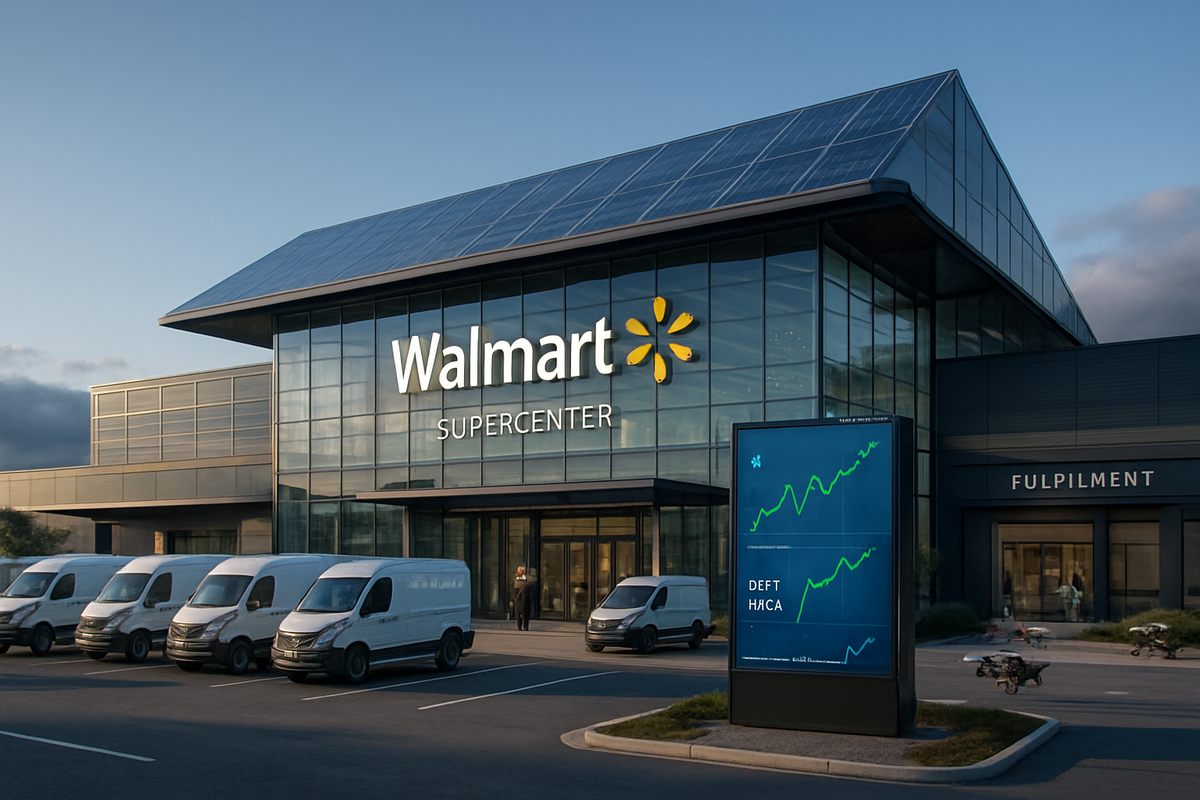
On a day marked by heightened market volatility and geopolitical jitters, Walmart Inc. (NYSE: WMT) emerged as the definitive leader of the Dow Jones Industrial Average, climbing 2.17% to close at $121.14. As of today, March 24, 2026, the retail behemoth’s performance stands in stark contrast to the broader tech-heavy indices, which have struggled under the weight of "AI fatigue" and rising energy costs. This upward movement reinforces a growing trend among institutional investors who are pivoting toward "tangible economy" stocks that offer predictable earnings and essential consumer appeal.
The rally in Walmart’s shares is not merely a defensive play; it reflects the market's growing confidence in the company’s structural transformation under its new leadership. With the Dow Jones Industrial Average (DJIA) currently hovering around the 46,250 mark—pulling back from its historic 50,000 peak reached earlier this year—Walmart has become the go-to "safe haven" for capital looking to weather the storm of persistent inflation and global supply chain disruptions.
A Strategic Pivot and a New Era of Leadership
The primary catalyst for today’s gain stems from a renewed appreciation of Walmart’s fundamental shift in its business model. This month marks the first full quarter under CEO John Furner, who officially took the helm on February 1, 2026. Furner has accelerated the "store-as-hub" strategy, which has turned over 4,700 U.S. locations into high-efficiency fulfillment centers. This move has allowed Walmart to offer same-day delivery to nearly 95% of the American population, a logistical feat that has effectively neutralized the competitive advantage once held by pure-play e-commerce giants.
The timeline leading up to today’s surge began in mid-February, when Walmart reported a stellar fourth-quarter performance, showcasing its first $1 trillion market capitalization milestone. Investors were particularly impressed by the growth of Walmart Connect, the company’s retail media division. Advertising and membership fees from Walmart+ now account for nearly one-third of the company's total operating income, marking a transition from a low-margin grocer to a diversified high-margin powerhouse.
Market participants noted that the 2.17% rise today was also fueled by the "barbell consumer" phenomenon. Recent data suggests that over 75% of Walmart’s market share gains in the last six months have come from households earning more than $100,000 per year. As energy prices spike above $100 per barrel due to ongoing tensions in the Middle East, even affluent shoppers are trading down to Walmart for their essential goods, providing a robust floor for the company’s revenue.
Winners, Losers, and the Battle for the Basket
While Walmart (NYSE: WMT) led the pack, other players in the consumer staples and retail space are experiencing a mixed bag of results. Costco Wholesale Corp. (NASDAQ: COST) saw a modest bump of 0.8% today, trading near the $995 level. While Costco remains a favorite for its high membership retention and strong balance sheet, its premium valuation—trading at nearly 50 times earnings—has made some value-conscious investors wary, leading them to rotate into the more reasonably priced Walmart.
Conversely, Target Corp. (NYSE: TGT) has found the current environment more challenging. Although Target’s stock is up 15.6% year-to-date, it lagged behind today with a minor 0.4% decline. Analysts suggest that Target is struggling to match Walmart’s aggressive "Everyday Low Price" strategy as inflation-weary consumers prioritize necessities over the discretionary "cheap-chic" items that typically drive Target's margins. In the consumer goods space, Procter & Gamble Co. (NYSE: PG) faced selling pressure, dropping 1.1% as investors fret over "private-label pressure," where shoppers are increasingly opting for Walmart’s Great Value brand over more expensive national names.
The "losers" of today's session were largely found in the high-growth technology sectors. Companies that had previously benefited from the AI hype cycle saw significant outflows as the market prioritized immediate cash flows over long-term promises. This "flight to quality" has created a stark divergence in the market, where the reliability of a grocery receipt is currently valued more than the potential of a neural network.
Resilience in a Volatile Global Landscape
Walmart’s ascent is part of a broader historical precedent where consumer staples outperform during periods of economic transition. The current market environment—characterized by a "hawkish pause" from the Federal Reserve with interest rates holding steady at 3.50%–3.75%—is reminiscent of the late-cycle dynamics seen in previous decades. With the Consumer Price Index (CPI) stubbornly hovering between 2.4% and 2.7%, the "inflation-proof" nature of Walmart’s business model has become its greatest asset.
Furthermore, this event highlights the "decoupling" of the consumer staples sector from the broader market. The Consumer Staples Select Sector SPDR Fund (NYSE Arca: XLP) has risen 13.2% year-to-date, far outstripping the S&P 500. This shift suggests that the era of "easy money" in growth stocks may be over, as investors return to the fundamentals of supply chain efficiency, inventory management, and price leadership.
The ripple effects of Walmart's dominance are also being felt by competitors and partners. Logistics providers and suppliers are being forced to adapt to Walmart’s increasingly automated supply chain. Historically, when Walmart gains this much momentum, it triggers a "deflationary wave" across the retail sector as competitors are forced to lower prices to maintain foot traffic, a trend that policymakers at the Fed are watching closely as they navigate the fine line between growth and inflation control.
The Path Ahead: Scenarios for 2026 and Beyond
Looking toward the remainder of 2026, the short-term outlook for Walmart remains bullish, provided the company can manage its inventory levels amidst volatile shipping costs. A key strategic pivot to watch will be Walmart’s further integration of healthcare services. With its massive physical footprint and high frequency of visits, the expansion of Walmart Health clinics could provide the next major leg of growth, potentially disrupting traditional healthcare providers.
However, challenges remain. If geopolitical tensions subside and oil prices return to the $70 range, the "trade-down" effect may weaken as consumer confidence rebounds, potentially leading to a rotation back into discretionary retail and tech. Investors should also monitor for "valuation fatigue"; with many staples trading at historic premiums, any miss in the upcoming Q1 2026 earnings reports could trigger a sharp correction in the sector.
The long-term scenario involves Walmart leveraging its massive data engine to personalize the shopping experience further. By utilizing AI not for speculative ventures, but for practical inventory forecasting and hyper-targeted advertising, Walmart is positioned to maintain its dominance regardless of the macroeconomic climate. The transition from a "store" to a "data-driven logistics platform" is nearly complete, making Walmart a core holding for any defensive-minded portfolio.
Conclusion: A Market Redefined by Essentials
Today’s 2.17% rise in Walmart (NYSE: WMT) serves as a potent reminder that in times of uncertainty, the market returns to the basics. The retail giant has successfully navigated a period of intense leadership change and economic turbulence to emerge as the anchor of the Dow Jones Industrial Average. By focusing on high-margin revenue streams like advertising and leaning into its logistical superiority, Walmart has rewritten the playbook for what it means to be a "staple" in the modern economy.
Moving forward, investors should keep a close eye on energy prices and the Federal Reserve's rhetoric regarding interest rates. While Walmart provides a sturdy shelter, the broader sector is trading at elevated levels that require flawless execution to sustain. For now, the "flight to quality" is in full effect, and as of March 24, 2026, Walmart remains the undisputed king of the retail landscape.
This content is intended for informational purposes only and is not financial advice.