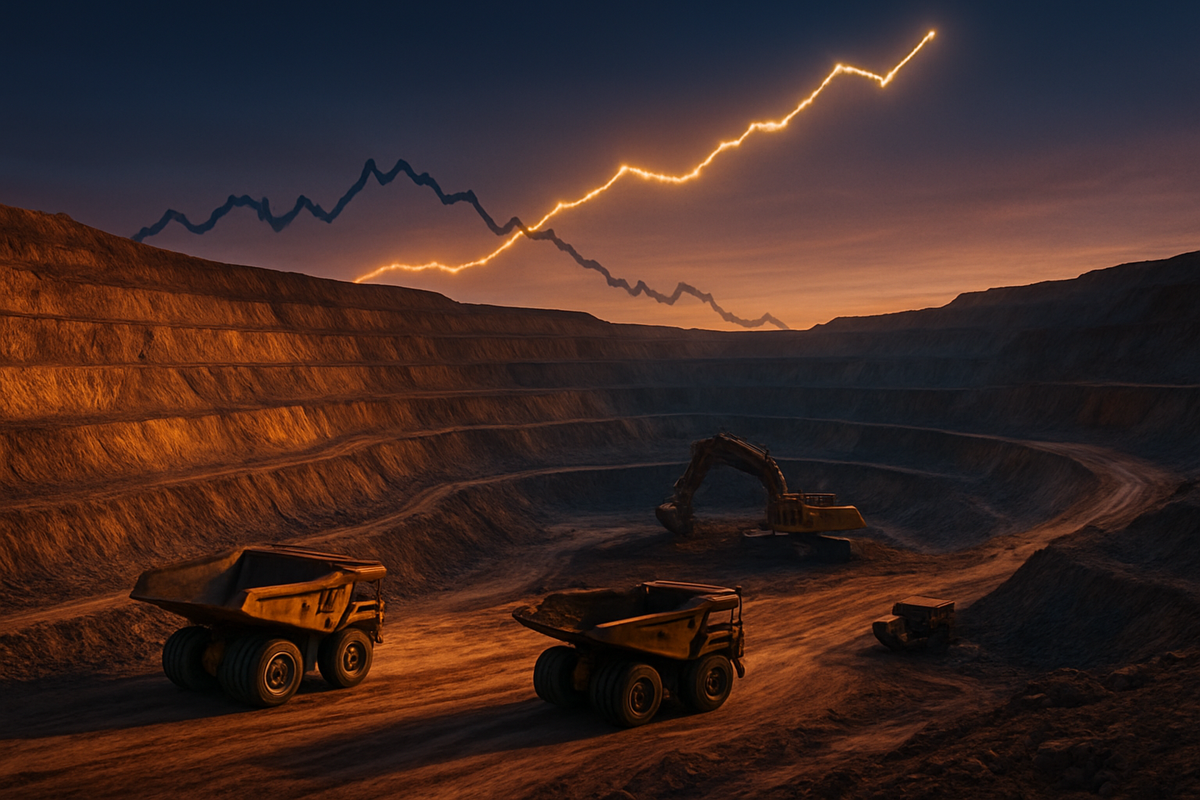
The world’s premier gold miners are facing a stark reality check as the first quarter of 2026 draws to a close. Despite historically high bullion prices that have teased the $5,000 per ounce mark, the industry's titans are struggling to translate record metal values into equity gains. Share prices for Newmont Corporation (NYSE: NEM) and Barrick Gold Corporation (NYSE: GOLD) have undergone a sharp correction, signaling that the "golden era" for mining stocks may be more complicated than the spot price suggests.
The primary catalyst for this downturn is a combination of lackluster production forecasts and a relentless rise in operational expenses. Investors who flocked to the sector expecting a windfall are now grappling with what analysts call the "Great Decoupling"—a phenomenon where the soaring price of gold is increasingly offset by the crushing weight of AISC (All-In Sustaining Costs) inflation. For the market's heavyweights, the start of 2026 has been defined not by record profits, but by a fight to maintain margins against a backdrop of aging assets and rising labor costs.
Operational Headwinds and the 2026 "Trough"
The selling pressure intensified recently as Newmont Corporation (NYSE: NEM) officially designated 2026 as a "trough year" for its global operations. The Denver-based miner, which had reached a peak share price in January following a bullish year-end rally, has seen its stock tumble approximately 26% from those highs. Management stunned the market by guiding for a 2026 production total of just 5.3 million ounces, a significant step back from previous projections. This intentional "pause" in production is part of a broader resequencing strategy aimed at accessing higher-grade ore in late 2027, but the immediate impact on the balance sheet has left shareholders uneasy.
Compounding the production slump is the alarming rise in All-In Sustaining Costs. Newmont projected its 2026 AISC to hit $1,680 per ounce, a figure driven largely by persistent labor shortages and the ballooning cost of heavy mining equipment. In an era where "tier-one" assets are harder to find and even harder to staff, Newmont's struggle highlights a industry-wide trend: the cost of pulling an ounce of gold from the ground is rising faster than many operational models predicted. The market’s reaction was swift, with heavy selling reflecting a lack of patience for the company’s "long-term value" narrative.
Simultaneously, Barrick Gold Corporation (NYSE: GOLD) has faced its own share of turmoil. The Toronto-based giant saw its share price drop 19% on exceptionally heavy trading volume this month, as concerns over production stagnation reached a fever pitch. Unlike Newmont’s planned trough, Barrick’s struggles appear more systemic, with analysts pointing to a lack of organic growth and the recent sale of several non-core assets that have failed to replenish the company’s production pipeline. While CEO Mark Hill has championed a leaner, more focused portfolio, the market is beginning to question if Barrick is shrinking its way toward irrelevance in a high-demand environment.
Winners and Losers in a Bifurcated Market
The primary "losers" in this current cycle are undoubtedly the generalist investors and institutional funds that shifted heavily into large-cap miners as a hedge against global currency volatility. These investors, expecting miners to act as a leveraged play on the gold price, have instead found themselves holding companies with thinning margins. The 26% drop in Newmont and the 19% slide in Barrick have wiped out billions in market capitalization, leading to a rotation out of the "Big Two" and into more nimble competitors.
Conversely, the "winners" in this environment appear to be the mid-tier producers and royalty companies. While Newmont and Barrick struggle with the logistical nightmare of mega-projects, smaller operators with lower AISC and higher grade-to-tonnage ratios are attracting the capital that is fleeing the giants. Companies that have managed to keep their costs below $1,200 per ounce are now the darlings of the sector, as they are the only ones truly capturing the upside of the $5,000 gold price.
Additionally, equipment manufacturers and labor providers are thriving. The very inflation that is crippling Newmont’s margins—driven by a 15% year-over-year increase in the cost of autonomous haulage systems and specialized labor—represents record revenue for the service sectors. This creates a parasitic relationship where the providers of mining infrastructure are capturing a larger share of the gold value chain than the miners themselves.
The 'Great Decoupling' and Industry Trends
The current crisis underscores the "Great Decoupling," a term coined to describe the fundamental break between bullion's performance and mining equities. Historically, gold stocks traded in lockstep with the metal, often with a 2x or 3x leverage. However, in 2026, the correlation has broken. Persistent cost inflation in energy, explosives, and chemicals, combined with a tightening global labor market, has created a ceiling for mining profits that didn't exist in previous gold bull markets.
This trend is also being exacerbated by "jurisdictional risk." As Newmont and Barrick seek to replace their depleting reserves, they are forced into increasingly unstable regions. Barrick’s recent production halts in Africa and Newmont’s ongoing disputes over tax royalties in South America have added a "risk premium" to their stocks that the physical metal does not carry. The market is effectively telling the mining giants that their operational complexity is no longer worth the risk when physical ETFs or digital gold tokens offer the same price exposure without the labor strikes or equipment failures.
Furthermore, the sale of non-core assets by Barrick highlights a desperate need for capital discipline. By shedding smaller mines to focus on "tier-one" assets, Barrick is effectively betting the company’s future on a handful of massive projects. If these projects face even minor delays or cost overruns, the company has no buffer. This "all-or-nothing" strategy is a significant departure from the diversified portfolios of the early 2010s and signals a new, more aggressive era of resource management.
Strategic Pivots and the Road Ahead
Looking forward, the mining industry must undergo a strategic pivot if it hopes to re-attract disillusioned capital. For Newmont Corporation (NYSE: NEM), the challenge will be proving that 2026 is truly a "trough" and not a "new normal." Investors will be watching the company’s 2027 development milestones with extreme scrutiny. Any delay in the transition to higher-grade zones could lead to a permanent de-rating of the stock. Newmont may also need to accelerate its adoption of full-scale mine automation to combat the $1,680/oz AISC, a move that requires significant upfront capital but promises lower long-term labor dependency.
For Barrick Gold Corporation (NYSE: GOLD), the path forward likely involves further consolidation or a massive strategic partnership. There is growing speculation that Barrick may look to merge its North American operations into a joint venture with other players to achieve better economies of scale. The market’s reaction to their asset sales suggests that "shrinking to grow" is a tough sell; Barrick needs a major discovery or a transformative acquisition to change the stagnation narrative.
Short-term, the sector is likely to remain volatile as the market digests these production cuts. However, if gold prices remain at these elevated levels, the sheer cash flow generated—even at higher costs—may eventually force a valuation floor. The emergence of new mining technologies, such as in-situ leaching for gold or advanced AI-driven exploration, could provide the next catalyst for a margin recovery, but these are multi-year transitions that will do little to help the 2026 balance sheets.
Investor Outlook and Summary
The first quarter of 2026 has served as a sobering reminder that gold mining is an industrial business first and a financial hedge second. The 26% decline in Newmont and the 19% drop in Barrick reflect a market that is no longer willing to overlook rising costs and stagnant production, even when the underlying commodity is at an all-time high. The "Great Decoupling" is the new reality, and investors must be more selective than ever, focusing on miners that can demonstrate true cost control.
As we move toward the second half of the year, the primary metrics to watch will be AISC stability and development progress at Newmont’s key sites. If inflation begins to cool and equipment lead times shorten, the "trough" might indeed prove to be a buying opportunity. However, if labor and equipment costs continue their upward trajectory, the current $1,680/oz guidance might actually be optimistic.
For now, the mining giants are under immense pressure to perform. The era of easy growth through rising gold prices is over; the era of operational excellence has begun. Investors should remain cautious, keeping a close eye on quarterly production reports and any further revisions to cost guidance, as these will be the true drivers of share price recovery in a bifurcated gold market.
This content is intended for informational purposes only and is not financial advice.