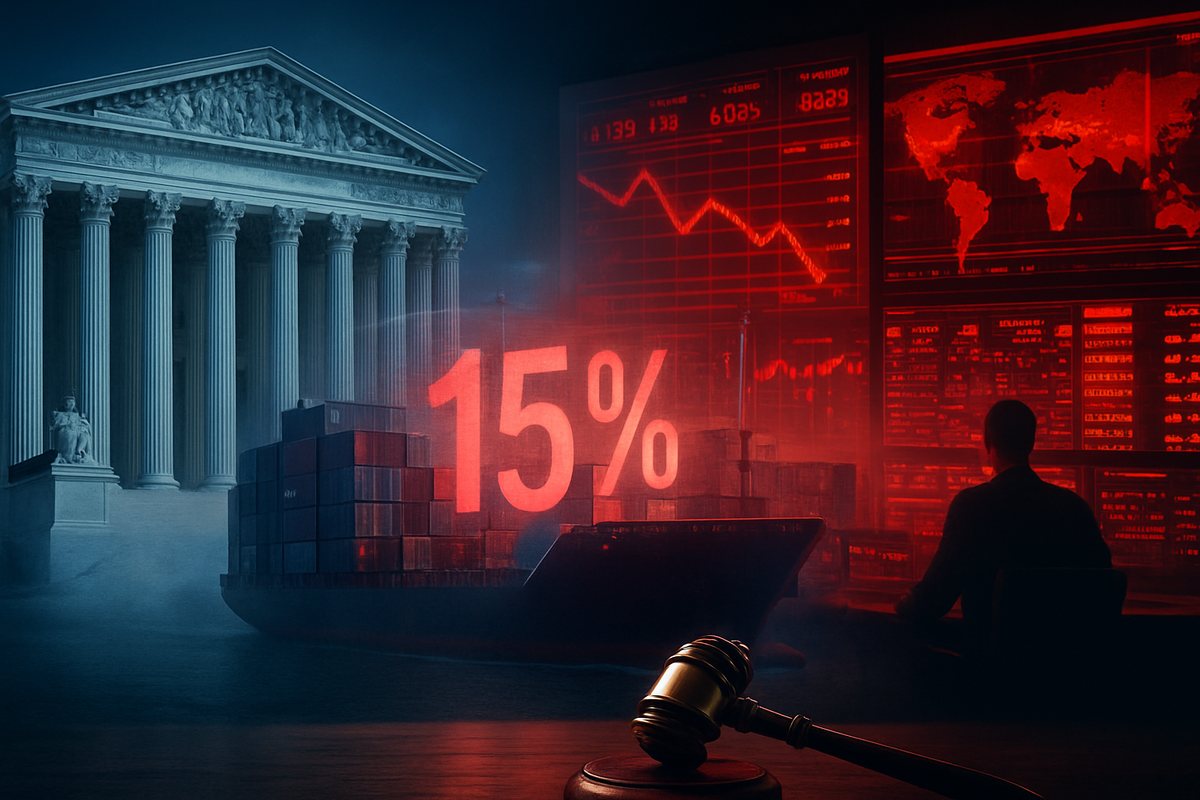
The global trade landscape was thrown into a state of profound uncertainty this month following a landmark ruling by the United States Supreme Court that effectively dismantled the executive branch's use of emergency powers to levy "reciprocal" tariffs. In a 6-3 decision handed down on February 20, 2026, the Court ruled that the International Emergency Economic Powers Act (IEEPA) does not grant the President the unilateral authority to impose taxes or duties, a power the Constitution explicitly reserves for Congress. The ruling has created a potential fiscal crisis for the Treasury, which now faces the prospect of refunding nearly $200 billion in duties collected since the policy's inception in early 2025.
However, any market optimism regarding a return to free trade was short-lived. Within twenty-four hours of the ruling, the Trump administration executed a strategic pivot, invoking Section 122 of the Trade Act of 1974 to impose a 15% global import surcharge. This move, designed to address what the administration calls a "catastrophic" balance-of-payments deficit, has triggered a new wave of volatility across international markets. As of today, March 23, 2026, businesses are scrambling to adapt to a 150-day "temporary" tariff window that many fear will become a permanent fixture of the American economic strategy.
The Path to the High Court and the Section 122 Pivot
The legal battle reached its zenith in the consolidated case of Learning Resources, Inc. v. Trump, which challenged the administration’s use of IEEPA to bypass the standard legislative process for trade policy. Chief Justice John Roberts, writing for the majority, invoked the "Major Questions Doctrine," asserting that if Congress intended to delegate the vast power to tax international commerce to the President, it would have done so with "exceeding clarity." The Court’s decision emphasized that Article I, Section 8 of the Constitution remains the definitive boundary of federal taxing power. While the dissent—led by Justices Kavanaugh, Thomas, and Alito—warned of "practical chaos" and a destabilized executive, the majority held that the rule of law outweighed the administration's stated economic emergencies.
The timeline of the fallout was remarkably condensed. On February 20, the ruling was announced, sending global stock indices into a brief but sharp rally as importers anticipated an end to the "reciprocal tax" era. By the evening of February 21, the administration responded via a series of executive orders and social media proclamations. Citing the need to protect the U.S. dollar and reduce the trade deficit, President Trump invoked Section 122, initially proposing a 10% surcharge before quickly escalating it to the statutory maximum of 15%. This "Plan B" serves as a bridge, allowing the administration to keep tariffs in place for up to 150 days while it initiates formal Section 301 investigations intended to establish more permanent, product-specific duties.
The immediate reaction from the trade community has been one of exhausted frustration. Port authorities and logistics giants like FedEx (NYSE: FDX) have reported a surge in "pre-surcharge" shipments as companies tried to clear customs before the new 15% rate took effect on February 24. Meanwhile, the Treasury Department is currently inundated with claims from thousands of American companies seeking the return of "unconstitutionally seized" tariff payments, a process that legal experts predict could take years to adjudicate.
Corporate Impact: Giants Grapple with Refund Hopes and New Surcharges
For tech behemoth Apple (NASDAQ: AAPL), the Supreme Court ruling represented a momentary multi-billion dollar win. The company has paid an estimated $3.3 billion in tariffs over the last year, and the prospect of a refund offered a significant boost to its cash reserves. However, the subsequent 15% global surcharge under Section 122 threatens to neutralize these gains. CEO Tim Cook has reportedly accelerated the diversification of Apple’s supply chain, shifting more assembly operations to India and Vietnam, though the global nature of the 15% surcharge means that almost no region—outside of those with specific free trade exemptions—is safe from the new costs.
Retailers are facing an even tighter squeeze. Walmart (NYSE: WMT) and Target (NYSE: TGT) both saw initial stock pops following the SCOTUS ruling, only to see those gains erased as the Section 122 announcement hit the wires. Walmart’s CFO, John Rainey, recently warned that the company's ability to absorb these costs is at its limit. While Walmart has utilized its massive scale to negotiate lower prices from suppliers, a flat 15% surcharge on all imports is expected to lead to visible price increases on "back-to-school" and "holiday" inventory later this year. CEO Doug McMillon has publicly called for a "predictable trade framework" to replace the current cycle of litigation and executive pivots.
The industrial sector is similarly embattled. Caterpillar (NYSE: CAT), a major exporter that also relies on imported steel and components, faces a projected $2.6 billion tariff headwind for the 2026 fiscal year. Under CEO Joe Creed, the company has begun a strategic shift toward high-margin service contracts to decouple its earnings from the volatility of equipment sales. However, the manufacturing costs associated with the 15% surcharge have already forced the company to trim discretionary spending and reconsider its 2026 capital expenditure plans.
Wider Significance and the "Emergency" Trade Trend
The current situation marks a pivotal moment in the history of American trade policy, signaling a move away from the broad use of IEEPA toward more specialized, but equally aggressive, trade statutes. The invocation of Section 122 is particularly significant; it is a rarely used tool from the Nixon era designed for balance-of-payments crises. By using it now, the administration is testing the limits of what constitutes an "economic emergency." This sets a precedent where any perceived imbalance in trade could be met with blanket surcharges, fundamentally altering the "rules-based" international order that dominated the late 20th century.
The ripple effects are being felt globally. Traditional allies in the European Union and neighbors like Mexico and Canada are weighing retaliatory measures, though some are hesitant given the 150-day expiration date of the Section 122 move. If the U.S. continues to oscillate between different legal justifications for tariffs, the global trade community may begin to permanently bypass American markets to avoid the "tariff lottery." This trend toward regionalization and the "balkanization" of supply chains is accelerating as companies prioritize stability over the low costs once offered by globalized manufacturing.
Furthermore, the SCOTUS ruling on the Major Questions Doctrine reinforces a broader judicial trend toward curbing the "administrative state." By insisting that Congress must be the one to levy duties, the Court is attempting to force the legislative branch back into the center of trade policy. However, with a deeply divided Congress, the result has not been new legislation, but rather an executive branch that is increasingly creative in its interpretation of existing, older statutes like the Trade Act of 1974.
What Comes Next: The 150-Day Countdown
The market’s primary focus is now on the 150-day clock attached to Section 122. Under the statute, these emergency surcharges expire unless Congress votes to extend them. Given the current political climate, such a vote is unlikely to be straightforward. The administration is expected to use this window to launch "fast-track" Section 301 investigations, which focus on unfair trade practices. This would allow them to transition from a blanket 15% global surcharge to a more targeted, but perhaps even higher, set of tariffs on specific sectors like semiconductors, EVs, and heavy machinery by late summer 2026.
In the short term, investors should watch for a "margin squeeze" in the Q1 and Q2 earnings reports of major importers. Companies that cannot pass these costs to consumers or find immediate supply chain workarounds will likely see a significant impact on their bottom lines. There is also the "refund wildcard"—if the Treasury begins processing the $200 billion in IEEPA refunds, it could provide an unexpected liquidity injection for hundreds of mid-to-large-cap companies, potentially fueling a mid-year market recovery even as the 15% surcharge remains in place.
Strategically, the era of "just-in-time" global manufacturing appears to be yielding to a "just-in-case" model, where companies maintain higher inventories and local manufacturing footprints to hedge against policy shifts. This transition is capital-intensive and likely to be inflationary in the medium term, a factor that the Federal Reserve will undoubtedly have to weigh as it considers its interest rate path for the remainder of 2026.
Wrap-Up and Investor Outlook
The month of February 2026 will be remembered as the moment the U.S. trade war moved from a policy debate to a constitutional crisis and back again. The Supreme Court has successfully reasserted Congressional authority over the power to tax, but the executive branch has proven equally nimble in finding alternative legal pathways to maintain its protectionist agenda. The pivot to Section 122 has replaced one form of uncertainty with another, leaving global markets in a state of high alert.
Moving forward, the market will likely remain in a "holding pattern" as it observes the effectiveness of the 15% surcharge and the progress of the Section 301 investigations. For investors, the key takeaways are clear: the "tariff-free" world of the past is not returning anytime soon, regardless of judicial rulings. Resilience and supply chain flexibility have become the most valuable assets a company can possess in this new era.
As we move toward the summer, watch for the "150-day cliff" in July 2026. This will be the next major flashpoint for the markets, as the administration will either have to let the tariffs lapse, secure a Congressional extension, or successfully transition to a new set of Section 301 duties. Until then, the global trade landscape remains a theater of "enforced volatility," where the only certainty is change.
This content is intended for informational purposes only and is not financial advice