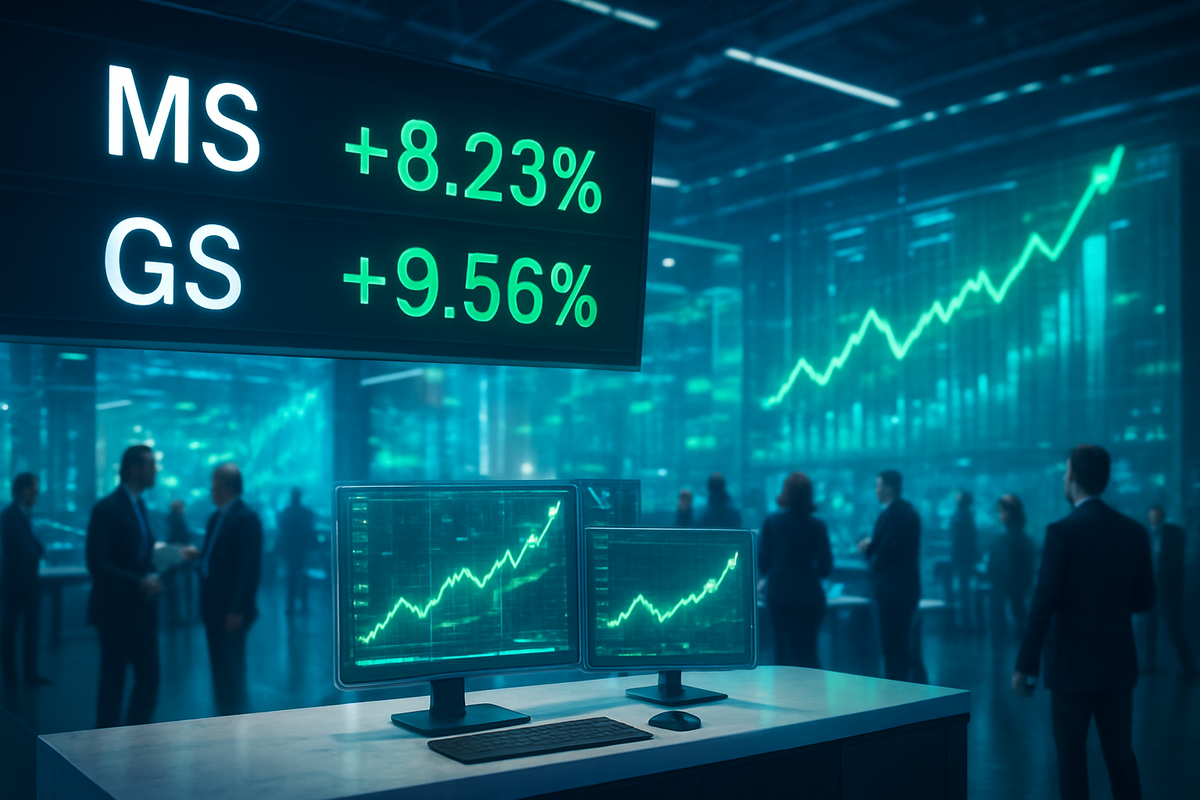
NEW YORK — In a resounding show of resilience, the financial sector powered a significant market rally on Tuesday, March 17, 2026. Leading the charge, shares of investment banking titans Morgan Stanley (NYSE: MS) and Goldman Sachs (NYSE: GS) both surged over 2%, propelling the S&P 500 to its strongest single-day performance since the onset of the "March Oil Shock" earlier this month. The gains signal a growing investor consensus that the banking sector is poised for a robust turnaround despite the geopolitical volatility that has dominated the first quarter of the year.
The recovery comes at a critical juncture for the global economy. After a grueling two weeks of "risk-off" sentiment triggered by escalating tensions in the Middle East and a spike in crude prices, today’s market action suggests that institutional investors are looking past short-term stagflation fears toward a more favorable regulatory and earnings environment. With the Federal Reserve signaling a pause in its rate-cutting cycle and a pivotal vote on banking capital requirements looming later this week, the financial sector has reclaimed its position as the engine of domestic market growth.
A Turnaround Rooted in Resilience and Regulation
The rally on March 17 was catalyzed by a combination of strong technical support levels and a shift in sentiment regarding the "Basel III Endgame" re-proposal. Investors moved aggressively into large-cap banks following reports that the Federal Reserve, scheduled to vote on March 19, would likely finalize a version of the rules that significantly lowers capital requirements for the nation’s largest lenders. This move would effectively free up billions of dollars in capital for share buybacks and increased lending, directly benefiting the bottom lines of Wall Street’s elite.
The timeline leading to today’s surge began in late February 2026, when a geopolitical crisis in the Strait of Hormuz sent Brent crude past $110 per barrel, wiping nearly $6 trillion from global equity values in just seven days. However, the domestic banking sector entered this period from a position of unprecedented strength. In January, Goldman Sachs (NYSE: GS) reported a record-breaking $4.62 billion profit for the final quarter of 2025, while Morgan Stanley (NYSE: MS) saw its investment banking revenue jump by 47% in the same period.
Key stakeholders, including institutional fund managers and private equity firms, have spent the last 48 hours rotating back into financials. The "Great Thaw" in M&A activity, which saw global deal volumes hit a record $5.1 trillion in 2025, appears to be resuming after a brief pause. Market participants are betting that the backlog of "veteran unicorn" IPOs and the ongoing artificial intelligence infrastructure boom will continue to feed the fee-based pipelines of the major investment houses throughout the remainder of 2026.
Winners and Losers in the New Financial Landscape
The primary beneficiaries of Tuesday’s rally are the "Big Two" of investment banking. Goldman Sachs (NYSE: GS) has effectively completed its strategic pivot away from consumer banking, having offloaded its Apple Card portfolio to JPMorgan Chase (NYSE: JPM) earlier this year. This "return to roots" strategy has allowed Goldman to capture the lion's share of the equities trading market, which saw record volumes today. Meanwhile, Morgan Stanley (NYSE: MS) is reaping the rewards of its wealth management dominance, with assets under management (AUM) now hovering at $9.3 trillion—within striking distance of its $10 trillion long-term objective.
Conversely, the landscape remains challenging for some regional players. While the broader Financial Select Sector SPDR Fund (NYSE: XLF) rose 1.8%, smaller institutions represented by the SPDR S&S Regional Banking ETF (NYSE: KRE) saw more modest gains. These banks face continued pressure from the administration’s proposal to cap credit card interest rates at 10%, a move that could severely impact the net interest margins of consumer-heavy lenders. JPMorgan Chase (NYSE: JPM) and Bank of America (NYSE: BAC) have fared better, using their scale to offset these regulatory headwinds through diversified revenue streams in corporate debt writing and global payments.
Fintech disruptors like PayPal (NASDAQ: PYPL) and Block (NYSE: SQ) have seen a more mixed reaction. While they benefit from the general "risk-on" appetite, they remain vulnerable to the higher-for-longer interest rate environment established by the Federal Reserve’s current 3.5% to 3.75% benchmark range. For these companies, the recovery in traditional financials represents both a stabilizing market and a competitive threat as legacy banks accelerate their own digital transformation efforts under the "10-to-1" deregulation initiative.
Analyzing the Wider Significance: Policy and Precedent
Today’s market movement is more than a simple technical bounce; it is a reflection of the "One Big Beautiful Bill Act" (OBBBA) of 2025 reaching full maturity. This sweeping tax reform has simplified individual brackets and incentivized labor through overtime and tip tax exemptions, keeping consumer spending resilient even as energy prices fluctuated. For the financial sector, the act's corporate provisions have streamlined capital deployment, making today’s 2% gains for Morgan Stanley (NYSE: MS) and Goldman Sachs (NYSE: GS) a byproduct of a structurally leaner regulatory environment.
The current trend also mirrors the recovery patterns seen following the 2023 regional banking crisis, but with a significant difference: capital adequacy. Unlike previous cycles where banks were forced into a defensive posture, the class of 2026 is operating with robust balance sheets and a friendly regulatory tailwind. The administration’s "10-to-1" initiative—requiring the repeal of ten regulations for every new one—has specifically targeted compliance costs in the financial sector, allowing banks to pivot from "survival mode" to "growth mode" faster than in any previous recovery in the last two decades.
However, the geopolitical ripple effects cannot be ignored. The "Iran War" shock of early March remains the primary "black swan" on the horizon. If the conflict sustains oil prices at triple digits for an extended period, the resulting inflationary pressure may force the Federal Reserve into a more aggressive stance, potentially derailing the sector's momentum. History suggests that while financial stocks lead the way out of a crisis, they are also the first to feel the chill of a cooling economy.
The Road Ahead: Strategic Pivots and Potential Scenarios
Looking forward, the immediate focus for the market will be the Federal Reserve’s leadership transition. With Chair Jerome Powell’s term expiring in May 2026, the financial sector is closely watching for the nomination of a successor. Candidates like Kevin Hassett are currently favored by prediction markets, and a nomination perceived as "pro-growth" could provide the next major leg up for bank stocks. In the short term, the March 19 Basel III vote remains the most significant binary event for the sector.
Strategically, the major banks are likely to accelerate their M&A activity in the second half of the year. The current administration has reduced the average time from deal announcement to closing by nearly 35%, creating a fertile ground for consolidation. Investors should expect a wave of strategic acquisitions in the AI and fintech space as traditional giants seek to consolidate their technological advantages. The challenge will be navigating the "stagflation" risk if energy prices do not stabilize by the summer.
In a "bull" scenario, a stabilization of oil prices combined with a bank-friendly Basel III outcome could see the XLF reaching new all-time highs by June. Conversely, a "bear" scenario would involve a further escalation of Middle Eastern tensions, forcing the Fed to hike rates again and potentially triggering a credit contraction. For now, the "dealmaking thaw" appears to have survived its first major stress test of the year.
Summary and Investor Outlook
The recovery witnessed on March 17, 2026, marks a pivotal moment for Wall Street. The 2% gains in Morgan Stanley (NYSE: MS) and Goldman Sachs (NYSE: GS) serve as a barometer for a sector that has successfully navigated a period of intense geopolitical and inflationary pressure. The combination of record earnings, regulatory relief, and a robust M&A pipeline has created a "perfect storm" of optimism that has effectively neutralized the bearish sentiment of early March.
Moving forward, the market’s trajectory will be defined by three key factors: the final language of the Basel III capital requirements, the trajectory of crude oil prices, and the identity of the next Federal Reserve Chair. Investors should maintain a watchful eye on these developments while noting that the structural reforms of 2025 have provided the banking sector with a more resilient foundation than at any point in the post-2008 era.
As the second quarter approaches, the financial sector remains the primary indicator of broader market health. While volatility is far from over, today’s rally suggests that the giants of Wall Street are once again ready to lead.
This content is intended for informational purposes only and is not financial advice.