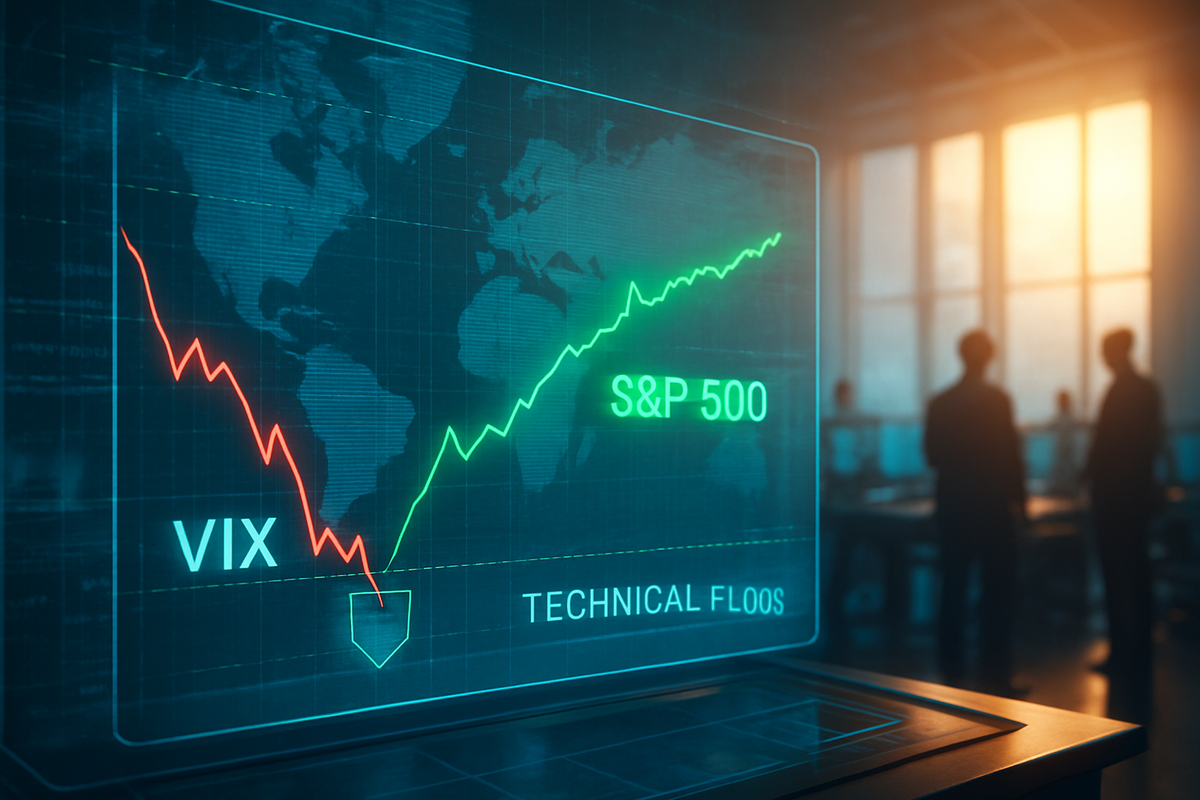
The CBOE Volatility Index (VIX), often referred to as Wall Street’s "fear gauge," experienced a dramatic 13.5% decline on March 10, 2026, signaling a sharp relief rally across global equity markets. This significant contraction in expected volatility follows nearly two weeks of extreme market duress triggered by the onset of "Operation Epic Fury," a joint U.S.-Israeli military campaign against Iranian nuclear and military infrastructure that began in late February. As news of backchannel diplomatic maneuvers and a potential reopening of the Strait of Hormuz reached trading desks, the panic that had gripped the S&P 500 (NYSEARCA:SPY) and the Nasdaq-100 (NASDAQ: QQQ) over the last ten days appeared to hit a definitive exhausted state.
The double-digit drop in the VIX suggests that investors are moving past the "initial shock" phase of the conflict and are beginning to price in a contained, albeit intense, military scenario rather than a prolonged global conflagration. This "thaw" in sentiment coincided with the successful technical defense of the "war low" established on March 6, 2026, providing a much-needed psychological floor for institutional buyers. While the geopolitical landscape remains fraught with uncertainty, the market's response today indicates a pivot from blind panic to a calculated assessment of the "new normal" in the Middle East.
The Catalyst: Diplomacy Amidst the Smoke
The volatility collapse on March 10 was the culmination of a frantic 11-day period that saw the global order shift overnight. The conflict escalated on February 28, 2026, when the U.S. and Israel launched a massive air campaign targeting nearly 900 sites in Iran. The initial market reaction was a "gap down" of historic proportions as Iran retaliated by formally declaring the closure of the Strait of Hormuz—the world’s most critical oil chokepoint. This move pushed West Texas Intermediate (WTI) crude oil to a peak of $120 per barrel, sparking fears of a 1970s-style stagflationary spiral.
By the morning of March 10, however, the narrative began to shift. Reports surfaced that the U.S. Department of Energy had coordinated a massive, multi-national release from Strategic Petroleum Reserves (SPR), which helped bring oil prices back down toward the $90 range. Simultaneously, intelligence reports suggested that the Iranian Assembly of Experts, currently grappling with a leadership vacuum following the reported assassination of Supreme Leader Ayatollah Ali Khamenei during the initial strikes, was entertaining a third-party mediation offer from Switzerland and Oman. These whispers of de-escalation acted as a primary catalyst for the VIX’s 13.5% tumble, as the cost of "tail-risk" protection—insurance against a total market collapse—dropped precipitously.
Initial market reactions saw high-beta technology stocks and AI leaders lead the rebound. Traders noted that the "war low" of March 6—where the S&P 500 briefly touched 6,636—held firm despite overnight threats of further drone strikes on regional energy infrastructure. The "bullish hammer" candle formed on the daily charts of the major indices on March 10 served as a technical signal that the sellers had finally been exhausted, drawing in algorithmic "buy-the-dip" programs that further compressed volatility.
Winners and Losers: The "Peace Trade" Rotation
The primary winners of this sudden volatility crush are the mega-cap technology firms and growth-oriented companies that had been unfairly punished during the flight-to-safety trade. NVIDIA Corporation (NASDAQ: NVDA) and Microsoft (NASDAQ: MSFT) both saw significant gains as investors rotated back into the "artificial intelligence" secular growth theme, gambling that the geopolitical friction would not derail the global digital infrastructure build-out. Similarly, the aerospace and travel sector saw a reprieve; Delta Air Lines (NYSE: DAL) rallied nearly 6% as the prospect of stabilizing fuel costs lowered the immediate threat to its Q1 2026 margins.
On the losing side of this "peace trade" are the traditional safe havens and conflict beneficiaries. Defense contractors like Lockheed Martin (NYSE: LMT) and Northrop Grumman (NYSE: NOC), which had surged 15% since the start of the conflict, saw a mild pullback as the market began to price in the possibility of a shorter, "decapitation-style" conflict rather than a decades-long ground war. More significantly, the Energy Select Sector SPDR Fund (NYSEARCA:XLE) faced selling pressure. While companies like Exxon Mobil Corporation (NYSE: XOM) remain highly profitable at $90 oil, the "war premium" that had driven their stock prices to record highs in early March began to evaporate, leading to a rotation out of energy and back into growth.
Analyzing the Significance: A Return to Fundamentals?
The defense of the "war low" and the massive drop in the VIX represent a critical juncture in the 2026 market cycle. Historically, major geopolitical shocks—from the 1990 invasion of Kuwait to the 2022 invasion of Ukraine—often follow a pattern where the market finds a durable bottom within weeks of the initial kinetic action. Today’s price action suggests that the "maximalist" military goals of the U.S.-Israeli coalition may be viewed by the market as a faster route to regional "clarity" than years of failed nuclear diplomacy.
Furthermore, this event highlights the increasing resilience of the U.S. economy to energy shocks. Unlike the 1970s, the U.S. remains the world’s largest oil producer, and the rapid deployment of the SPR on March 9 showed a more aggressive regulatory stance toward price stabilization. This "policy intervention" has effectively capped the VIX's ability to stay above the 35 level, preventing a full-scale liquidity crisis in the broader financial markets. The "war low" defense also suggests that the institutional appetite for equities remains high, as pension funds and private equity firms view these geopolitical dislocations as generational buying opportunities rather than reasons to exit the market entirely.
What Comes Next: The Long Road to Stability
Looking ahead, the market's focus will likely shift from the front lines in the Persian Gulf to the Bureau of Labor Statistics. The March 11 Consumer Price Index (CPI) report looms large; if the spike in energy prices during early March is shown to have "leaked" into broader core inflation, the Federal Reserve may be forced to keep interest rates higher for longer, potentially creating a "double bottom" scenario for the S&P 500 later this spring. Investors should expect a "sawtooth" recovery—a period of high, albeit declining, volatility where the VIX settles into a new, higher range of 18-22 rather than returning to the pre-war lows of 12-14.
Strategic pivots will be required for those heavily hedged. If the diplomatic backchannels prove successful and the Strait of Hormuz is officially reopened by late March, the "fear trade" will unwind entirely, potentially fueling a massive "short squeeze" in tech and discretionary stocks. However, any sudden escalation—such as a direct Iranian strike on a major desalination plant in the Gulf—could send the VIX screaming back toward 40. The current opportunity lies in the "middle ground": sectors like cybersecurity and renewable energy, which benefit from both the immediate conflict and the long-term strategic shift away from Middle Eastern instability.
Conclusion: Market Resilience in the Face of Conflict
The 13.5% drop in the VIX on March 10, 2026, serves as a testament to the market's remarkable ability to digest even the most extreme geopolitical trauma. By successfully defending the "war low," the major indices have signaled that the "peak fear" associated with the initial Iranian conflict has likely passed. Investors have moved from a state of paralysis to one of opportunistic repositioning, favoring growth and stability over the raw volatility of the energy and defense sectors.
Moving forward, the durability of this recovery depends on two factors: the continued cooling of oil prices and the lack of further "black swan" escalations in the Middle East. While the "fear gauge" has retreated, the underlying risks remain historically elevated. Investors should watch the $85-90 level in WTI crude and the 200-day moving average on the S&P 500 as the key markers for the next phase of this market cycle. For now, the "war low" holds, and the bulls have reclaimed the narrative in a display of resilience that few would have predicted just ten days ago.
This content is intended for informational purposes only and is not financial advice.