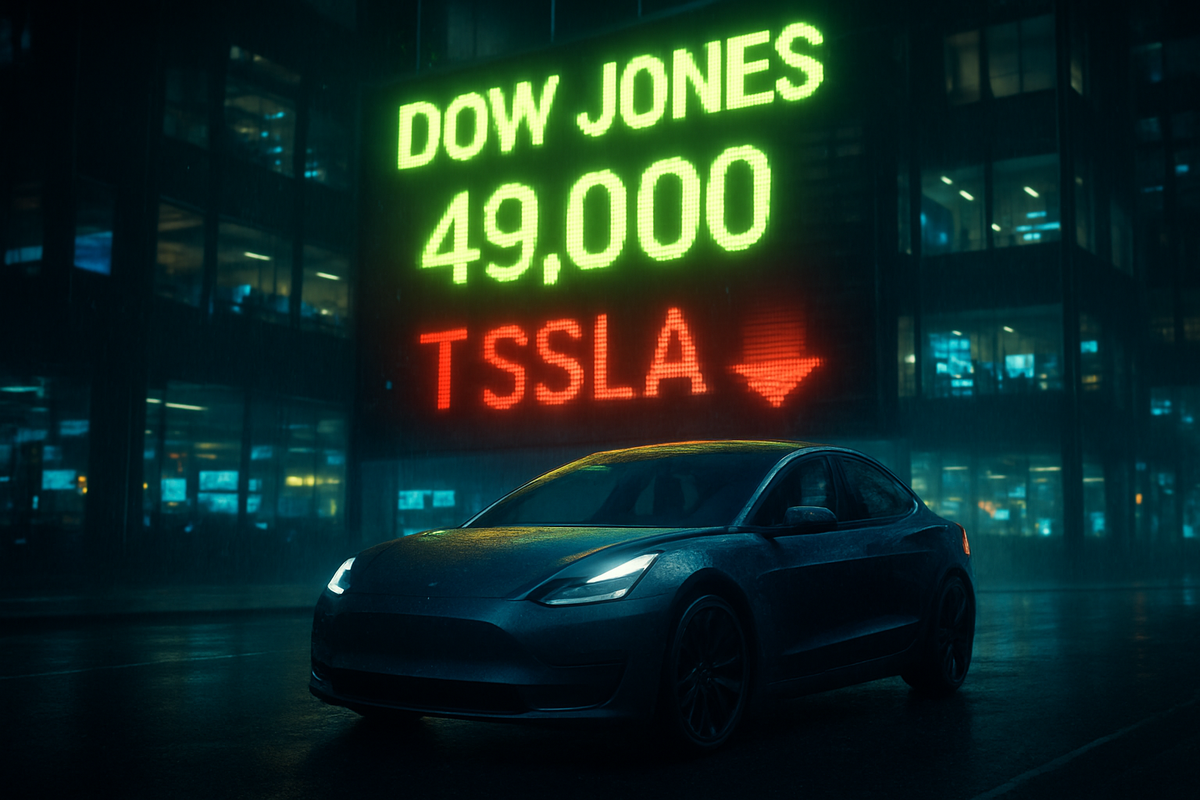
In a session characterized by exuberant record-breaking across major indices, Tesla Inc. (NASDAQ: TSLA) found itself an outlier today, January 6, 2026. As the Dow Jones Industrial Average (INDEXDJX: .DJI) surged past the historic 49,000 mark, Tesla’s stock struggled to find its footing, weighed down by a sobering delivery report and a shifting geopolitical landscape that favored traditional energy sectors over the electric vehicle (EV) pioneer.
The divergence highlights a growing rift between the "risk-on" sentiment lifting the broader market and the specific fundamental challenges facing Tesla. While investors celebrated a massive rally in energy and industrials, the EV leader faced a "demand vacuum" following the expiration of federal tax credits and intensifying global competition. The day's trading underscored a critical pivot for Tesla, as its identity as a high-volume automaker continues to clash with its high-multiple valuation as an artificial intelligence and robotics firm.
A Tale of Two Tapes: Record Highs vs. Delivery Lows
The primary catalyst for today’s market surge was a major geopolitical shift involving the capture of Venezuelan leader Nicolás Maduro, an event that sent shockwaves through the energy sector. Investors flocked to companies like Chevron (NYSE: CVX) and Halliburton (NYSE: HAL), betting on the eventual opening of Venezuelan oil reserves to U.S. investment. This rotation drove the S&P 500 (INDEXSP: .INX) and the Nasdaq Composite (INDEXNASDAQ: .IXIC) up by approximately 0.65%, even as Tesla shares fluctuated wildly, ultimately trending downward in afternoon trading.
The downward pressure on Tesla stems from its Q4 2025 delivery figures, released just days ago. The company reported delivering 418,227 vehicles for the final quarter of 2025, a 15.6% decline compared to the same period in 2024. This brought the full-year 2025 total to roughly 1.64 million units—a 9% year-over-year drop. This marks the second consecutive year of declining sales for the company, a trend that has rattled long-term bulls who once expected consistent 50% annual growth.
Initial market reactions were mixed, with some analysts attempting to frame the results as "better than feared" given the macroeconomic headwinds. However, the reality of a "demand vacuum" became undeniable as the session progressed. The expiration of the $7,500 federal EV tax credit in the U.S. at the end of 2025 had pulled significant demand forward into the third and fourth quarters of last year, leaving the order book for early 2026 looking remarkably thin.
Winners and Losers in a Shifting Landscape
The clear winners in today’s session were the "Old Economy" giants. Chevron (NYSE: CVX) saw its stock jump over 5% as the prospect of a political transition in Venezuela promised new exploration opportunities. Similarly, industrial and energy services firms benefited from a rotation out of mega-cap tech laggards and into sectors poised to gain from geopolitical stability and lower energy costs.
On the losing side, Tesla’s decline has cast a shadow over the broader EV sector. Competitors like Rivian Automotive (NASDAQ: RIVN) and Lucid Group (NASDAQ: LCID) also faced selling pressure as the market questioned the viability of pure-play EV manufacturers in a post-subsidy environment. Perhaps most significantly, 2026 has solidified the dominance of BYD Co. Ltd. (OTC: BYDDY), which officially surpassed Tesla as the world’s largest BEV manufacturer by volume in 2025. BYD’s aggressive global expansion and more diverse, affordable product lineup have allowed it to weather the global slowdown more effectively than Tesla’s aging Model 3 and Model Y fleet.
Furthermore, traditional automakers like Ford Motor Company (NYSE: F) and General Motors (NYSE: GM) have seen a stabilization in their stock prices as they pivot back toward hybrid models, which have gained favor among consumers wary of the infrastructure challenges and the loss of EV incentives. Tesla’s refusal to enter the hybrid market has left it uniquely exposed to the current lull in pure electric adoption.
The Significance of Brand Fatigue and Strategic Pivots
The current pressure on Tesla is not merely a matter of delivery numbers; it is a reflection of a complex intersection of politics and product strategy. CEO Elon Musk’s high-profile involvement in the Trump administration, specifically his role leading the Department of Government Efficiency (DOGE), has created a polarizing brand image. Market data from early 2026 suggests this political alignment has alienated a segment of Tesla’s traditional customer base in liberal-leaning U.S. states and European markets, contributing to what some analysts call "brand fatigue."
Historically, Tesla has relied on its technological lead to maintain premium pricing. However, as of early 2026, its product lineup is seen as increasingly stagnant. The "stripped-down" affordable versions of the Model 3 released in late 2025 have yet to achieve the mass-market penetration needed to offset the decline in higher-margin sales. This has forced a valuation crisis: nearly 45% of Tesla’s current market cap is derived from its future potential in autonomous "Cybercabs" and the Optimus robotics program.
This event fits into a broader industry trend where the "first-mover advantage" in EVs has largely evaporated. The market is now rewarding execution and product variety over visionary promises. The regulatory environment is also shifting; with the expiration of U.S. tax credits, the industry is entering a "survival of the fittest" phase where manufacturing efficiency and cost control are the only sustainable paths to profitability.
What Lies Ahead for the EV Leader
Looking forward, Tesla faces a precarious path. In the short term, the company must prove that its Full Self-Driving (FSD) software can reach a level of reliability that justifies its massive AI-based valuation. A successful rollout of a dedicated Robotaxi fleet in select markets could decouple the stock from its automotive manufacturing woes. However, any further delays in this technology could lead to a significant "re-rating" of the stock toward traditional automotive multiples, which would imply a substantial downside from current levels.
Long-term, Tesla may be forced into a strategic pivot, potentially accelerating the development of a truly low-cost "Model 2" or expanding its energy storage business, which remains a bright spot in its portfolio. The energy division has shown resilient growth, and some investors argue that Tesla’s future lies more in becoming a decentralized utility and AI provider than a car company.
The potential for a "strategic reset" is high. If Tesla cannot reinvigorate its vehicle demand by mid-2026, the board may face increasing pressure to separate the automotive business from the AI and robotics divisions to unlock shareholder value. Market participants will be watching closely for any signs of a "Model 2" prototype or a breakthrough in 4680 battery cell production costs that could restore the company’s competitive edge.
Summary and Investor Outlook
Today’s session serves as a stark reminder of the challenges facing Tesla as it navigates a post-subsidy world. While the broader market celebrates new highs driven by geopolitical shifts and energy prospects, Tesla is grappling with an identity crisis. The key takeaways from today are clear: the "demand vacuum" is real, the competitive threat from China is intensifying, and the company's valuation is increasingly dependent on unproven AI technologies.
Moving forward, the market is likely to remain bifurcated. Investors should watch for the Q1 2026 earnings report, which will reveal the full impact of the tax credit expiration on Tesla's margins. The critical metrics to monitor will be FSD take-rates and the scaling of the energy storage business.
Ultimately, Tesla remains a high-stakes bet on the future of autonomy. While the broader market's "risk-on" mood provides a temporary cushion, the fundamental pressure on the core automotive business cannot be ignored. Investors must decide whether they are buying a struggling car company or a revolutionary AI powerhouse—a distinction that will define Tesla’s trajectory for the remainder of 2026.
This content is intended for informational purposes only and is not financial advice.