

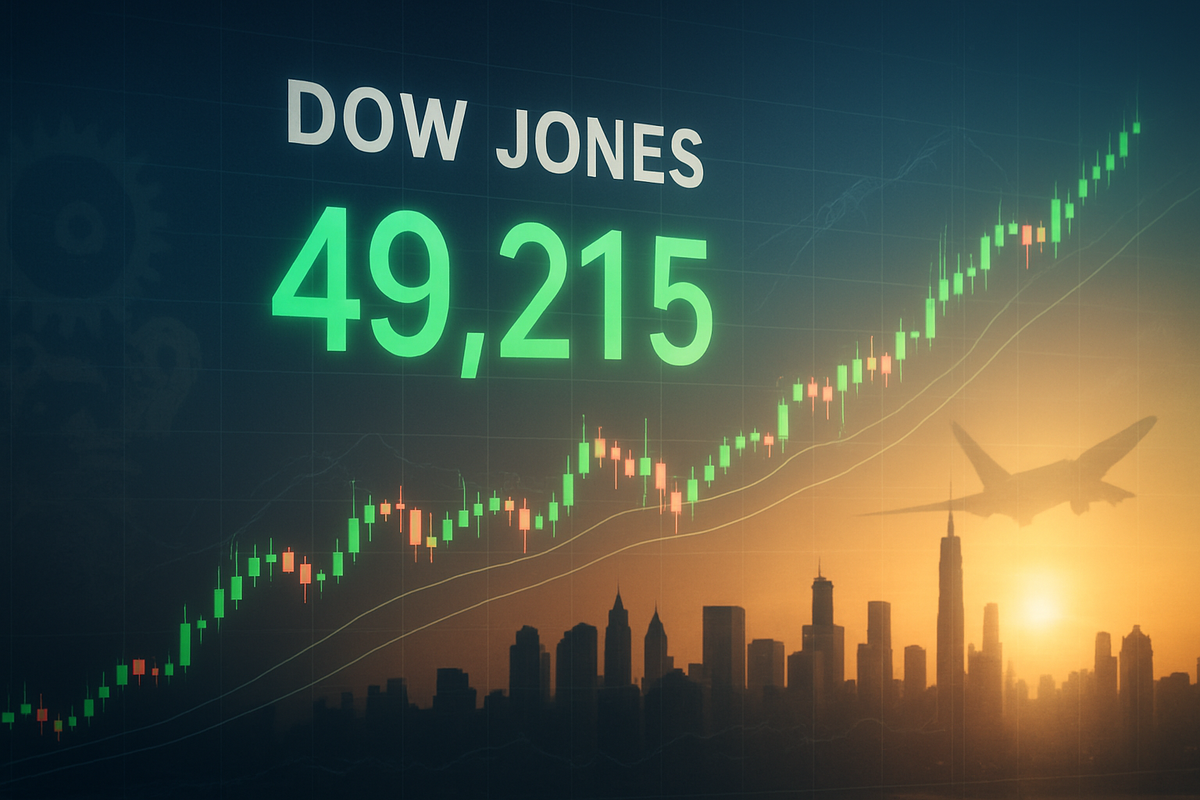
The Dow Jones Industrial Average (NYSE: ^DJI) has officially entered uncharted territory, surging past critical resistance levels to reach a new all-time high of 49,215 in the opening days of 2026. This technical breakout marks a decisive shift in market leadership, as investors pivot away from the high-growth volatility of the tech sector and into the seasoned stability of industrial and financial giants. The move above the 49,000 handle is not merely a psychological victory; it represents a fundamental validation of the "soft landing" narrative that dominated economic discourse throughout 2025.
As of January 6, 2026, the index’s trajectory suggests that the long-awaited 50,000-point milestone is no longer a distant dream but a likely short-term target. Technical indicators across the board—from Relative Strength Index (RSI) readings to moving average convergences—signal that while the market is "hot," the underlying structure of this rally remains remarkably robust. For the broader market, this breakout serves as a beacon of confidence, suggesting that the industrial backbone of the U.S. economy is prepared to lead the next leg of the secular bull market.
The Path to 49,000: A Timeline of Resilience
The journey to this historic peak began in mid-2025, when the Dow established a broad ascending channel that acted as a guide-rail for steady, incremental gains. However, the path was not without its hurdles. Throughout the final quarter of 2025, the index faced significant resistance near the 48,500 level, forming what technical analysts described as a "double top" pattern—a formation that often precedes a reversal. Market sentiment wavered in late December when a traditional "Santa Claus rally" failed to materialize, leading to a four-day losing streak that saw the index retreat toward its 50-day Simple Moving Average (SMA).
The tide turned during the first trading session of 2026. On January 2nd, a surge in buying pressure, catalyzed by better-than-expected manufacturing data and cooling inflationary prints, propelled the Dow back toward its resistance zone. By January 5th, the index decisively broke above the 48,500 ceiling, triggering a wave of short-covering and algorithmic "buy" orders. This momentum carried into January 6th, as the index climbed over 300 points to settle comfortably above 49,200. Key stakeholders, including institutional pension funds and retail investors rebalancing their portfolios for the new year, have been instrumental in providing the liquidity necessary for this breakout.
Initial market reactions have been overwhelmingly positive, though tempered by caution regarding the speed of the ascent. The Federal Reserve's hinted trajectory toward a policy rate of 3.00%–3.25% by the end of 2026 has provided the necessary "Goldilocks" environment—low enough to stimulate growth but high enough to keep the specter of hyper-inflation at bay.
Winners and Losers in the New Market Regime
The current breakout is characterized by a "rotation of the guard." Leading the charge are heavyweights in the industrial and aerospace sectors. Boeing (NYSE: BA) and Caterpillar (NYSE: CAT) have emerged as the primary engines of the Dow’s recent performance, benefiting from a resurgence in global infrastructure spending and a stabilized supply chain. Boeing, in particular, has seen its stock price buoyed by a series of major international contracts signed in late 2025, while Caterpillar continues to reap the rewards of domestic energy transition projects.
Financial institutions are also standing in the winner's circle. Goldman Sachs (NYSE: GS) and UnitedHealth Group (NYSE: UNH) have seen increased inflows as the steepening yield curve improves net interest margins and healthcare spending remains a resilient pillar of the economy. These "Value" components of the Dow are currently outperforming the high-multiple "Growth" stocks that dominated the previous two years, as investors seek out companies with strong cash flows and sustainable dividends.
Conversely, the tech-heavy components that previously buoyed the index are seeing more nuanced performance. While Nvidia (NASDAQ: NVDA) and Micron Technology (NASDAQ: MU) remain critical to the Dow’s technical health due to their role in the AI-industrial complex, they are no longer the sole drivers of the market. Companies with extreme valuations that lack a clear path to profitability in a "higher-for-longer" interest rate environment are finding themselves sidelined. The breakout in the Dow, which is price-weighted, highlights how a few high-priced industrial stocks can exert more influence than a dozen mid-cap tech firms.
Wider Significance and Historical Context
This breakout fits into a broader industry trend of "re-industrialization" in the United States. After a decade dominated by software and digital services, the 2026 market is placing a premium on "atoms over bits." The surge in the Dow reflects a massive capital reallocation toward domestic manufacturing, energy independence, and logistical infrastructure. This shift has significant ripple effects on competitors and partners alike, as the "Dow 50,000" chase forces global fund managers to increase their exposure to U.S. blue-chip equities, potentially at the expense of emerging markets or speculative tech.
Historically, the Dow’s crossing of major psychological barriers has often been followed by periods of heightened volatility as the market "digests" its gains. Similar to the crossing of 10,000 in 1999 or 30,000 in 2020, the move past 49,000 is likely to invite a tug-of-war between bulls and bears. However, unlike the dot-com bubble, the current rally is supported by a 14-day RSI of 67.9, which, while approaching "overbought" territory (above 70), suggests there is still room for momentum to carry the index higher before a meaningful correction occurs.
From a policy standpoint, the breakout validates the current administration's focus on industrial policy and the Federal Reserve's delicate handling of interest rates. However, it also raises questions about market concentration and whether the Dow's success is masking underlying weaknesses in smaller-cap stocks that are not part of the 30-stock average.
What Comes Next: The Road to 50,000 and Beyond
In the short term, the market is eyeing the 50,000 psychological milestone as the next major hurdle. Technical analysts point to a Fibonacci extension level at 49,300 as the immediate resistance to clear. If the Dow can hold the 48,800–49,000 range as a new support floor—a classic "break-and-retest" maneuver—the path to 50,000 could be cleared before the end of the first quarter of 2026.
Strategic pivots will be required for investors who have spent the last three years heavily weighted in tech. The emergence of a "structural bull market" in industrials suggests that a diversified approach, focusing on companies with tangible assets and pricing power, will be the winning strategy for the remainder of 2026. However, challenges remain. Any sudden geopolitical flare-up or a reversal in the downward trend of inflation could force the Federal Reserve to pause its rate-cut cycle, which would likely send the Dow back into its previous consolidation zone.
Final Assessment: A Milestone in the Making
The technical breakout of the Dow Jones Industrial Average is a watershed moment for the 2026 financial landscape. It signals a return to fundamentals, where earnings growth, industrial output, and fiscal stability take center stage. The index’s ability to shatter record highs despite the volatility of the previous year is a testament to the resilience of the U.S. economy and the strategic rotation of capital into high-quality assets.
Moving forward, investors should watch for the Dow’s behavior at the 50,000 level and monitor the RSI for signs of exhaustion. While the current momentum is undeniably bullish, the gap between the index and its 200-day SMA (~48,147) suggests that a "healthy" pullback to retest support levels would be a welcome development for the long-term sustainability of the rally. For now, the Dow is the undisputed leader of the market, and its breakout into new record territory is a signal that the blue-chip bull still has plenty of room to run.
This content is intended for informational purposes only and is not financial advice