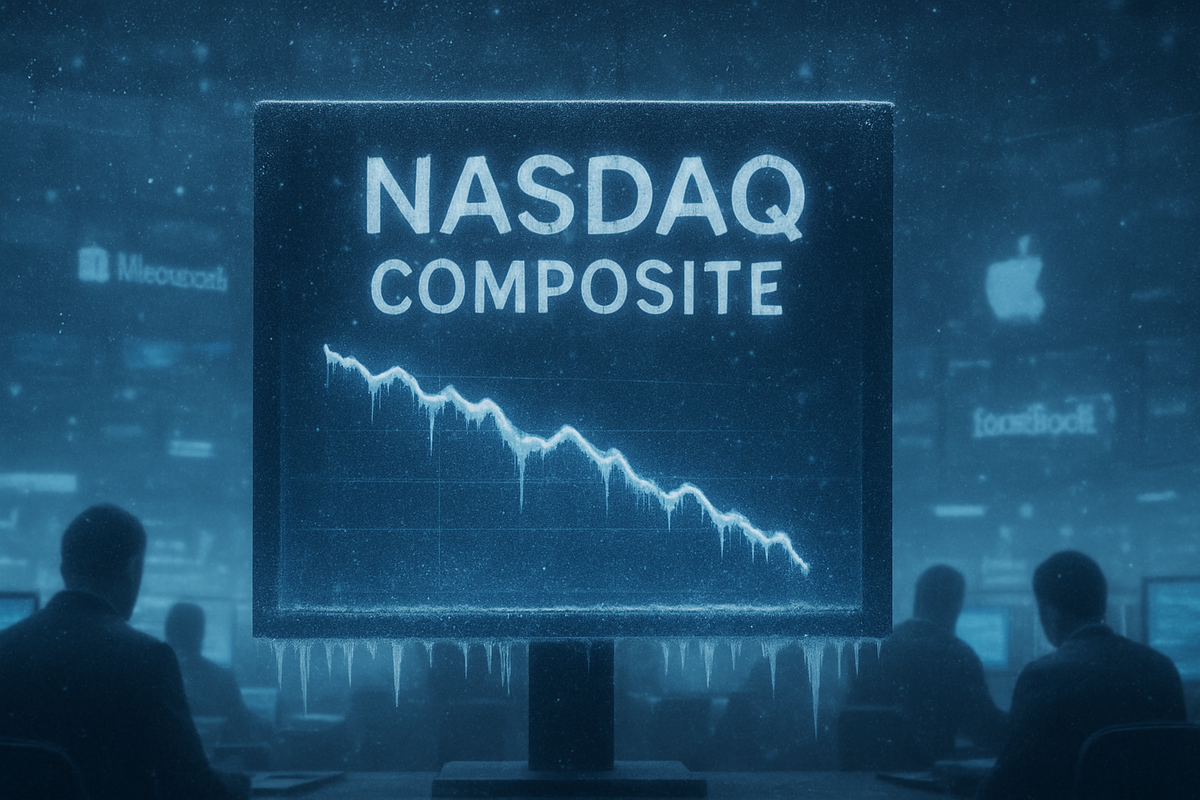
As the clock struck midnight on New Year’s Eve, the usual celebratory atmosphere on Wall Street was replaced by a palpable sense of unease. The tech-heavy Nasdaq Composite, which had spent much of 2025 riding the highs of an artificial intelligence "supercycle," ended the year not with a bang, but with a whimper. The traditional "Santa Claus rally"—the reliable year-end surge that typically lifts equities during the final five trading days of December and the first two of January—failed to materialize for the third consecutive year, leaving investors to grapple with a stagnant market as they enter the first week of 2026.
This lack of momentum is more than just a seasonal anomaly; it is a signal of "technical exhaustion" in a sector that has been the primary engine of global growth. With the Nasdaq struggling to maintain its footing after a late-December sell-off, the failure of the rally suggests that the "AI fever" which defined the previous 24 months may finally be breaking. As the market opens for 2026, the absence of year-end cheer has set a cautious tone for a year already clouded by leadership transitions at the Federal Reserve and growing skepticism regarding the return on investment for massive tech expenditures.
The 2025 holiday season was characterized by what analysts are calling the "Santa Stall." Historically, the Santa Claus rally delivers an average gain of about 1.3% to the S&P 500 and even more to the growth-oriented Nasdaq. However, in the window spanning December 24, 2025, to January 2, 2026, the Nasdaq Composite saw a decline of nearly 1%, while the S&P 500 dropped approximately 0.6%. This marks a significant departure from historical norms and serves as a sobering reminder of the market's current fragility.
The timeline of this downturn began in mid-December following the Federal Reserve’s final meeting of 2025. While the Fed lowered the benchmark rate to a range of 3.50%–3.75%, the accompanying commentary was unexpectedly hawkish. Fed officials signaled a "cautious normalization" for 2026, suggesting that further cuts might be paused to combat persistent inflation that remains stubbornly above the 2% target. This news triggered a wave of profit-taking, particularly in the semiconductor and software sectors, which had seen double-digit gains earlier in the year.
Key institutional players, including JPMorgan Chase & Co. (NYSE: JPM) and Morgan Stanley (NYSE: MS), had already begun warning of "extreme crowding" in the "Magnificent 7" stocks. By the final week of December, the selling pressure intensified as institutional funds rebalanced their portfolios, shifting away from high-multiple tech stocks and toward defensive sectors. This internal rotation effectively neutralized any retail-driven holiday buying, leaving the Nasdaq pinned below its all-time highs of approximately 26,283.
The primary victims of this lack of momentum are the "hyperscalers" and semiconductor giants that have led the market since 2023. Nvidia (NASDAQ: NVDA), the poster child for the AI revolution, saw its shares wobble in late December as investors questioned whether the demand for its next-generation Blackwell chips could continue at its current "off the charts" pace. Similarly, Microsoft (NASDAQ: MSFT) and Alphabet (NASDAQ: GOOGL) faced headwinds as the market shifted its focus from AI potential to tangible revenue. With these companies projected to spend over $527 billion on AI infrastructure in 2026, any sign of slowing growth is met with immediate skepticism.
On the other hand, the "Santa Stall" may provide a silver lining for value-oriented and defensive companies. As capital rotates out of tech, sectors like healthcare and consumer staples are seeing renewed interest. Companies such as UnitedHealth Group (NYSE: UNH) and Procter & Gamble (NYSE: PG) could emerge as "winners" in the early months of 2026 as investors seek shelter from the volatility of the Nasdaq. Furthermore, mid-cap stocks that were overshadowed by the AI giants in 2025 may finally find room to breathe if the market's concentration begins to diversify.
However, for the broader tech sector, the implications are stark. Startups and secondary AI players, which have been commanding valuations of 10x to 100x revenue, are now facing a "funding winter" as the public market's appetite for risk wanes. Meta Platforms (NASDAQ: META) and Amazon (NASDAQ: AMZN), while still fundamentally strong, are under increased pressure to prove that their massive capital expenditures are translating into bottom-line efficiency rather than just infrastructure bloat.
The failure of the 2025 Santa Claus rally is a significant indicator of a shift in the broader market cycle. Historically, when the rally fails, the subsequent three months often see a loss of around 1.0%, effectively dampening the "January Effect." This trend is particularly concerning given the historical precedents of 1993–1994 and 2015–2016, where consecutive rally failures preceded periods of significant macroeconomic stress and flat market performance.
This event fits into a wider trend of "AI spending fatigue." After two years of aggressive investment, approximately 95% of enterprises have yet to extract meaningful value from their AI implementations. This disconnect between spending and utility is creating a "fragile equilibrium" in the market. If 2024 was the year of AI hype and 2025 was the year of AI infrastructure, 2026 is shaping up to be the year of the "AI ROI Audit."
Furthermore, the market is facing a unique regulatory and policy hurdle. Federal Reserve Chair Jerome Powell’s term is set to expire in May 2026. The uncertainty surrounding his successor, combined with a softening labor market and persistent inflation, has created a "wait-and-see" environment. This policy vacuum is contributing to the lack of conviction among investors, as the "Fed Put"—the idea that the central bank will always step in to support the market—is no longer a certainty.
Looking ahead to the first quarter of 2026, the Nasdaq faces a challenging road to recovery. In the short term, the market will likely remain range-bound as it awaits the Q4 2025 earnings season. Investors will be scrutinizing the guidance provided by the tech giants, looking for any indication that AI demand is cooling. A "strategic pivot" may be required for many tech firms, shifting their narrative from "growth at all costs" to "profitable efficiency" to appease a more skeptical shareholder base.
In the long term, the absence of year-end momentum could lead to a healthy, albeit painful, correction. If the AI bubble—currently drawing comparisons to the dot-com era—does not burst, it will at least need to deflate to more sustainable levels. Market opportunities may emerge in "AI application" companies—those that use the existing infrastructure to solve specific industry problems—rather than the "AI plumbing" companies that have dominated the charts thus far.
Potential scenarios for 2026 include a "flat year" where the Nasdaq trades sideways as the economy digests the rate hikes and tech spending of previous years. Alternatively, if the labor market continues to soften and the Fed remains sidelined by the leadership transition, a more pronounced bearish trend could take hold by mid-year.
The failure of the 2025 Santa Claus rally serves as a clear warning that the easy gains of the AI era may be behind us. The key takeaways for the start of 2026 are clear: technical exhaustion is real, AI spending is under the microscope, and the Federal Reserve’s "higher for longer" stance on interest rates is continuing to weigh on growth stocks. The Nasdaq's inability to find its footing during the traditionally bullish holiday window suggests that the market is entering a phase of consolidation and re-evaluation.
Moving forward, the market will be driven by data rather than sentiment. Investors should keep a close watch on two primary factors: the upcoming Q4 earnings reports from the "Magnificent 7" and the rumors surrounding the next Federal Reserve Chair. These will be the true catalysts for 2026. While the absence of Santa Claus on Wall Street this year is disappointing, it may ultimately lead to a more disciplined and resilient market in the long run. For now, however, the tech sector remains in the grip of a winter chill that shows no signs of thawing.
This content is intended for informational purposes only and is not financial advice.