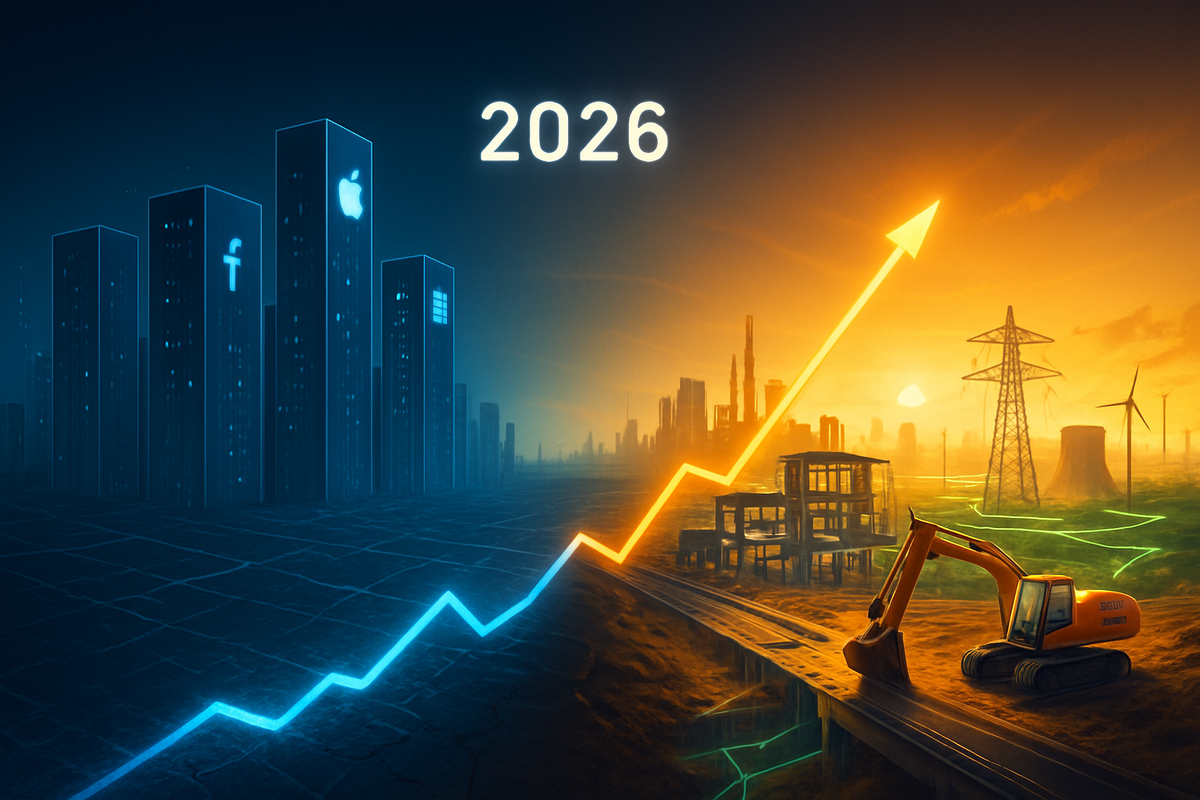
The dawn of 2026 has brought a stark realization for Wall Street: the era of "growth at any price" dominated by a handful of silicon giants is under siege. As the first trading sessions of the new year unfold, a dramatic divergence has emerged between the long-reigning "Magnificent Seven" and the broader market. While the tech-heavy Nasdaq-100 has stumbled out of the gate with a five-session losing streak, the Russell 2000 and the S&P 500 Equal Weight index are surging to new heights, signaling a profound "Great Rotation" that many analysts believe could define the investment landscape for the next decade.
This shift is not merely a technical correction but a fundamental re-evaluation of value. Investors are increasingly rotating capital out of overextended mega-cap stocks and into the "Impressive 493"—the often-overlooked components of the S&P 500 that are finally reaping the benefits of U.S. reshoring, a stabilizing interest rate environment, and the tangible, "blue-collar" application of artificial intelligence. As of January 2, 2026, the market is no longer a monolithic entity led by a few; it has become a bifurcated arena where physical infrastructure and domestic industrials are the new champions.
The Cracks in the Magnificent Seven
The primary catalyst for this divergence is a combination of "AI fatigue" and a series of high-profile regulatory and operational setbacks for the tech elite. Tesla (NASDAQ: TSLA) set a somber tone for the group, reporting 2025 vehicle deliveries of just 1.63 million units—a 9% decline from the previous year—sending its shares tumbling nearly 3% on the first day of 2026 trading. Meanwhile, Amazon (NASDAQ: AMZN) and Meta Platforms (NASDAQ: META) have faced sharp retreats as the "January Effect" failed to materialize for consumer-facing tech, with investors questioning the return on investment for the collective $400 billion in capital expenditures poured into AI infrastructure over the last two years.
The timeline leading to this moment was paved with mounting skepticism throughout late 2025. As the Federal Reserve entered a "hawkish easing" cycle, targeting a terminal rate of 3.25% to 3.50%, the high-multiple valuations of Big Tech began to look increasingly fragile compared to the "catch-up trade" in small caps. The Russell 2000, which entered 2026 trading at a forward P/E of roughly 15x—a significant discount to the S&P 500’s 22x—has become the primary beneficiary of this capital flight, hitting an all-time high of approximately 2,590 in early January.
Regulatory pressures have also reached a "Year of Reckoning." Alphabet (NASDAQ: GOOGL) officially entered its court-mandated "remedy phase" this month following its search monopoly ruling. The tech giant is now legally barred from exclusive default search agreements and must implement "choice screens" on U.S. devices. Similarly, Apple (NASDAQ: AAPL) is bracing for a landmark $7 billion consumer class action trial set to begin in February 2026, focusing on its App Store commission structure. These structural headwinds have stripped the Magnificent Seven of their status as "safe haven" assets, forcing institutional investors to look elsewhere for growth.
Winners and Losers of the New Regime
The clear winners in this shifting landscape are companies tied to the physical expansion of the U.S. economy. In the industrials sector, Caterpillar (NYSE: CAT) has emerged as a top performer, with its Energy & Transportation segment now accounting for nearly half of its revenue, fueled by the insatiable demand for data center construction and domestic mining. Eaton (NYSE: ETN) and GE Vernova (NYSE: GEV) are also seeing record backlogs as they act as the "backbone of the grid," providing the electrical switchgear and transformers necessary for the electrification of American factories.
The utilities sector has undergone a radical transformation from a defensive "bond proxy" to a growth-oriented powerhouse. NextEra Energy (NYSE: NEE) is leveraging its massive renewable portfolio to meet the carbon-neutral mandates of tech hyperscalers, while Vistra Corp (NYSE: VST) and Constellation Energy (NYSE: CEG) are outperforming due to a "nuclear renaissance" that provides reliable baseload power to AI clusters. Smaller players like Oklo Inc. (NYSE: OKLO) are also finding strength as their small modular reactors (SMRs) offer a way for data centers to bypass the multi-year utility interconnection queues.
Conversely, the losers are those caught in the crosshairs of valuation resets and antitrust litigation. Beyond the aforementioned struggles of Tesla and Alphabet, Amazon (NASDAQ: AMZN) is facing a looming October 2026 trial regarding "Project Nessie," an algorithm the FTC alleges was used to manipulate prices. Even Nvidia (NASDAQ: NVDA), while still a favorite for AI hardware, has experienced heightened volatility as investors move from "growth at any price" to a "show me the money" sentiment regarding the actual ROI of the chips being deployed.
Wider Significance and the 'Blue-Collar AI' Trend
This event fits into a broader industry trend where the "digital gold rush" is giving way to the "physical infrastructure boom." The significance of this rotation cannot be overstated; it represents a move toward "Blue-collar AI"—the application of artificial intelligence to manufacturing, logistics, and energy management, rather than just consumer apps and advertising. This shift is bolstered by the "One Big Beautiful Bill Act" (OBBBA) of 2025, which extended 100% bonus depreciation for domestic manufacturing investments, creating a powerful incentive for companies to reshore operations.
The ripple effects are being felt across the financial sector as well. JPMorgan Chase (NYSE: JPM) and Goldman Sachs (NYSE: GS) are seeing a surge in debt issuance for data center capex and a rejuvenated IPO pipeline, which is expected to include major 2026 targets like SpaceX or OpenAI. This suggests that while the secondary market for existing tech giants is cooling, the primary market for new, infrastructure-focused ventures is heating up.
Historically, this divergence mirrors the "Post-Dotcom" era of the early 2000s, where the broader market recovered while the previous decade's tech darlings spent years in a horizontal churn. The difference in 2026 is the speed of the rotation, driven by the immediate and massive energy and hardware requirements of the AI revolution, which are favoring the "Impressive 493" over the software-centric leaders of the past.
What Comes Next: Strategic Pivots and Scenarios
In the short term, the market is likely to remain bifurcated. We may see a "valuation floor" established for the Magnificent Seven as they become value plays in their own right, but the leadership mantle has clearly passed. Companies like Apple and Alphabet will likely be forced into strategic pivots, potentially spinning off business units or adopting more open-ecosystem models to satisfy regulators and reignite investor interest.
A potential scenario for the remainder of 2026 involves a "broadening out" where mid-cap stocks in the healthcare and financial sectors join the rally. SoFi Technologies (NASDAQ: SOFI), for instance, has transitioned into a profitable powerhouse and is targeting millions of new members as it expands into high-margin fintech services. If the Fed continues its easing cycle without reigniting inflation, the "Goldilocks" environment could sustain this rotation for several quarters, allowing the Russell 2000 to close the valuation gap with the S&P 500.
However, challenges remain. Any resurgence in inflation (currently at 2.7%) could force the Fed to pause its rate cuts, which would disproportionately hurt the smaller, floating-rate-debt-heavy companies that are currently leading the charge. Investors should also watch for the "harvest phase" of AI—if the companies buying Nvidia’s chips cannot prove they are generating revenue from them by mid-2026, the entire sector could face a secondary, more painful correction.
Summary and Market Outlook
The "Great Rotation" of early 2026 marks a definitive end to the era of Big Tech exceptionalism. The key takeaways are clear: valuation matters, regulatory risks are no longer theoretical, and the physical requirements of the AI era are creating a new class of industrial and utility winners. The market is moving from a concentrated bet on a few software giants to a diversified play on the rebuilding of the American industrial base.
Moving forward, the market appears healthy despite the stagnation in the major indices. The broadening of participation is a classic sign of a maturing bull market, rather than a dying one. Investors should shift their focus from "Magnificent" to "Material," watching closely for earnings growth in the industrial and energy sectors. The next few months will be critical in determining if the "Impressive 493" can carry the torch or if the gravitational pull of a tech slowdown will eventually drag the entire market into a deeper consolidation.
This content is intended for informational purposes only and is not financial advice.