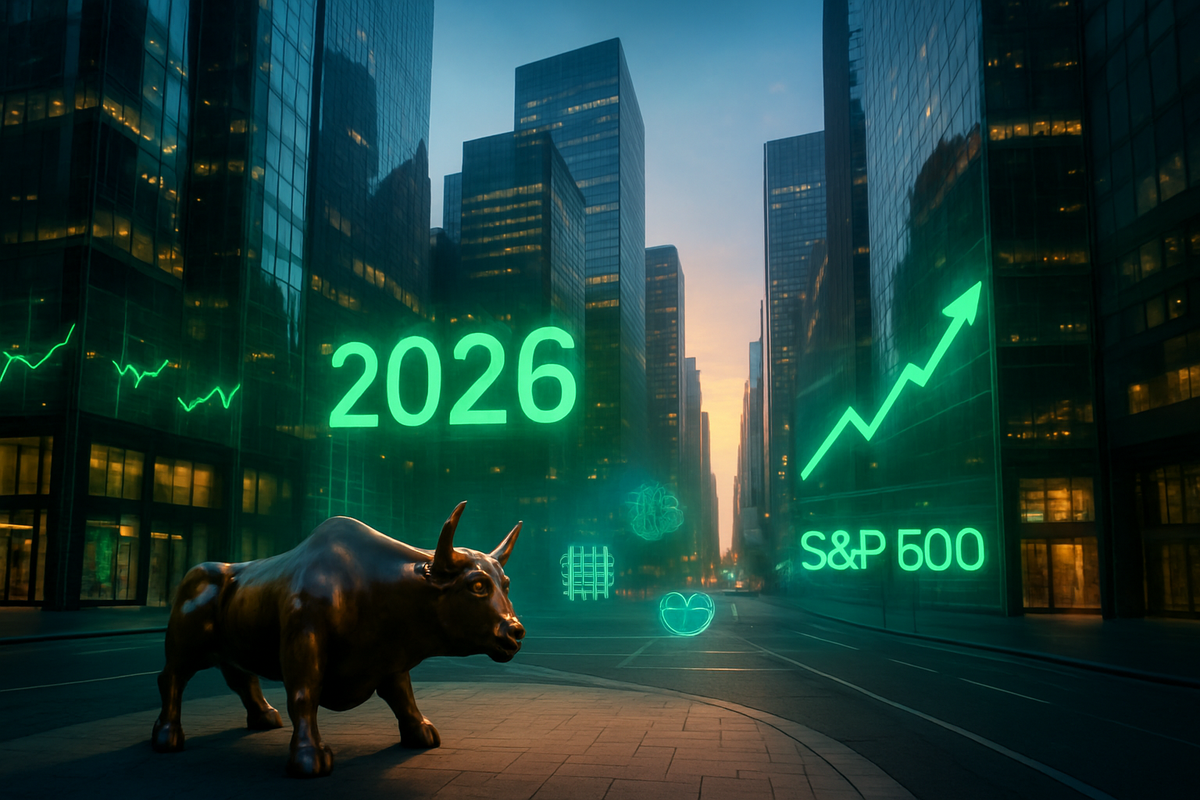
As the final trading days of 2025 wind down, a rare and powerful consensus has emerged among the titans of finance: the bull market that has defined the mid-2020s is far from over. From the sprawling headquarters of global investment banks to the specialized research desks of boutique shops, the outlook for 2026 is remarkably uniform. Analysts are projecting a fourth consecutive year of gains for the S&P 500, a feat that would solidify this era as one of the most resilient periods of wealth creation in modern market history.
This unanimous optimism is fueled by a "triple-tailwind" of accelerating artificial intelligence (AI) productivity, a favorable shift toward lower interest rates, and a pro-growth fiscal environment. While the rapid ascent of the past three years has left some observers wary of "valuation fatigue," the prevailing view on Wall Street is that the market is transitioning from a period of speculative hype into a phase of tangible earnings execution. For investors, the immediate implication is a shift in strategy: moving away from the "easy money" of 2023-2024 and toward a more nuanced, earnings-driven approach in 2026.
The Consensus: A Rare Alignment of Giants
The convergence of market forecasts for 2026 is striking in its breadth. Major institutions like Goldman Sachs (NYSE: GS) and JPMorgan Chase (NYSE: JPM) have set year-end targets for the S&P 500 in the range of 7,500 to 7,800, implying a double-digit upside from current levels. Even more aggressive are the boutique firms; Oppenheimer & Co. (NYSE: OPY) has emerged as one of the most bullish on the Street with a target of 8,100, while Evercore ISI has suggested a "bull case" scenario that could see the index touch 9,000 if AI-driven productivity gains permeate the broader economy faster than expected.
The timeline leading to this consensus began in early 2025, as inflation finally settled near the Federal Reserve's 2% target, allowing for a steady cycle of interest rate cuts. This "soft landing" paved the way for the current optimism. Key players like Mike Wilson of Morgan Stanley (NYSE: MS) and Tom Lee of Fundstrat Global Advisors have both pointed to historical precedents where a three-year winning streak often leads to a powerful fourth year, particularly during transformative technological shifts. The initial market reaction to these year-ahead outlooks has been a "Santa Claus rally" in late December 2025, as institutional fund managers reposition their portfolios to capture the expected 2026 momentum.
Winners and Losers: The AI Execution Era
The 2026 rally is expected to be led by companies that have successfully moved from AI experimentation to full-scale implementation. Nvidia (NASDAQ: NVDA) and Broadcom (NASDAQ: AVGO) remain at the top of analyst "buy" lists, with the expectation that Nvidia’s next-generation "Vera Rubin" platform will drive a new wave of data center investment. Similarly, Oracle (NYSE: ORCL) and Amazon (NASDAQ: AMZN) are viewed as primary beneficiaries of the ongoing cloud infrastructure build-out. In the semiconductor space, Micron Technology (NASDAQ: MU) is being highlighted for its critical role in providing high-bandwidth memory for AI servers.
Beyond technology, the financial sector is poised for a significant rebound. As interest rates move toward a "neutral" level of approximately 3.0%, analysts expect a surge in deal-making and a reduction in funding costs. Citigroup (NYSE: C) is being touted as a top turnaround play, while Ally Financial (NYSE: ALLY) and Robinhood Markets (NASDAQ: HOOD) are expected to benefit from increased consumer activity and retail engagement. However, the outlook is not universally positive. Companies deemed "AI laggards" or those vulnerable to automation, such as Chegg (NYSE: CHGG) and staffing firm ManpowerGroup (NYSE: MAN), are being flagged as high-risk. Furthermore, retailers with heavy import exposure like Target (NYSE: TGT) and Nike (NYSE: NKE) face potential margin compression due to the persistent "high-tariff" environment expected to remain a policy staple in 2026.
Broader Significance: A Structural Shift in Prosperity
The wider significance of this unanimous consensus lies in its historical rarity. A four-year bull run of this magnitude typically signals a structural shift in the economy rather than a mere cyclical upturn. Analysts are comparing the current environment to the late 1990s, when the internet revolution drove sustained productivity gains. The "AI Productivity Shift" is now viewed as the primary engine of the 2026 market, with Goldman Sachs projecting that AI-related efficiencies will account for nearly half of all S&P 500 earnings growth in the coming year.
This event also reflects a shift in the regulatory and policy landscape. The anticipated impact of the "One Big Beautiful Bill Act" (OBBBA), characterized by corporate tax cuts and deregulation, is seen as a major offset to potential trade headwinds. This fiscal tailwind has effectively reduced "recession fear" among institutional investors to its lowest level in a decade. However, the ripple effects are complex; while U.S. equities are thriving, the consensus warns of a "K-shaped" global recovery where domestic-focused U.S. small caps, represented by the Russell 2000, may significantly outperform international competitors who lack the same fiscal support and technological lead.
The Road Ahead: 2026 and Beyond
Looking ahead to the first half of 2026, the market will likely face a "show me" period where companies must prove that their AI investments are translating into bottom-line profits. Short-term volatility is expected as the Federal Reserve completes its easing cycle and the market adjusts to the "neutral rate" reality. Strategic pivots will be required for many legacy firms; those that fail to integrate "Agentic AI" into their workflows may find themselves permanently sidelined.
In the long term, the primary challenge will be the potential for an "AI air pocket"—a scenario where capital expenditure on technology outpaces immediate revenue returns. Investors should also watch for potential geopolitical shifts that could disrupt the global semiconductor supply chain, which remains the Achilles' heel of the current bull market. Despite these risks, the prevailing scenario for 2026 is one of "resilient growth," where the broadening of the rally into sectors like industrials and healthcare provides a safety net for the broader indices.
Conclusion: A Market Built on Fundamentals
The key takeaway for the 2026 outlook is that Wall Street has moved past the "fear of missing out" and into a phase of calculated confidence. The consensus among both big banks and boutique shops suggests that the S&P 500 is supported by strong fundamental earnings growth, estimated at $305 to $320 per share for the index. This move from multiple expansion to earnings-driven growth is a healthy sign for the longevity of the bull market, even if the pace of gains slows compared to the explosive returns of 2023.
As we enter the new year, investors should keep a close eye on quarterly earnings reports from the "Magnificent Seven" and monitor the health of the consumer in the face of sustained tariffs. While the consensus is bullish, 2026 will undoubtedly be a "stock picker's market," where the gap between the technological "haves" and "have-nots" will widen. The message from Wall Street is clear: the trend is your friend, but execution is everything.
This content is intended for informational purposes only and is not financial advice.