As the final trading days of 2025 wind down, Wingstop Inc. (NASDAQ: WING) finds itself at a critical crossroads that many analysts are calling a definitive "inflection point." After a year defined by extreme price swings—climaxing in a sharp October sell-off—the Dallas-based chicken wing specialist is emerging with a leaner cost structure and an aggressive global expansion strategy that has reignited investor interest.
The narrative surrounding Wingstop has shifted from a post-pandemic "same-store sales" story to one of massive unit growth and technological dominance. While the stock saw a dramatic dip earlier this autumn, a flurry of year-end analyst upgrades and record-breaking store opening data suggest that the company’s recent price correction may have been the "reset" the market needed to price in its next decade of growth.
From Market Darling to Value Play: The 2025 Rollercoaster
The path to this inflection point was anything but linear. In the first half of 2025, Wingstop was trading near all-time highs, peaking at approximately $381 in early June. However, the sentiment soured in October when the company reported a 5.6% decline in domestic same-store sales for the third quarter. This "normalization" of sales, which followed a staggering 20.9% growth period the previous year, triggered a massive sell-off. By October 30, 2025, shares had plummeted to an intraday low of $207, a 35% haircut that left many questioning if the "flavor brand" had finally hit its ceiling.
The recovery began in earnest throughout December. The catalyst was a realization among institutional investors that while same-store sales were lapping difficult comparisons, the underlying business fundamentals were stronger than ever. Key players like Morgan Stanley (NYSE: MS) and Goldman Sachs (NYSE: GS) maintained their "Overweight" and "Buy" ratings, respectively, arguing that the market had overreacted to temporary sales softness. A late-December initiation of coverage by Freedom Capital Markets with a $320 price target further bolstered the stock, which has since rallied back toward the $250 level as of December 29, 2025.
Central to this turnaround was the company's Q3 performance in areas other than top-line sales. Despite the comps miss, Wingstop reported an 18.6% increase in Adjusted EBITDA, reaching $63.7 million. This was fueled by a record-breaking 114 net new openings in a single quarter, signaling that franchisees remain hungry for the brand’s high-margin, asset-light model.
Winners and Losers in the Wing War
The primary winner in Wingstop’s current trajectory is its massive network of franchisees. Management successfully navigated commodity volatility, reporting that bone-in wing prices have stabilized, allowing company-owned cost of sales to fall by 300 basis points to 74.8% in the third quarter. This predictability in food costs—historically the Achilles' heel of the chicken sector—has made Wingstop one of the most attractive investment options for multi-unit operators.
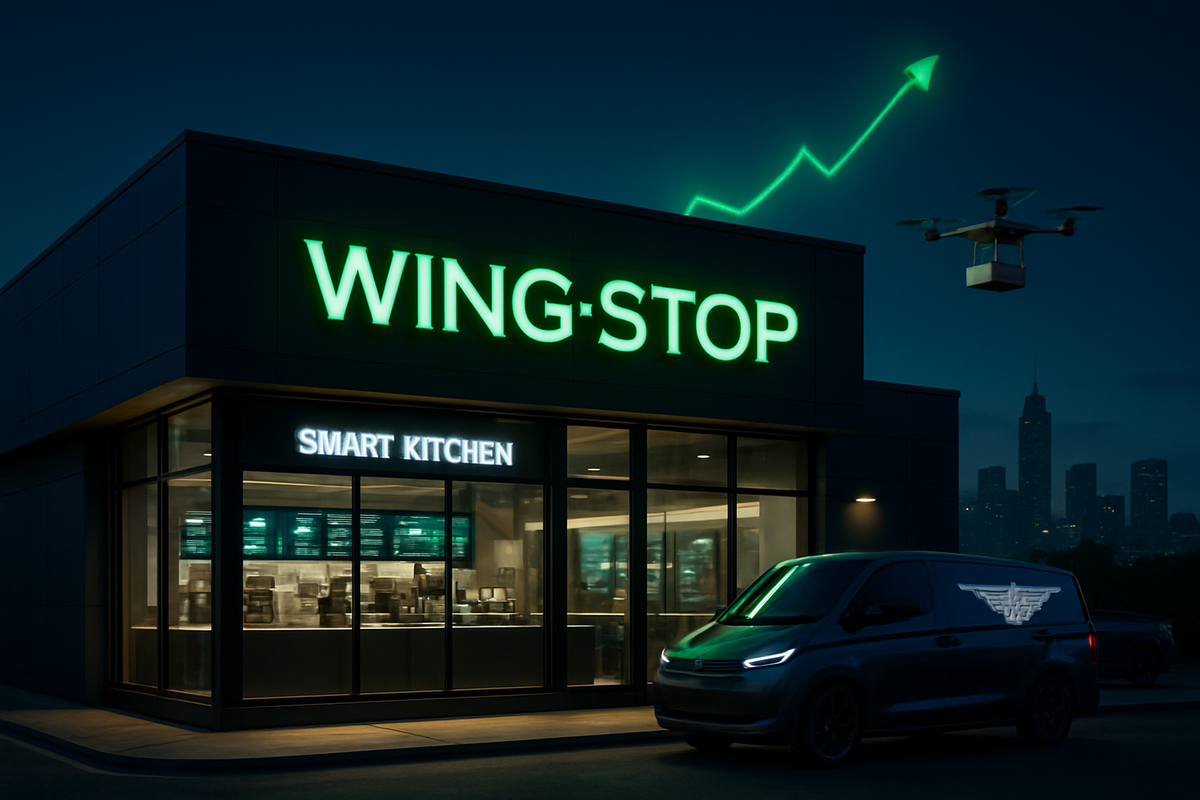
On the other side of the ledger, traditional "casual dining" competitors like Buffalo Wild Wings, owned by Inspire Brands, and smaller regional players may find themselves losing ground. Wingstop’s pivot toward a "Smart Kitchen" AI platform has reduced service times by 50%, bringing the average order ready-time down to just 10 minutes. In an environment where the consumer is increasingly price-sensitive and time-starved, Wingstop’s digital-first efficiency (representing nearly 73% of total sales) creates a barrier to entry that legacy sit-down brands are struggling to breach.
Publicly traded peers like Yum! Brands, Inc. (NYSE: YUM), the parent of KFC, and Domino's Pizza, Inc. (NYSE: DPZ) are also feeling the heat. While Domino's has long been the king of digital delivery, Wingstop’s average unit volume (AUV) is now marching toward the $3 million mark, a level of productivity that rivals the most efficient fast-food chains in the world.
Broader Industry Trends: AI and the "Asset-Light" Shift
Wingstop’s current inflection point is a microcosm of two broader trends in the 2025 restaurant industry: the "AI-ification" of the kitchen and the shift toward international unit growth as a primary valuation driver. The rollout of the Smart Kitchen platform across 2,000 domestic units has proven that automation isn't just about replacing labor; it's about maximizing throughput. By using AI to predict order flows and optimize fry-station timing, Wingstop has managed to increase guest satisfaction scores even as it scales.
Furthermore, Wingstop’s aggressive international pipeline—highlighted by a landmark deal to enter India with a 1,000-restaurant target—reflects a move toward the global scale typically reserved for brands like McDonald's Corp (NYSE: MCD). This shift suggests that the market is beginning to value Wingstop not as a niche "wing joint," but as a global technology and logistics platform that happens to sell chicken.
Historically, companies that successfully transition from "high-growth darling" to "efficient global scaler" often see a period of stock price consolidation followed by a long-term upward trajectory. Analysts are comparing Wingstop’s current 2025 "reset" to the period Chipotle Mexican Grill (NYSE: CMG) underwent several years ago, where a focus on operational excellence and digital loyalty preceded a massive multi-year rally.
The Road Ahead: 2026 and the 10,000-Unit Goal
Looking into the short term, the primary catalyst for Wingstop will be the full-scale national rollout of its "Club Wingstop" loyalty platform in Q2 2026. This program is designed to capture high-frequency, "wealthier" customer cohorts and use data-driven marketing to offset any lingering same-store sales softness. If the pilot programs in the Southwest are any indication—where loyalty adoption led to mid-single-digit outperformance—the program could be the key to returning the brand to positive comps by mid-2026.
Strategically, the company is also looking to expand its "chicken sandwich" and "boneless" offerings to further mitigate the impact of bone-in wing price fluctuations. By diversifying the menu while maintaining a "simple" operational footprint, Wingstop aims to keep its franchisee margins in the mid-30% range, ensuring the development pipeline remains robust even if interest rates remain elevated.
The long-term scenario remains centered on the company’s stated goal of 10,000 global units. With the UK division reaching 85 sites this month and the India expansion on the horizon, the infrastructure for this growth is largely in place. The challenge will be maintaining brand "cool" and quality control as the footprint doubles over the next several years.
Investor Wrap-Up: What to Watch
Wingstop’s journey through 2025 has been a masterclass in operational resilience. While the 35% price dip in October was painful for short-term holders, it arguably cleared the froth from a stock that was priced for perfection. The company ends the year with record-high EBITDA margins, a stabilized supply chain, and a technological edge that its competitors are still trying to replicate.
For investors, the key metrics to watch in the first half of 2026 will be the pace of the India rollout and the initial sign-up rates for the new loyalty program. If Wingstop can prove that its AI-driven kitchens can maintain 10-minute service times at scale, the current "inflection point" may be remembered as the moment the company matured into a true blue-chip staple of the restaurant sector.
As of December 29, 2025, the market seems to be betting on the latter. With a revised 2025 guidance of 475–485 net new global units, Wingstop isn't just surviving the normalization of the post-pandemic era—it is actively engineering its next phase of dominance.
This content is intended for informational purposes only and is not financial advice.