

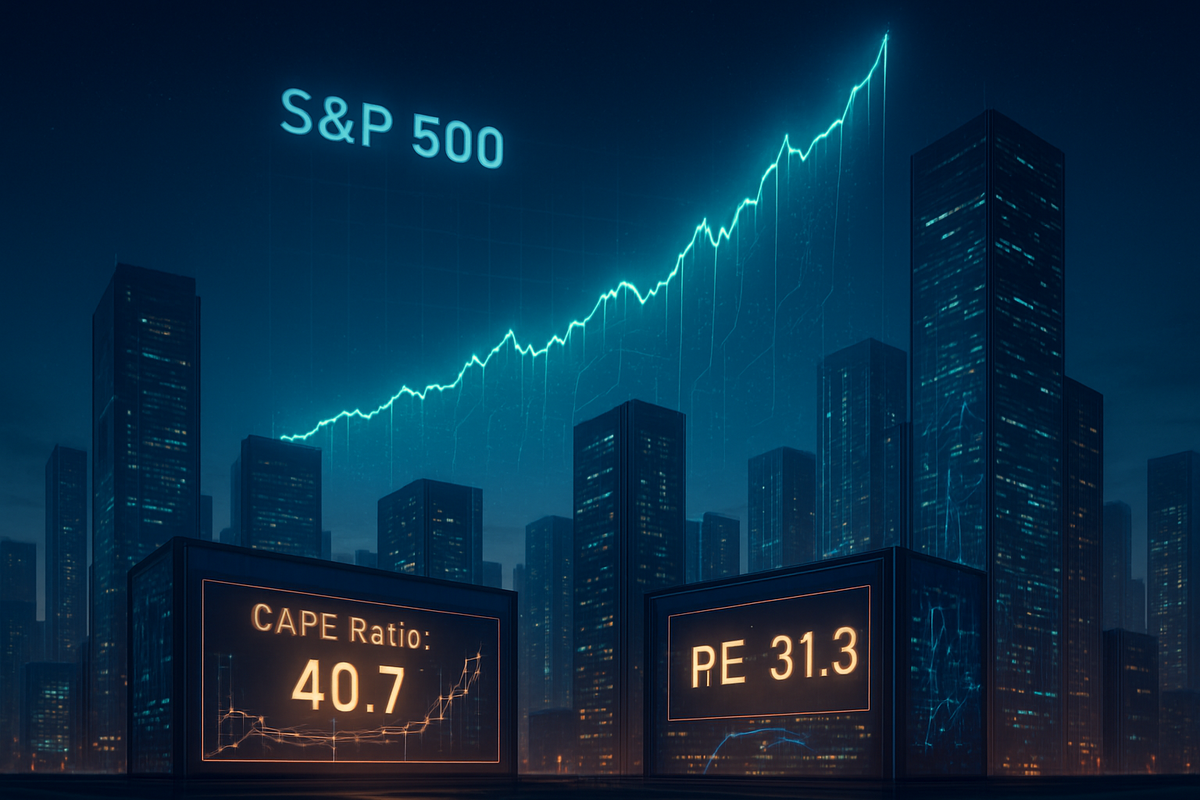
As the final trading days of 2025 draw to a close, the financial world finds itself standing on a high-altitude plateau that few predicted and many fear. The S&P 500 (INDEXSP: .INX) enters 2026 trading at levels that defy traditional gravity, having surged nearly 20% this year alone to hover around the 6,930 mark. This follows a blockbuster 2024, creating a rare three-year stretch of double-digit returns that has pushed valuation multiples to heights seen only twice in the last century: the eve of the Great Depression and the peak of the dot-com bubble.
For investors, the immediate implication is a market that is "priced for perfection." With the cyclically adjusted price-to-earnings (CAPE) ratio sitting at a staggering 40.7, the margin for error has effectively evaporated. Every corporate earnings report, every Federal Reserve whisper, and every geopolitical tremor now carries the potential to trigger a systemic re-rating. While the "AI Revolution" has provided a fundamental engine for this growth, the sheer velocity of the ascent has left the market vulnerable to the very prosperity it has created.
The Ascent to 6,900: A Timeline of Exuberance
The road to this "historically expensive" moment was paved by a series of unprecedented economic tailwinds that converged over the last 24 months. Following a resilient 2024, where the index gained roughly 25%, 2025 became the year where artificial intelligence transitioned from a speculative promise to a dominant earnings driver. The timeline reached a fever pitch in mid-2025 when Nvidia (NASDAQ: NVDA) briefly touched a $5 trillion market capitalization, cementing the "circular AI economy" as the primary pillar of market liquidity.
A critical turning point occurred just weeks ago, in early December 2025, when the Federal Reserve opted for an "insurance cut," lowering the federal funds rate to a range of 3.50% to 3.75%. Despite robust GDP growth and a labor market that remains historically tight, the Fed’s move was viewed as a green light for further multiple expansion. This liquidity injection, combined with investor anticipation of a massive $285 billion tax cut package slated for 2026, has created a "melt-up" environment where the S&P 500 reached an all-time intraday high of 6,952.84.
However, the reaction from institutional stakeholders has been far from uniform. While retail sentiment remains buoyed by the "fear of missing out" (FOMO), major asset managers have begun sounding the alarm on the Equity Risk Premium (ERP). For the first time in over two decades, the ERP has turned negative, meaning investors are essentially receiving no additional compensation for the risk of holding equities over "risk-free" Treasury bonds. This divergence between price action and risk-adjusted value has defined the closing weeks of 2025, as the market prepares for a year where the "soft landing" narrative must finally face the reality of its own valuation.
The Great Divide: Winners, Losers, and the Safety Rotation
In this high-valuation landscape, a "Great Divide" has emerged between companies that can justify their premiums and those that cannot. The primary winners remain the "picks and shovels" of the AI era. Companies like Broadcom (NASDAQ: AVGO) and Palantir Technologies (NASDAQ: PLTR) have seen their stocks surge by over 60% in the latter half of 2025, driven by explosive demand for AI-ready infrastructure and software. Similarly, the "Memory Trio" consisting of Micron (NASDAQ: MU), SK Hynix (KOSPI: 000660), and Western Digital (NASDAQ: WDC) have capitalized on the insatiable need for high-bandwidth memory, with Western Digital posting gains exceeding 200% over the last eighteen months.
Conversely, the "losers" of late 2025 are those whose valuations have decoupled from their fundamental growth trajectories. Tesla (NASDAQ: TSLA) has become a focal point for skeptics, with a forward P/E ratio exceeding 180x despite slowing electric vehicle demand and intensifying global competition. Legacy software giants like Salesforce (NYSE: CRM) and Adobe (NASDAQ: ADBE) have also struggled to keep pace, as investors shift capital away from general SaaS models toward specialized AI infrastructure. Furthermore, consumer-facing brands like Lululemon (NASDAQ: LULU) have faced a brutal re-rating, falling nearly 45% as tariff-induced supply chain costs began to eat into margins.
Amidst this volatility, a significant rotation into "defensive value" is underway. Investors are increasingly seeking refuge in Berkshire Hathaway (NYSE: BRK.B), which has become a preferred "catch-up" play for those wary of tech concentration. Healthcare staples like Johnson & Johnson (NYSE: JNJ) and Merck (NYSE: MRK) are seeing renewed interest for their "margin of safety" and reliable dividends. Even the utility sector, led by NextEra Energy (NYSE: NEE), has transformed into a defensive winner, as the massive electricity requirements of AI data centers provide a unique growth tailwind for otherwise sleepy stocks.
AI Productivity vs. The Buffett Indicator
The wider significance of this market moment lies in the tension between two competing narratives: the structural shift of the AI revolution and the historical warnings of the "Buffett Indicator." Proponents of the current valuation argue that we are witnessing a productivity leap comparable to the Industrial Revolution. They contend that traditional metrics like the CAPE ratio are obsolete because they do not account for the exponential efficiency gains AI will bring to corporate margins. In this view, the S&P 500 isn't expensive; it is simply being revalued for a more productive era.
However, the historical precedents are sobering. The Buffett Indicator—the ratio of total market capitalization to GDP—has surged to an unprecedented 226%, far surpassing the 200% level that preceded the 2000 dot-com crash. When the market reaches these extremes, historical data suggests that forward 10-year returns are often flat or negative. This event fits into a broader trend of market concentration, where the "Magnificent Seven" now represent nearly 40% of the entire index, creating a systemic vulnerability where a single earnings miss from a tech titan could ripple through the entire global financial system.
Furthermore, the regulatory and policy implications of 2026 cannot be ignored. While the market has priced in the benefits of deregulation and tax cuts, it has been less attentive to the potential "inflationary shock" of proposed tariffs. If the incoming administration’s trade policies lead to a resurgence in CPI data, the Federal Reserve may be forced to reverse its recent rate cuts, potentially popping the valuation bubble that has sustained the market throughout 2025.
The 2026 Outlook: Consolidation or Correction?
As we look toward the first quarter of 2026, the market faces two primary scenarios. The first is a "valuation consolidation," where stocks trade sideways for an extended period, allowing earnings to catch up to prices. This would require corporate America to deliver on the aggressive 15% earnings growth targets currently projected by analysts. If the "AI monetization" phase continues to accelerate, the S&P 500 could theoretically maintain its high altitude without a major drawdown.
The second, more volatile scenario is a "valuation re-rating" triggered by a liquidity squeeze or an earnings disappointment. Short-term challenges, such as the saturation of AI hardware demand or a slowdown in consumer spending due to high debt levels, could force a rapid contraction of multiples. Investors should watch for a potential strategic pivot toward "quality at a reasonable price" (GARP), as the era of "buying the dip" in high-beta tech may finally be reaching its limit. Market opportunities may emerge in neglected sectors like mid-cap industrials or international markets that have traded at a steep discount to the U.S. for a decade.
Summary: A Year of Vigilance
The story of the market as 2025 ends is one of incredible resilience but also extreme fragility. The key takeaways for the coming months are clear: the S&P 500 is historically expensive, market concentration is at an all-time high, and the "margin of safety" has shifted from growth stocks to defensive value and high-quality dividend payers. While the momentum of 2025 is undeniable, the laws of financial physics suggest that such steep ascents eventually require a period of normalization.
Moving forward, the market will be hyper-sensitive to any signs of "AI fatigue" or inflationary pressure that could disrupt the Fed’s current easing cycle. Investors should maintain a diversified posture, keeping a close eye on the Equity Risk Premium and the performance of the 10-year Treasury yield. The coming months will determine whether 2025 was the peak of a historic bubble or the foundation of a new, high-valuation era. Regardless of the outcome, 2026 promises to be a year where discipline and risk management will be more valuable than ever.
This content is intended for informational purposes only and is not financial advice.