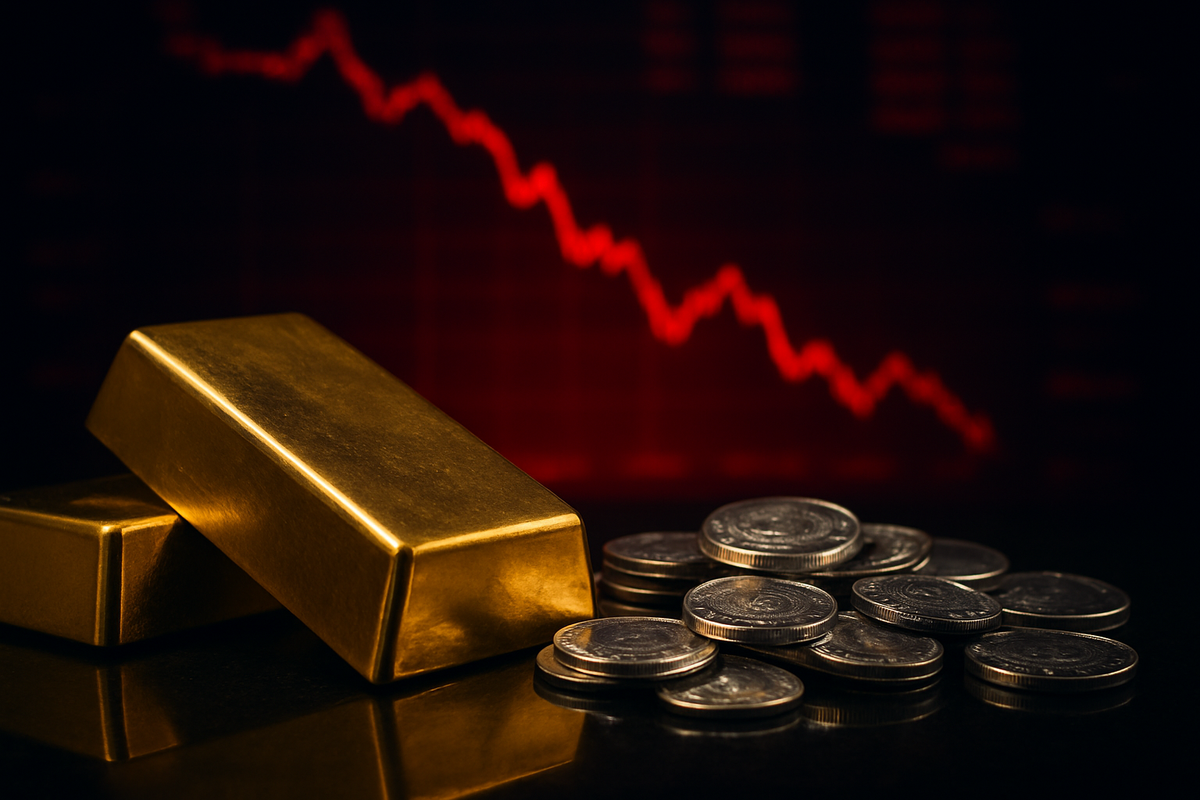
As the final trading days of 2025 unfold, the "Hard Asset Super-Cycle" that dominated the financial landscape for the past twelve months has hit a sudden and jarring roadblock. On December 29, 2025, gold and silver prices experienced their most significant single-day retreats of the year, pulling back sharply from record-breaking peaks that had many analysts calling for a permanent decoupling from traditional fiat currencies. The reversal has sent ripples through the commodities markets, signaling a pivot toward investor caution as geopolitical risk premiums begin to evaporate.
The immediate implications of this pullback are felt most acutely in the futures markets, where a combination of technical exhaustion and regulatory intervention has forced a massive liquidation of long positions. While the broader 2025 rally was underpinned by structural deficits and aggressive central bank diversification, the year-end correction suggests that the "mania phase" of the precious metals market may have finally reached its limit. For investors, the question is no longer how high the ceiling is, but where the new floor will be established as the market enters 2026.
A Technical Speed Bump in a Historic Year
The timeline leading to this week’s reversal began with a parabolic surge throughout the autumn of 2025. Gold reached a staggering all-time high of $4,549.71 per ounce earlier this month, marking a 74.5% year-to-date gain. Silver’s performance was even more dramatic, briefly breaching the $84.00 mark on December 29 before the tide turned. This "perfect storm" of gains was driven by a Federal Reserve that slashed rates to the 3.5%–3.75% range and a U.S. national debt that ballooned past $38 trillion following the passage of the "One Big Beautiful Bill" Act in July.
However, the rally hit a wall this morning as several key catalysts converged simultaneously. First and foremost, reports of productive peace discussions between President Trump and Ukrainian President Zelensky significantly deflated the "war premium" that had been baked into bullion prices for years. Simultaneously, the CME Group (NASDAQ: CME) intervened to curb extreme volatility by hiking margin requirements on silver futures. This forced highly leveraged traders to liquidate positions, leading to a "flash crash" in silver prices, which plummeted over 14% to the low $70s within hours.
The sell-off was further exacerbated by a sudden rebound in the U.S. Dollar Index (DXY), which stabilized near 98.3 following stronger-than-expected year-end manufacturing data. As institutional desks moved to lock in historic profits during the thin liquidity of the holiday season, the "safe-haven" trade saw its first major exodus of 2025. The reversal was not merely a domestic event; in India, the world’s largest physical consumer, a regulatory crackdown by Sebi on unregulated digital gold platforms led to a 50% drop in UPI-based purchases, removing a massive pillar of support from the global spot market.
Winners and Losers in the Mining Sector
The sudden price correction has created a divergent landscape for public companies tied to the metals. Major producers like Newmont Corporation (NYSE: NEM) and Barrick Gold Corporation (NYSE: GOLD) saw their shares retreat as the market repriced their future cash flow projections based on a $4,300 gold environment rather than the $4,500+ peak. While these companies remain highly profitable compared to 2024 levels, the "gold rush" sentiment that had pushed their valuations to multi-year highs has cooled, leading to a rotation out of senior miners and into more defensive equity sectors.
Streaming and royalty companies, such as Wheaton Precious Metals Corp. (NYSE: WPM), may emerge as relative winners in this environment. Because their business models rely on fixed-cost contracts rather than direct mining operations, they are better insulated from the immediate volatility of spot prices. However, pure-play silver miners like First Majestic Silver Corp. (NYSE: AG) have borne the brunt of the volatility. With silver’s 14% intraday drop, First Majestic and similar high-beta silver stocks saw double-digit percentage declines, reflecting the metal's reputation as "gold on steroids" during both rallies and retreats.
Exchange-traded funds have also seen massive outflows. The iShares Silver Trust (NYSE Arca: SLV) and the SPDR Gold Shares (NYSE Arca: GLD) recorded their largest single-day redemptions of the year as retail investors, spooked by the suddenness of the drop, moved to the sidelines. This exodus suggests that the "debasement trade"—the idea that metals are the only hedge against a failing dollar—is facing its first real test of confidence since the fiscal expansion of mid-2025.
Broader Significance and the "Digital Gold" Shift
The late-2025 pullback is more than just a technical correction; it represents a shift in how the market views the hierarchy of assets. One of the most significant disruptors to the precious metals rally has been the GENIUS Act, passed in July 2025, which established a federal framework for regulated stablecoins. For the first time, digital assets backed by the U.S. Treasury have begun to compete directly with physical gold for "safe-haven" capital. As the regulatory fog cleared, a portion of the capital that traditionally flowed into bullion moved into these regulated digital instruments, creating a new headwind for gold’s dominance.
Historically, this event mirrors the 2011 silver peak and the subsequent "taper tantrum" of 2013, where overextended positions were purged in a high-volatility environment. However, the 2025 context is unique due to the structural industrial demand for silver. Unlike previous cycles, silver is now classified as a "strategic critical mineral" essential for AI semiconductors and the global solar expansion. This industrial floor may prevent a total collapse of prices, even as the speculative "mania" fades.
Furthermore, the pullback highlights the limits of central bank influence. While the People’s Bank of China and other BRICS+ nations have been aggressive buyers throughout 2025, the year-end reversal shows that even record-breaking institutional demand cannot fully offset a massive retail and speculative liquidation. This serves as a reminder that gold and silver remain sensitive to real interest rates and the perceived stability of the global geopolitical order, regardless of long-term debt trajectories.
What Lies Ahead: The Path to 2026
In the short term, market participants should prepare for continued volatility as the "dust settles" from the December 29 crash. The first two weeks of January will be critical; if gold can hold the $4,300 support level, it would signal that the long-term bull market remains intact. Conversely, a breach below $4,000 could trigger a deeper "bear market" correction as the momentum that defined 2025 evaporates. Strategic pivots will be required for mining companies, which may now focus on cost-cutting and dividend preservation rather than aggressive exploration and acquisition.
Long-term, the structural drivers of the 2025 rally—high national debt, industrial silver shortages, and a multi-polar currency world—have not disappeared. The pullback may be viewed by "smart money" as a necessary cooling period that removes the "froth" from the market. Potential scenarios for 2026 include a period of consolidation where gold trades in a wide range between $4,100 and $4,400, allowing the global economy to digest the inflationary shocks of the 2025 trade tariffs.
A New Reality for Precious Metals
The events of late 2025 mark a definitive end to the "unhinged" bullishness that saw gold and silver reach levels once thought impossible. The 14% crash in silver and the retreat of gold from the $4,500 threshold serve as a stark reminder that even the most robust "Hard Asset Super-Cycle" is subject to the laws of gravity and the whims of geopolitical diplomacy. The market is moving from a phase of speculative mania into one of cautious valuation.
Moving forward, the key takeaway for investors is the importance of diversification and the recognition of new competitors in the "safe-haven" space, particularly regulated digital assets. While the fundamental case for gold and silver remains tied to the $38 trillion U.S. debt and industrial demand, the technical breakdown of December 29 suggests that the easy gains of 2025 are over. In the coming months, investors should watch for Federal Reserve minutes and the progress of Eastern European peace talks, as these will be the primary drivers of whether this pullback is a temporary dip or the beginning of a long-term trend reversal.
This content is intended for informational purposes only and is not financial advice.