Walk into a Hermès boutique on Rodeo Drive these days and watch what happens at checkout. The sales associate doesn't reach for a clunky card reader. She taps a tablet, the client taps their phone, done. Three seconds, maybe four.
That tiny moment is where luxury retail's payment story actually lives in 2026. Biometric authentication got fast enough to feel invisible. Stablecoins became a genuine settlement rail. This piece walks through where in-store payments for luxury retail are actually headed — the hardware quietly replacing terminals, crypto rails for international buyers, biometric checkout, and the data infrastructure stores are building behind the scenes.
Why Payment Friction Is a Luxury Problem, Not Just a Tech One
Here's something most articles about retail payments miss entirely: in luxury, the payment terminal is part of the theater. If it's clunky, it breaks the spell the brand spent six figures building with marble floors and ambient lighting.
Boutiques in Milan, Dubai, and increasingly Miami have been quietly swapping fixed terminals for mobile POS devices that staff carry like a tray. Louis Vuitton did this years ago in its flagship stores. The point wasn't speed for speed's sake — it was letting the associate stay beside the client instead of walking them to a counter. Small thing. Changes the whole feel of the sale.
Now layer crypto into that picture. International luxury buyers (Gulf clients, certain Asian markets, a growing slice of younger European buyers) increasingly want to settle in stablecoins or other digital assets without the store treating it like some exotic special request. A handful of European boutiques and a growing number of Dubai retailers have started running a Crypto Point Of Sale directly alongside their normal card readers, letting clients choose between fiat and digital assets at the same till, same speed, same receipt format. No separate "crypto desk" in the back room. No waiting twenty minutes for a manual conversion. Whether that becomes standard across the industry or stays a niche convenience for a specific buyer segment is still an open question, but the infrastructure exists now, which it didn't three years ago.
The Hardware Nobody Talks About
Everyone wants to discuss apps and blockchain. Almost nobody wants to discuss the actual physical terminal sitting on the counter, which is honestly where the real shift is happening.
A few trends worth flagging:
- Tap-to-phone is replacing dedicated readers. Staff use the same iPhone or Android device for inventory lookup and payment processing. One device, fewer cables, less counter clutter.
- Biometric pre-authorization is being piloted by select private banking partnerships in Geneva and Singapore — palm scan or facial recognition tied to a pre-loaded client profile, skipping the card entirely for repeat VIP shoppers.
- Offline-capable terminals matter more than people assume. A boutique in a remote ski resort or a yacht showroom in Monaco can't always rely on solid connectivity. Modern POS hardware now queues transactions and syncs once signal returns.
- Multi-currency display at the point of sale, showing price in the client's home currency in real time rather than after-the-fact conversion on a statement.
None of this is glamorous. It's plumbing. But plumbing is what makes the house livable, and luxury retail has finally started investing in its plumbing instead of just its facade.
Biometrics, Privacy, and the Trust Question
Quick gut check: would you let a boutique scan your face to skip the checkout line? Some people would, instantly. Others find it deeply uncomfortable. Both reactions are reasonable.
This is the genuine tension in the room right now. Biometric checkout is fast and feels exclusive — that's exactly why high-end retail likes it. But it raises real data-handling questions that brands haven't fully answered publicly. Where is that facial data stored? Who has access? What happens if the boutique gets breached?
These aren't hypothetical concerns dressed up to sound responsible — they're the same questions that came up with Apple Pay a decade ago, except now the data being collected is biometric, which carries different legal weight under regulations like GDPR in the EU and various state-level biometric privacy laws in the US (Illinois' BIPA being the famous one). Retailers operating across multiple jurisdictions are having to build compliance frameworks store by store, not as an afterthought.
This is also why most luxury houses are moving carefully rather than rushing biometric checkout into every flagship at once. Reputation in this category is fragile. One data scandal does more damage to a heritage brand than a slow rollout ever could.
A Quick Look at What's Actually in Use
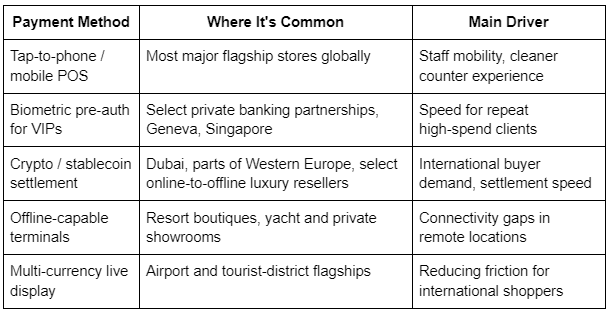
Nothing in that table is exotic anymore. That's the actual story — what felt experimental in 2022 is just operational reality now in 2026.
Why Crypto Keeps Coming Up (Without Taking Over the Conversation)
Worth being honest here: crypto is not replacing cards, and it's not replacing cash either, certainly not in luxury retail where reputational caution runs deep. But it has carved out a real, specific niche — international clients who hold significant digital assets and want the option to spend them directly rather than converting first.
A boutique that supports digital asset payments isn't making a political statement about decentralization. It's making a practical one: removing a barrier between a willing buyer and a sale. That's it. Stores that have quietly rolled out a crypto point of sale https://inqud.com/pos-terminal report that adoption skews heavily toward a specific segment — tech-wealth buyers, certain international tourists, younger collectors — rather than across the entire client base. Niche, but a real niche, and one that's growing rather than shrinking.
Should every luxury retailer rush to add crypto payment rails tomorrow? Not necessarily. It depends entirely on client base, region, and risk tolerance — questions each retailer needs to work through with their own financial and legal advisors rather than following a trend because a competitor did it first.
What This Actually Means for Shoppers
Forget the buzzwords for a second. What does any of this mean if you're the one standing at the counter?
It means checkout increasingly disappears. It means your phone, your face, or your wallet of choice all work the same way without a lecture from staff about which method is preferred. It means a Gulf buyer in Milan and a tourist in Tokyo and a tech founder in Dubai can all walk up to the same counter and pay in whatever way suits them, without the store treating any option as the "normal" one and the rest as exceptions.
That's not a revolution. It's just retail finally catching up to how people actually want to pay — quietly, quickly, and without being made to feel like the payment method itself is the interesting part of the visit.