There are two versions of Frankfurt, and they take turns occupying the same streets. For most of the year it is a compact, efficient banking city where you can find a decent hotel room on two days’ notice and a dinner table on the same evening. Then a big fair opens at the Messe, and the city starts operating by entirely different rules. Hotel rates triple. Restaurants stop answering the phone. The taxi rank outside the exhibition halls turns into a study in patience. If you are exhibiting at Messe Frankfurt for the first time, it helps to know which of these two cities you are flying into.
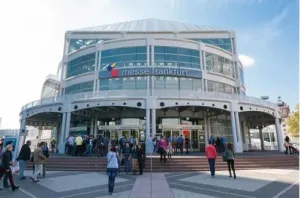
The exhibition grounds themselves are part of the story. Messe Frankfurt is one of the largest fair venues in the world, and it sits almost absurdly close to the centre of town: ten minutes from the central station, about fifteen from the airport when the roads behave. That proximity is both a gift and a trap. Everything is close, and during fair week roughly everyone in your industry is competing for the same closeness.
Know which weeks rewrite the rules
Not every event bends the city out of shape. Frankfurt hosts dozens of fairs a year, and most of them come and go without you noticing anything beyond a few more lanyards on the S-Bahn. A handful do something different. Heimtextil opens the year in January and fills the airport with textile buyers before the Christmas decorations are down. Ambiente, in February, is the big one for consumer goods and brings some of the largest visitor numbers of the calendar. ISH and Light + Building alternate through the spring in their respective cycles, IMEX takes over in May, Automechanika arrives every other September, and then there is the Frankfurt Book Fair in October, which is less a trade fair than a temporary occupation of the city by the entire publishing world.
Before you book flights, put your fair’s dates next to the wider Messe calendar. A show that overlaps or bumps against another one compounds every logistical problem, and knowing this in advance changes how early you book everything else.
Book the boring things first
First-time exhibitors pour their energy into the stand: the design, the graphics, the demo loop, the giveaways. All of that matters, and none of it will hurt you as badly as the three unglamorous bookings people leave for last, which are the hotel, the transport and the dinner tables.
The hotel question is brutal during the top-tier fairs. Rooms inside Frankfurt can be scarce and startlingly expensive months out, which is why veterans quietly book six months ahead or stay outside the city entirely. Offenbach, Eschborn, Bad Homburg, Darmstadt and even Mainz are all realistic bases with sane prices, provided you have solved the question of how you are actually getting to the halls each morning. Which brings us to transport.
Getting to and from the halls
For a solo visitor with a day ticket and no luggage, Frankfurt’s public transport is genuinely good. From the airport, the S8 or S9 takes you to the central station in around eleven minutes, and from there the S3 to S6 lines stop directly at the Messe’s own station. Trams 16 and 17 serve the Festhalle entrance. On an ordinary day this system is one of the pleasures of doing business in Frankfurt, and if that describes your fair week, use it with a clear conscience.
Exhibitors live a different week. You move earlier than the trains are pleasant, you carry sample cases and roll-ups, you leave later than you planned, and you experience the one truly grim moment of any Frankfurt fair: hall close. At six o’clock, tens of thousands of people are released at once into a plaza with a finite number of taxis, and the queue does not care how important your dinner is. During fair weeks, taxis cannot drive onto the grounds themselves, so everyone funnels to the same few ranks by the City Entrance and the congress centre.
The people who look suspiciously relaxed at 6:05 pm have generally pre-booked. Local chauffeur operators run fair-week service built around exactly these pain points, and FrankfurtRide’s dedicated Messe Frankfurt shuttle and transfer service is a good example of the genre: a fixed price agreed at booking, an airport pickup on arrival day, a set morning slot from your hotel to the halls, and a car waiting at a named entrance when the fair closes, rather than a queue. Over a five-day fair the cost difference against taxis is smaller than most people assume, and the difference in blood pressure is not.
Arrival day, done right
One scheduling rule veterans swear by: land the day before you think you need to. Arrival day always costs more hours than the calendar suggests. The flight is late, the hotel room is not ready, the stand build has a question only you can answer, and the exhibitors who stroll relaxed into dinner on opening eve are invariably the ones who gave themselves that buffer. Use the spare evening to collect your badge while the desks are empty and to walk your hall once, from the entrance your visitors will actually use. You will discover that the walk takes twice as long as the map suggested and that your stand’s spotlight points at the wrong wall, and both of those problems are fixable at six the night before. Neither is fixable at five to nine the next morning.
Inside the halls
Two practical things about the venue itself. First, the distances are serious. The grounds stretch across numbered halls that can be a genuine fifteen-minute walk apart, connected by the Via Mobile moving walkways; comfortable shoes are not a suggestion, they are equipment. Second, print or download your badge before you travel. The registration desks work fine, but every minute in that line on opening morning is a minute your competitor spent talking to your customer.
Bring a power bank. The halls have good coverage and Wi-Fi but sockets are the scarcest resource on any stand except chairs. And carry a bottle of water: fair-hall air has a dryness all of its own, and the catering queues at lunch rival the taxi queue at close.
The evening game
The real business of a Frankfurt fair happens after the halls empty. Dinner reservations during Ambiente or Book Fair week need to be made weeks in advance, not days. For a relaxed table, the apple-wine taverns of Sachsenhausen still work and give visitors something unmistakably local; for something sharper, the restaurants of the rehabilitated Bahnhofsviertel punch above their weight. And do not underestimate the hotel bars, which during fair weeks function as an unofficial extra exhibition hall where the actual deals get closed.
Keep an eye on German rhythms while you plan. Shops close on Sundays, kitchens close earlier than you may be used to, and breakfast at a fair-week hotel is best eaten early, both for the quiet and for the seats.
If Frankfurt is only your first stop
Half the exhibitors you meet will be mid-circuit, hopping from this fair straight to the next one at another German Messe. The good news is that the fixed-price ground game travels with you. MEDICA, boot and the Caravan Salon pull the same crowds to Messe Düsseldorf, where DüsseldorfRide runs the identical pre-booked model from Düsseldorf Airport, and German-market operators such as fr-transfer.de sell the same Festpreis idea to domestic corporate bookers. Whichever fair city your calendar sends you to next, the veteran move does not change: book the boring things first.
The week rewards preparation
None of this is meant to make Frankfurt sound hostile. It is one of the easiest cities in Europe in which to do serious business, precisely because it has spent decades absorbing these invasions and building the infrastructure to match. But the city rewards preparation disproportionately. Sort out the room, the rides and the reservations before you fly, and fair week becomes what it should be: five days of concentrated business in a town built for exactly that. Companies like FrankfurtRide publish their fair and airport routes with fixed prices precisely because the demand spike is so predictable; the fair calendar is public, and so is the solution. Leave it all until you land, and you will spend your most expensive week of the year standing in queues, learning each of these lessons at retail price.