

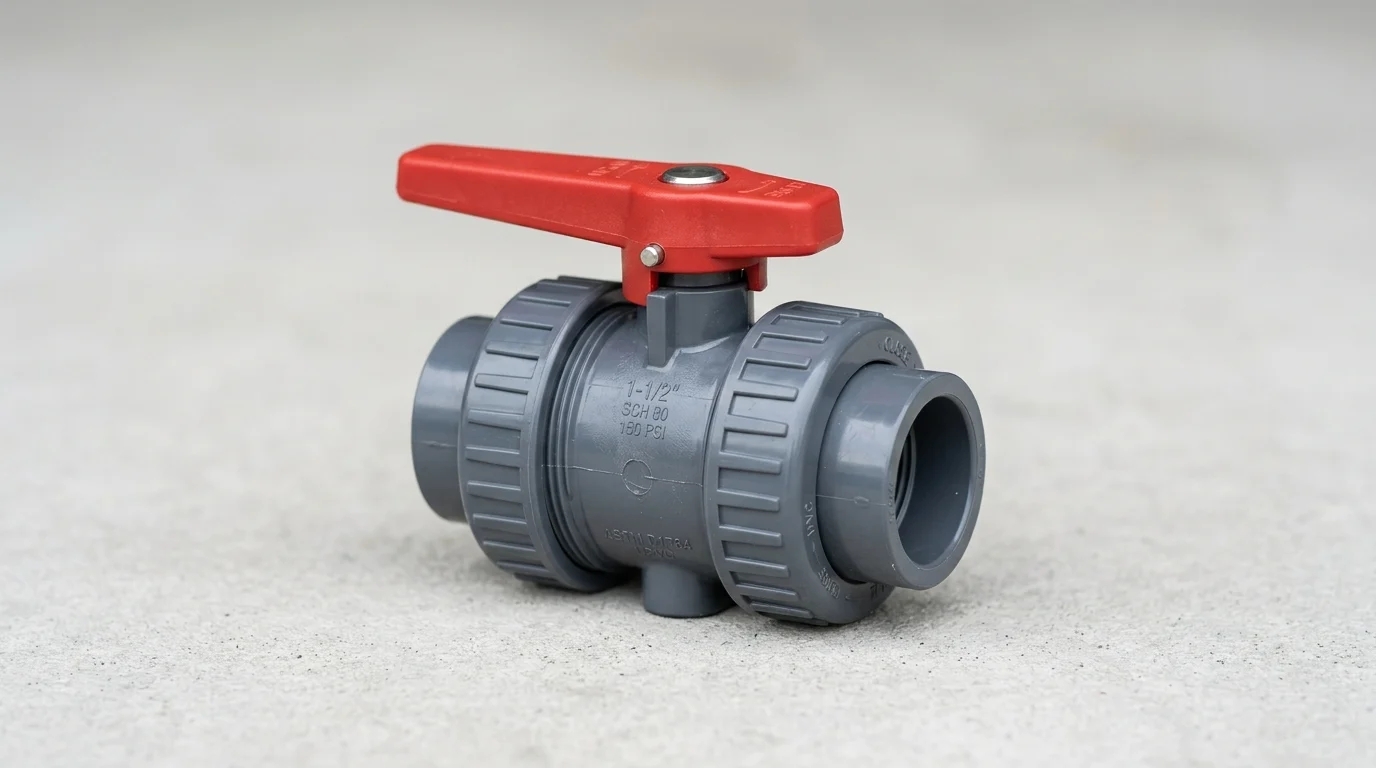
A PVC ball valve may look simple, but its pressure limit is one of the most important numbers in a piping system. Choose too low a rating, and the valve can become the weak point long before the pipe reaches its own capacity. Most PVC valves are specified at a standard temperature, often 73°F (23°C), and their safe working pressure can change with size, schedule, fluid conditions, and temperature. This article explains the difference between working pressure and burst pressure, why Schedule 40 and Schedule 80 labels do not tell the whole story, and how factors such as water hammer and temperature derating affect real-world valve selection.PVC Ball Valve Pressure Ratings
Most PVC ball valves are rated for a working pressure of roughly 150 to 235 psi at 73°F (23°C). When asking how much pressure a valve can “hold,” it is crucial to distinguish between its rated working pressure—the maximum safe limit under normal conditions—and its burst pressure, the point of catastrophic material failure. Typically, the burst pressure of a PVC valve is three to five times its working pressure, but this extreme limit should never be approached in practice. Actual safe limits vary significantly based on valve size, port style, and the specific manufacturer. Important Note: Always consult specific manufacturer data sheets for exact pressure ratings, derating multipliers, and safety margins, as these vary widely across designs. Polyvinyl chloride (PVC) is favored for its excellent corrosion resistance and cost-efficiency, but its mechanical limits must be strictly observed to prevent system failures.
What Pressure Ratings Mean
Pressure ratings dictate the maximum safe working pressure a valve can contain under ideal, static conditions. In North America, these limits are typically expressed in pounds per square inch (psi) at a standard ambient baseline temperature of 73°F (23°C). Internationally, the Pressure Nominal (PN) system expresses these limits in bar at a baseline of 20°C (68°F). These standardized figures assume a non-shock environment; they do not inherently account for dynamic variables such as water hammer, severe vibration, or thermal expansion. When a specification sheet lists a valve as rated for “150 psi non-shock water working pressure,” this must be recognized as an absolute maximum ceiling rather than a routine target operating tier.
Additionally, pressure capacity often decreases as valve size increases. It is also vital to distinguish between pipe Schedule ratings and valve pressure ratings, as they are frequently conflated. For example, a 1/2-inch Schedule 80 PVC pipe might safely hold up to 850 psi, but a 1/2-inch Schedule 80 valve installed on that exact same line is typically capped at a maximum of 235 psi.
Typical Pressure Ranges
Thermoplastic valves are generally categorized by their wall thickness schedules or PN classes. Compact or utility-grade valves often align with Schedule 40 dimensions, whereas industrial true union valves are molded to heavier Schedule 80 specifications to provide enhanced structural rigidity. However, while these schedule classifications relate to the valve’s dimensional compatibility with corresponding pipe, a valve’s pressure rating does not always perfectly match the pipe’s rating. It is important to note that listed pressure ratings and PN conversions are representative; actual limits vary by nominal pipe size and authoritative standards (such as ASTM D2466/D2467 or ISO 16135).
| Valve Type / Class | Standard Ambient Rating | Typical Industrial Application |
|---|---|---|
| Schedule 40 (Utility) | 150 psi (10.3 bar) at 73°F | Low-pressure cooling lines, light commercial plumbing |
| Schedule 80 (Industrial) | 235 psi (16.2 bar) at 73°F | Chemical processing, heavy wastewater treatment |
| PN10 Standard | 145 psi (10.0 bar) at 20°C | General European municipal water distribution |
| PN16 High-Pressure | 232 psi (16.0 bar) at 20°C | High-stress industrial piping networks |
Selecting between a 150 psi and a 235 psi rated component dictates not only the immediate pressure resistance of the piping system but also the long-term fatigue life of the installation. Systems subject to frequent on-off cycling or minor pressure fluctuations require the higher baseline of a Schedule 80 or PN16 component to reduce wear over time.
Factors That Reduce Safe Pressure Capacity

The nominal pressure rating stamped on a valve body represents its peak performance under strict laboratory conditions. In practical field deployments, multiple environmental and mechanical variables simultaneously degrade the safe operating capacity of the component. Failure to account for these derating factors frequently leads to premature material fatigue or component failure. Crucially, a system is only as strong as its weakest link. While the valve body might be rated for high pressure, the overall system limit is ultimately governed by the lowest-rated component in the assembly—whether that is the seals, fittings, pipe, or the connection method itself.
Material, Wall Thickness, and End Connections
The geometric design of the valve body and its integration into the broader piping network fundamentally alter its pressure threshold. While the core body of an industrial Schedule 80 valve may support 235 psi, the method of connection dictates the final system rating. Solvent-cemented socket connections distribute physical stress evenly across the joint and typically maintain the full pressure rating of the valve.
Conversely, threaded connections introduce stress concentrators at the root of the threads. As an illustrative industry rule of thumb, threaded PVC components are often estimated to lose up to 50% of their nominal capacity, meaning a 235 psi socket valve might drop to an estimated 117.5 psi when installed via NPT threads. This percentage is not a fixed standard and will vary by manufacturer and local code.
Temperature Derating and Chemical Compatibility
Polyvinyl chloride is highly sensitive to thermal variations. As the temperature of the internal fluid or the ambient environment increases, the tensile strength of the polymer matrix decreases proportionally. The standard North American rating baseline is 73°F (23°C). While 140°F (60°C) is often cited as a general upper service limit for standard PVC, it is not a universal absolute maximum for all pressure applications; actual safe ratings derate well below this limit and depend entirely on specific manufacturer guidelines and standards.
To estimate the actual safe operating limit, combine the base rating with applicable derating factors.
| Illustrative Calculation | Example Input / Value |
|---|---|
| Nominal Rating (at 73°F) | 150 psi |
| Temperature Derating Factor (e.g., at 100°F) | × 0.62 (Illustrative Estimate) |
| Connection Derating Factor (Socket) | × 1.0 |
| Estimated Safe Limit | = 93 psi |
At higher temperatures, such as 130°F (54°C), the illustrative multiplier can drop drastically to a range of 0.20 to 0.
How to Specify the Right PVC Ball ValveSteps to Verify Operating Conditions
Selecting the correct PVC ball valve requires a systematic evaluation of the fluid network’s baseline parameters. Engineers must account for dynamic system changes rather than relying solely on static metrics.
- Determine Maximum System Pressure: Identify the peak operating pressure and add a 20% to 30% safety margin to accommodate potential pressure surges or water hammer effects.
- Calculate Operating Temperature: PVC systems are universally rated at a baseline of 73°F (23°C). For applications exceeding this temperature, engineers must apply a temperature de-rating factor. A PVC ball valve rated for 150 PSI at 73°F will experience a significant reduction in pressure capacity as the media approaches the material’s maximum limit of 140°F (60°C).
- Assess Chemical Compatibility: Evaluate the specific media being transported. While PVC offers excellent resistance to general acids and alkalis, highly aggressive industrial chemicals may dictate the use of CPVC or require specific O-ring seal materials, such as EPDM or FKM.
Balancing Pressure, Cost, and Application Needs
Procurement specialists must weigh initial capital expenditure against long-term maintenance requirements. Over-specifying a valve unnecessarily increases project costs, while under-specifying risks catastrophic system failure and costly downtime.
For low-pressure irrigation or standard water treatment, a compact Schedule 40 PVC ball valve provides a highly cost-effective solution. Conversely, industrial chemical processing typically demands Schedule 80 true union valves. True union designs allow operators to remove the valve body for maintenance without cutting the surrounding pipe, drastically reducing long-term operational downtime despite carrying a higher initial procurement cost.
| Valve Design | Typical Max Pressure (at 73°F) | Maintenance Capability | Relative Cost | Ideal Application |
|---|---|---|---|---|
| Compact (Sch. 40) | 150 PSI | Non-repairable (must cut pipe) | Low | Residential, OEM, light irrigation |
| True Union (Sch. 80) | 150 – 235 PSI | Fully repairable in-line | High | Chemical processing, industrial water |
By aligning the valve specifications with precise environmental demands, facility managers can optimize both system safety and budget allocation.
Key Takeaways
- Most PVC ball valves are rated for approximately 150 to 235 psi at 73°F (23°C), but the exact limit depends on valve size, class, and manufacturer design.
- Use the listed working pressure as the maximum safe ceiling, not the burst pressure, which may be three to five times higher but represents failure risk.
- Always apply temperature derating because PVC valves lose pressure capacity as operating temperature rises above the standard rating baseline.
- Do not assume a valve can handle the same pressure as the connected PVC pipe, since valve ratings are often lower than Schedule 40 or Schedule 80 pipe ratings.
- Account for water hammer, vibration, thermal expansion, and other shock conditions by selecting a valve with an appropriate safety margin.
- Check the manufacturer’s data sheet for exact psi or PN ratings, derating multipliers, applicable standards, and installation limits before specifying a PVC ball valve.
Frequently Asked QuestionsWhat is the typical pressure rating of a PVC ball valve?
Most PVC ball valves are rated around 150 to 235 psi at 73°F (23°C), depending on size, design, schedule class, and manufacturer specifications.
Is burst pressure the same as working pressure?
No. Working pressure is the safe operating limit, while burst pressure is the failure point. Burst pressure may be three to five times higher, but it should never be used as an operating target.
Does temperature affect PVC ball valve pressure capacity?
Yes. PVC pressure ratings are usually based on 73°F (23°C). As temperature rises, allowable pressure drops, so always apply the manufacturer’s temperature derating factor.
Can a PVC valve handle the same pressure as Schedule 80 PVC pipe?
Not always. A Schedule 80 PVC pipe may have a much higher rating than the valve installed on it. Always use the valve’s own pressure rating, not the pipe rating.
What does non-shock pressure rating mean?
A non-shock rating applies to steady pressure without water hammer, vibration, or sudden surges. Dynamic conditions require extra safety margin and may reduce safe operating pressure.
Media Contact
Company Name: ZHEJIANG DONSEN ENVIRONMENTAL TECHNOLOGY CO.LTD
Email: Send Email
Country: China
Website: https://www.donsen.com/