

As of December 24, 2025, the artificial intelligence landscape has reached a pivotal juncture marked by the massive global rollout of NVIDIA’s (NASDAQ: NVDA) Blackwell B200 GPUs. While NVIDIA continues to post record-breaking quarterly revenues—recently hitting a staggering $57 billion—the architecture’s arrival coincides with a strategic rebellion from its largest customers. Cloud hyperscalers like Google (NASDAQ: GOOGL), Amazon (NASDAQ: AMZN), and Microsoft (NASDAQ: MSFT) are no longer content with being mere distributors of NVIDIA hardware; they are now aggressively deploying their own custom AI ASICs to reclaim control over their soaring operational costs.
The shipment of Blackwell represents the culmination of a year-long effort to overcome initial design hurdles and supply chain bottlenecks. However, the market NVIDIA enters in late 2025 is far more fragmented than the one dominated by its predecessor, the H100. As inference demand begins to outpace training requirements, the industry is witnessing a "Great Decoupling," where the raw, unbridled power of NVIDIA’s silicon is being weighed against the specialized efficiency and lower total cost of ownership (TCO) offered by custom-built hyperscale silicon.
The Technical Powerhouse: Blackwell’s Dual-Die Dominance
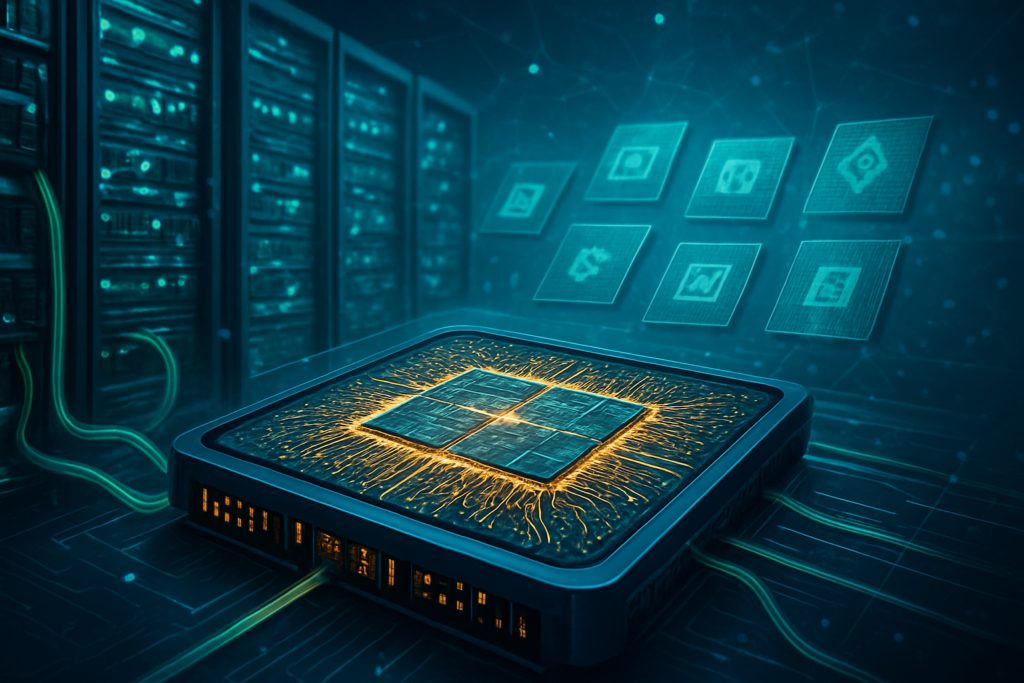
The Blackwell B200 is a technical marvel that redefines the limits of semiconductor engineering. Moving away from the single-die approach of the Hopper architecture, Blackwell utilizes a dual-die chiplet design fused by a blistering 10 TB/s interconnect. This configuration packs 208 billion transistors and provides 192GB of HBM3e memory, manufactured on TSMC’s (NYSE: TSM) advanced 4NP process. The most significant technical leap, however, is the introduction of the Second-Gen Transformer Engine and FP4 precision. This allows the B200 to deliver up to 18 PetaFLOPS of inference performance—a nearly 30x increase in throughput for trillion-parameter models compared to the H100 when deployed in liquid-cooled NVL72 rack configurations.
Initial reactions from the AI research community have been a mix of awe and logistical concern. While labs like OpenAI and Anthropic have praised the B200’s ability to handle the massive memory requirements of "reasoning" models (such as the o1 series), data center operators are grappling with the immense power demands. A single Blackwell rack can consume over 120kW, requiring a wholesale transition to liquid-cooling infrastructure. This thermal density has created a high barrier to entry, effectively favoring large-scale providers who can afford the specialized facilities needed to run Blackwell at peak performance. Despite these challenges, NVIDIA’s software ecosystem, centered around CUDA, remains a formidable moat that continues to make Blackwell the "gold standard" for frontier model training.
The Hyperscale Counter-Offensive: Custom Silicon Ascendant
While NVIDIA’s hardware is shipping in record volumes—estimated at 1,000 racks per week—the tech giants are increasingly pivoting to their own internal solutions. Google has recently unveiled its TPU v7 (Ironwood), built on a 3nm process, which aims to match Blackwell’s raw compute while offering superior energy efficiency for Google’s internal services like Search and Gemini. Similarly, Amazon Web Services (AWS) launched Trainium 3 at its recent re:Invent conference, claiming a 4.4x performance boost over its predecessor. These custom chips are not just for internal use; AWS and Google are offering deep discounts—up to 70%—to startups that choose their proprietary silicon over NVIDIA instances, a move designed to erode NVIDIA’s market share in the high-volume inference sector.
This shift has profound implications for the competitive landscape. Microsoft, despite facing delays with its Maia 200 (Braga) chip, has pivoted toward a "system-level" optimization strategy, integrating its Azure Cobalt 200 CPUs to maximize the efficiency of its existing hardware clusters. For AI startups, this diversification is a boon. By becoming platform-agnostic, companies like Anthropic are now training and deploying models across a heterogeneous mix of NVIDIA GPUs, Google TPUs, and AWS Trainium. This strategy mitigates the "NVIDIA Tax" and shields these companies from the supply chain volatility that characterized the 2023-2024 AI boom.
A Shifting Global Landscape: Sovereign AI and the Inference Pivot
Beyond the battle between NVIDIA and the hyperscalers, a new demand engine has emerged: Sovereign AI. Nations such as Japan, Saudi Arabia, and the United Arab Emirates are investing billions to build domestic compute stacks. In Japan, the government-backed Rapidus is racing to produce 2nm logic chips, while Saudi Arabia’s Vision 2030 initiative is leveraging subsidized energy to undercut Western data center costs by 30%. These nations are increasingly looking for alternatives to the U.S.-centric supply chain, creating a permanent new class of buyers that are just as likely to invest in custom local silicon as they are in NVIDIA’s flagship products.
This geopolitical shift is occurring alongside a fundamental change in the AI workload mix. In late 2025, the industry is moving from a "training-heavy" phase to an "inference-heavy" phase. While training a frontier model still requires the massive parallel processing power of a Blackwell cluster, running those models at scale for millions of users demands cost-efficiency above all else. This is where custom ASICs (Application-Specific Integrated Circuits) shine. By stripping away the general-purpose features of a GPU that aren't needed for inference, hyperscalers can deliver AI services at a fraction of the power and cost, challenging NVIDIA’s dominance in the most profitable segment of the market.
The Road to Rubin: NVIDIA’s Next Leap
NVIDIA is not standing still in the face of this rising competition. To maintain its lead, the company has accelerated its roadmap to a one-year cadence, recently teasing the "Rubin" architecture slated for 2026. Rubin is expected to leapfrog current custom silicon by moving to a 3nm process and incorporating HBM4 memory, which will double memory channels and address the primary bottleneck for next-generation reasoning models. The Rubin platform will also feature the new Vera CPU, creating a tightly integrated "Vera Rubin" ecosystem that will be difficult for competitors to unbundle.
Experts predict that the next two years will see a bifurcated market. NVIDIA will likely retain a 90% share of the "Frontier Training" market, where the most advanced models are built. However, the "Commodity Inference" market—where models are actually put to work—will become a battlefield for custom silicon. The challenge for NVIDIA will be to prove that its system-level integration (including NVLink and InfiniBand networking) provides enough value to justify its premium price tag over the "good enough" performance of custom hyperscale chips.
Summary of a New Era in AI Compute
The shipping of NVIDIA Blackwell marks the end of the "GPU shortage" era and the beginning of the "Silicon Diversity" era. Key takeaways from this development include the successful deployment of chiplet-based AI hardware at scale, the rise of 3nm custom ASICs as legitimate competitors for inference workloads, and the emergence of Sovereign AI as a major market force. While NVIDIA remains the undisputed king of performance, the aggressive moves by Google, Amazon, and Microsoft suggest that the era of a single-vendor monoculture is coming to an end.
In the coming months, the industry will be watching the real-world performance of Trainium 3 and the eventual launch of Microsoft’s Maia 200. As these custom chips reach parity with NVIDIA for specific tasks, the focus will shift from raw FLOPS to energy efficiency and software accessibility. For now, Blackwell is the most powerful tool ever built for AI, but for the first time, it is no longer the only game in town. The "Great Decoupling" has begun, and the winners will be those who can most effectively balance the peak performance of NVIDIA with the specialized efficiency of custom silicon.
This content is intended for informational purposes only and represents analysis of current AI developments.
TokenRing AI delivers enterprise-grade solutions for multi-agent AI workflow orchestration, AI-powered development tools, and seamless remote collaboration platforms.
For more information, visit https://www.tokenring.ai/.