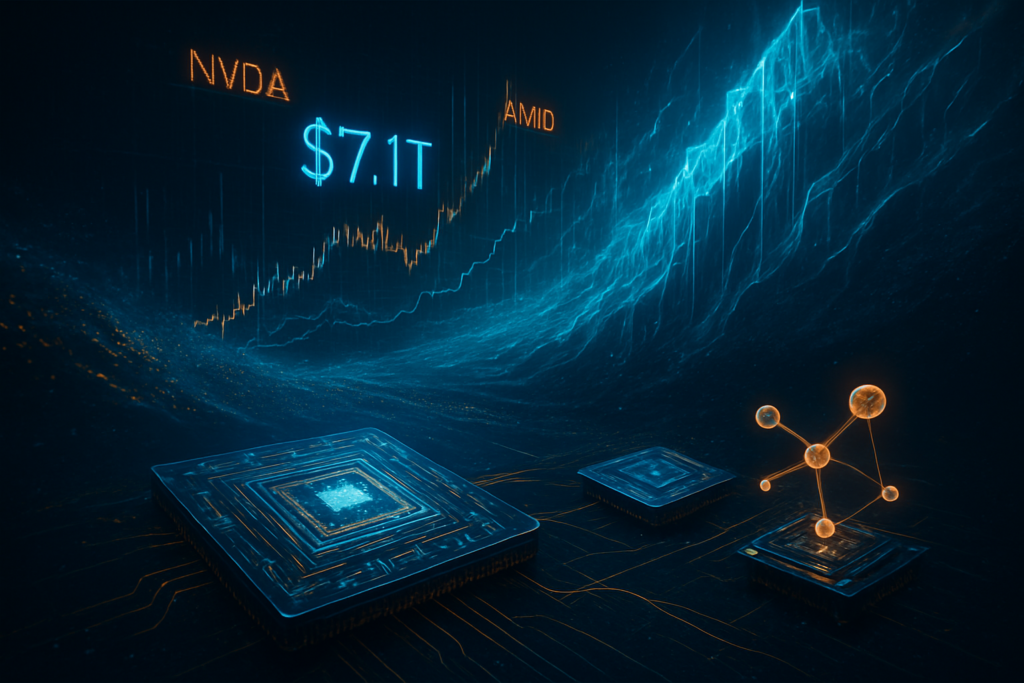
As the sun sets on the final full trading week of 2025, the financial world is witnessing a historic convergence of market forces known as "Triple Witching." Today, December 19, 2025, marks the simultaneous expiration of stock options, stock index futures, and stock index options contracts, totaling a staggering $7.1 trillion in notional value. This event, the largest of its kind in market history, has placed a spotlight on the semiconductor sector, where the high-stakes battle for AI dominance is being amplified by the mechanical churning of the derivatives market.
The immediate significance of this event cannot be overstated. With nearly 10.2% of the entire Russell 3000 market capitalization tied to these expiring contracts, the "Options Cliff" of late 2025 is creating a liquidity tsunami. For the AI industry, which has driven the lion's share of market gains over the last two years, this volatility serves as a critical stress test. As institutional investors and market makers scramble to rebalance their portfolios, the price action of AI leaders is being dictated as much by gamma hedging and "max pain" calculations as by fundamental technological breakthroughs.
The Mechanics of the 2025 'Options Cliff'
The sheer scale of today's Triple Witching is driven by a 20% surge in derivatives activity compared to late 2024, largely fueled by the explosion of zero-days-to-expiration (0DTE) contracts. These short-dated options have become the preferred tool for both retail speculators and institutional hedgers looking to capitalize on the rapid-fire news cycles of the AI sector. Technically, as these massive positions reach their expiration hour—often referred to as the "Witching Hour" between 3:00 PM and 4:00 PM ET—market makers are forced into aggressive "gamma rebalancing." This process requires them to buy or sell underlying shares to remain delta-neutral, often leading to sharp, erratic price swings that can decouple a stock from its intrinsic value for hours at a time.
A key phenomenon observed in today’s session is "pinning." Traders are closely monitoring price points where stocks gravitate as expiration approaches, representing the "max pain" for option buyers. For the semiconductor giants, these levels act like gravitational wells. This differs from previous years due to the extreme concentration of capital in a handful of AI-related tickers. The AI research community and industry analysts have noted that this mechanical volatility is now a permanent feature of the tech landscape, where the "financialization" of AI progress means that a breakthrough in large language model (LLM) efficiency can be overshadowed by the technical expiration of a trillion-dollar options chain.
Industry experts have expressed concern that this level of derivative-driven volatility could obscure the actual progress being made in silicon. While the underlying technology—such as the transition to 2-nanometer processes and advanced chiplet architectures—continues to advance, the market's "liquidity-first" behavior on Triple Witching days creates a "funhouse mirror" effect on company valuations.
Impact on the Titans: NVIDIA, AMD, and the AI Infrastructure Race
The epicenter of today's volatility is undoubtedly NVIDIA (NASDAQ: NVDA). Trading near $178.40, the company has seen a 3% intraday surge, bolstered by reports that the federal government is reviewing a new policy to allow the export of H200 AI chips to China, albeit with a 25% "security fee." However, the Triple Witching mechanics are capping these gains as market makers sell shares to hedge a massive concentration of expiring call options. NVIDIA’s position as the primary vehicle for AI exposure means it bears the brunt of these rebalancing flows, creating a tug-of-war between bullish fundamental news and bearish mechanical pressure.
Meanwhile, AMD (NASDAQ: AMD) is experiencing a sharp recovery, with intraday gains of up to 5%. After facing pressure earlier in the week over "AI bubble" fears, AMD is benefiting from a "liquidity tsunami" as short positions are covered or rolled into 2026 contracts. The company’s MI300X accelerators are gaining significant traction as a cost-effective alternative to NVIDIA’s high-end offerings, and today’s market activity is reflecting a strategic rotation into "catch-up" plays. Conversely, Intel (NASDAQ: INTC) remains a point of contention; while it is participating in the relief rally with a 4% gain, it continues to struggle with its 18A manufacturing transition, and its volatility is largely driven by institutional rebalancing of index-weighted funds rather than renewed confidence in its roadmap.
Other players like Micron (NASDAQ: MU) are also feeling the heat, with the memory giant seeing a 7-10% surge this week on strong guidance for HBM4 (High Bandwidth Memory) demand. For startups and smaller AI labs, this volatility in the "Big Silicon" space is a double-edged sword. While it provides opportunities for strategic acquisitions as valuations fluctuate, it also creates a high-cost environment for securing the compute power necessary for the next generation of AI training.
The Broader AI Landscape: Data Gaps and Proven Infrastructure
The significance of this Triple Witching event is heightened by the unique macroeconomic environment of late 2025. Earlier this year, a 43-day federal government shutdown disrupted economic reporting, creating what analysts call the "Great Data Gap." Today’s expiration is acting as a "pressure-release valve" for a market that has been operating on incomplete information for weeks. The recent cooling of the Consumer Price Index (CPI) to 2.7% YoY has provided a bullish backdrop, but the lack of consistent government data has made the mechanical signals of the options market even more influential.
We are also witnessing a clear "flight to quality" within the AI sector. In 2023 and 2024, almost any company with an "AI-themed" pitch could attract capital. By late 2025, the market has matured, and today's volatility reveals a concentration of capital into "proven" infrastructure. Investors are moving away from speculative software plays and doubling down on the physical backbone of AI—the chips, the cooling systems, and the power infrastructure. This shift mirrors previous technology cycles, such as the build-out of fiber optics in the late 1990s, where the winners were those who controlled the physical layer of the revolution.
However, potential concerns remain regarding the "Options Cliff." If the market fails to hold key support levels during the final hour of trading, it could trigger a "profit-taking reversal." The extreme concentration of derivatives ensures that any crack in the armor of the AI leaders could lead to a broader market correction, as these stocks now represent a disproportionate share of major indices.
Looking Ahead: The Road to 2026
As we look toward the first quarter of 2026, the market is bracing for several key developments. The potential for a "Santa Claus Rally" remains high, as the "gamma release" following today's expiration typically clears the path for a year-end surge. Investors will be closely watching the implementation of the H200 export policies and whether they provide a sustainable revenue stream for NVIDIA or invite further geopolitical friction.
In the near term, the focus will shift to the actual deployment of next-generation AI agents and multi-agent workflows. The industry is moving beyond simple chatbots to autonomous systems capable of complex reasoning, which will require even more specialized silicon. Challenges such as power consumption and the "memory wall" remain the primary technical hurdles that experts predict will define the semiconductor winners of 2026. Companies that can innovate in power-efficient AI at the edge will likely be the next targets for the massive liquidity currently swirling in the derivatives market.
Summary of the 2025 Triple Witching Impact
The December 19, 2025, Triple Witching event stands as a landmark moment in the financialization of the AI revolution. With $7.1 trillion in contracts expiring, the day has been defined by extreme mechanical volatility, pinning prices of leaders like NVIDIA and AMD to key technical levels. While the "Options Cliff" creates temporary turbulence, the underlying demand for AI infrastructure remains the primary engine of market growth.
Key takeaways for investors include:
- Mechanical vs. Fundamental: On Triple Witching days, technical flows often override company news, requiring a patient, long-term perspective.
- Concentration Risk: The AI sector’s dominance of the indices means that semiconductor volatility is now synonymous with market volatility.
- Strategic Rotation: The shift from speculative AI to proven infrastructure plays like NVIDIA and Micron is accelerating.
In the coming weeks, market participants should watch for the "gamma flip"—a period where the market becomes more stable as new contracts are written—and the potential for a strong start to 2026 as the "Great Data Gap" is finally filled with fresh economic reports.
This content is intended for informational purposes only and represents analysis of current AI developments.
TokenRing AI delivers enterprise-grade solutions for multi-agent AI workflow orchestration, AI-powered development tools, and seamless remote collaboration platforms.
For more information, visit https://www.tokenring.ai/.