Building products manufacturer JELD-WEN (NYSE: JELD) fell short of the market’s revenue expectations in Q3 2026, with revenue falling 1.4% year on year to $798.5 million. On the other hand, the company’s full-year revenue outlook of $3.15 billion at the midpoint was close to analysts’ consensus estimates. Its non-GAAP profit of $0.05 per share was in line with analysts’ consensus estimates.
For more on JELD-WEN, read our free full research report.
JELD-WEN (JELD) Q3 2026 highlights:
- Revenue $798.5 million vs S&P analysts’ consensus estimates of $806.3 million (1.4% year-on-year decline, 1% miss)
- Adjusted EPS $0.05 vs S&P analysts’ consensus estimates of $0.05 (in line)
- Adjusted EBITDA $54.4 million vs analysts’ consensus estimates of $49.7 million (6.8% margin, 9.5% beat)
- Revenue guidance The company reconfirmed its revenue guidance for the full year of $3.15 billion at the midpoint
- EBITDA guidance $135 million at the midpoint for the full year, above analysts’ consensus estimates of $130.1 million
- Operating margin 1.1%, up from -25% in the same quarter last year
- Free cash flow $15.8 million, up from -$16.5 million in the same quarter last year
- Organic revenue fell 1% year on year
- Market capitalization $110.2 million
"Our third-quarter results reflect the continued progress we are making to strengthen our business, even as market conditions remain challenging," said Chief Executive Officer William J. Christensen. "We remain focused on improving service, managing costs, and driving productivity, which are helping us improve our competitive position. Despite a softer market outlook, we are maintaining our full-year revenue and Adjusted EBITDA guidance while making important progress on our strategic priorities, including our debt refinancing and the future of our European business."
Revenue growth
Examining a company’s long-term performance can provide clues about its quality. Any business can experience short-term success, but top-performing ones sustain growth for years. JELD-WEN struggled to consistently generate demand over the last five years as its revenue dropped at a 7.5% annual rate. That underwhelming result suggests poor business quality.
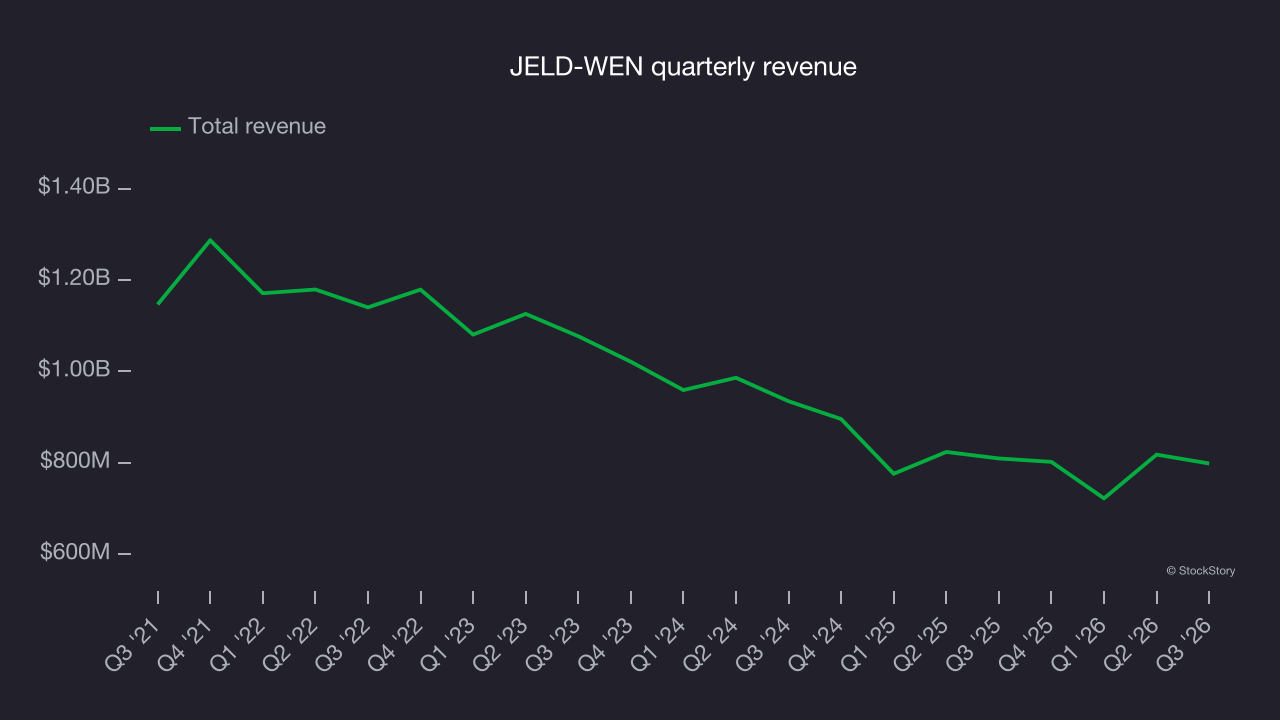
Long-term growth matters most, but within industrials, a half-decade historical view may miss cycles, industry trends or a company capitalizing on catalysts such as a new contract win or a successful product line. JELD-WEN’s recent performance shows its demand remained suppressed as its revenue has declined by 10.3% annually over the last two years. 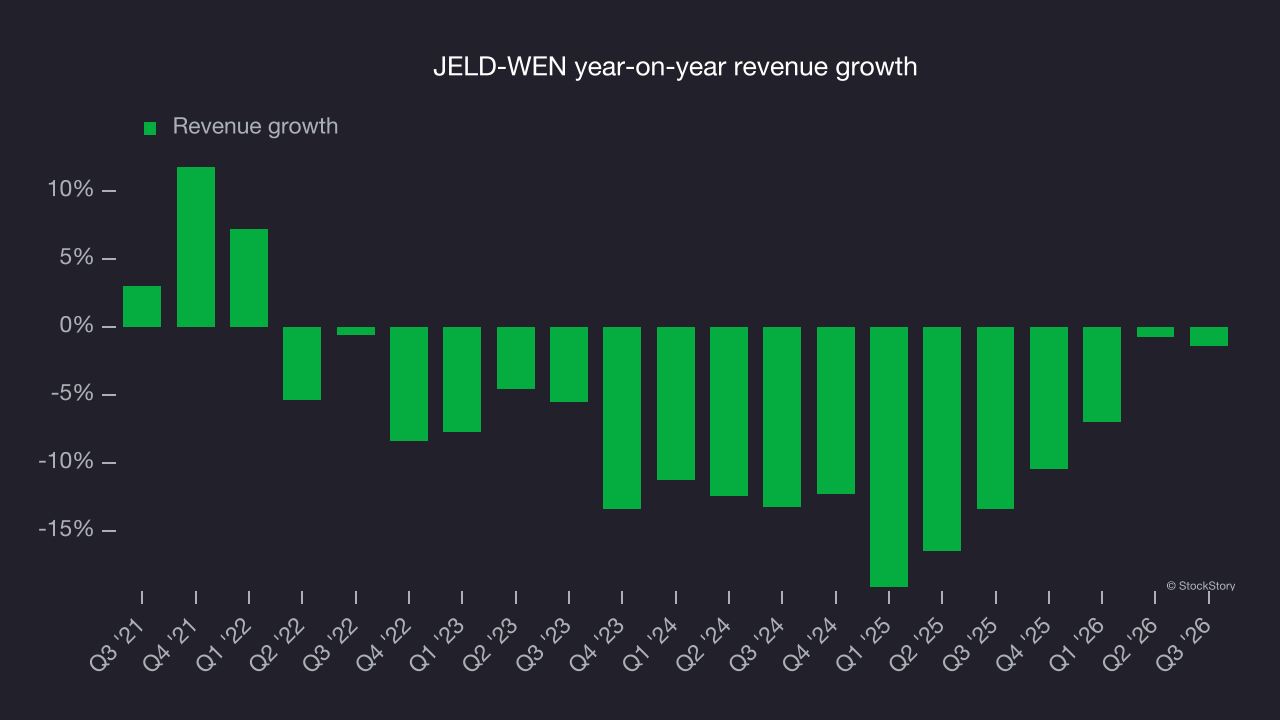
Analyzing the company’s organic revenue helps explain its revenue dynamics by stripping out one-time events like acquisitions and currency fluctuations that don’t accurately reflect its fundamentals. Over the last two years, JELD-WEN’s organic revenue averaged 8.9% year-on-year declines. This was in line with its two-year revenue growth, indicating that core operations, rather than acquisitions and divestitures, drove most of its results. 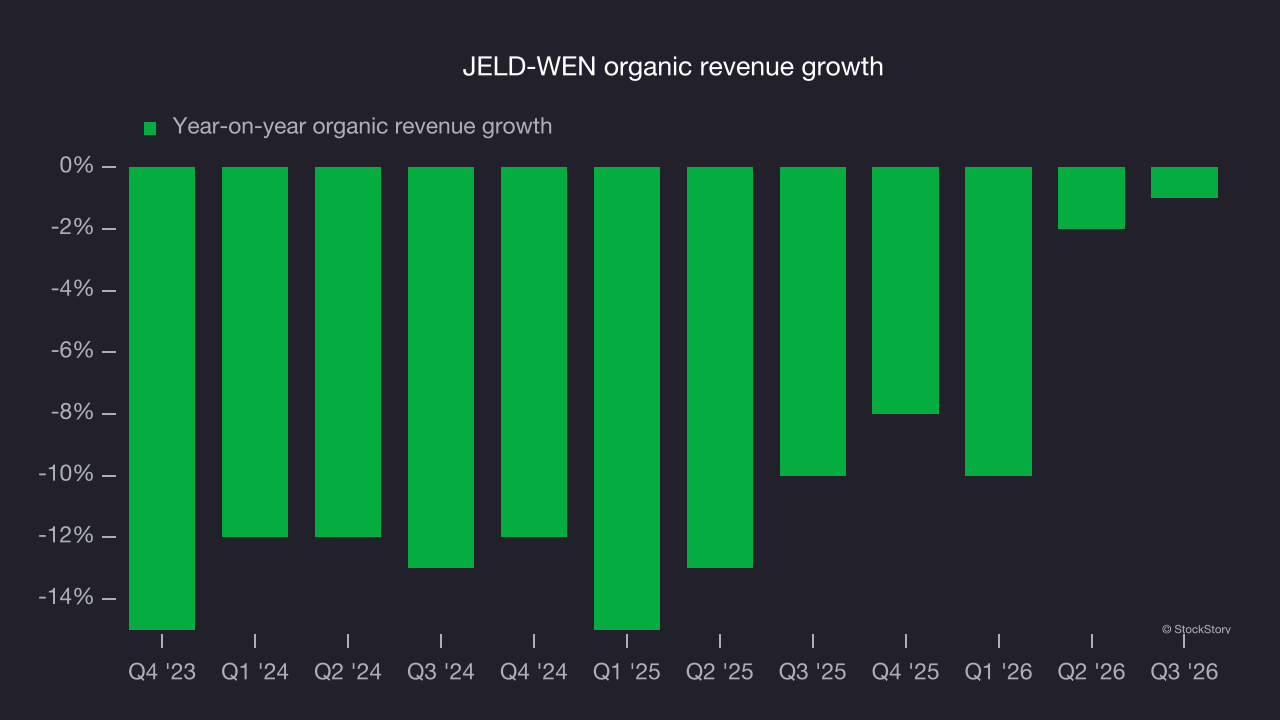
This quarter, JELD-WEN missed Wall Street’s consensus estimates and reported an uninspiring 1.4% year-on-year revenue decline, generating $798.5 million of revenue.
Looking ahead, sell-side analysts expect revenue to grow 1.8% over the next 12 months, according to S&P. Although this projection implies its newer products and services will drive better revenue performance, it is still below average for the sector.
Operating margin
Operating margin is one of the best measures of profitability because it tells us how much money a company takes home after procuring and manufacturing its products, marketing and selling those products and, most importantly, keeping them relevant through research and development.
Although JELD-WEN was profitable this quarter from an operational perspective, it’s generally struggled over a longer time period. Its expensive cost structure has contributed to an average operating margin of negative 1.6% over the last five years. Unprofitable industrials companies require extra attention because they can be vulnerable in a downturn. It’s hard to be confident the business can endure a full cycle.
Looking at the trend in its profitability, JELD-WEN’s operating margin decreased by 4.4 percentage points over the last five years. JELD-WEN’s performance was poor, showing that costs were rising and it couldn’t pass them on to its customers.
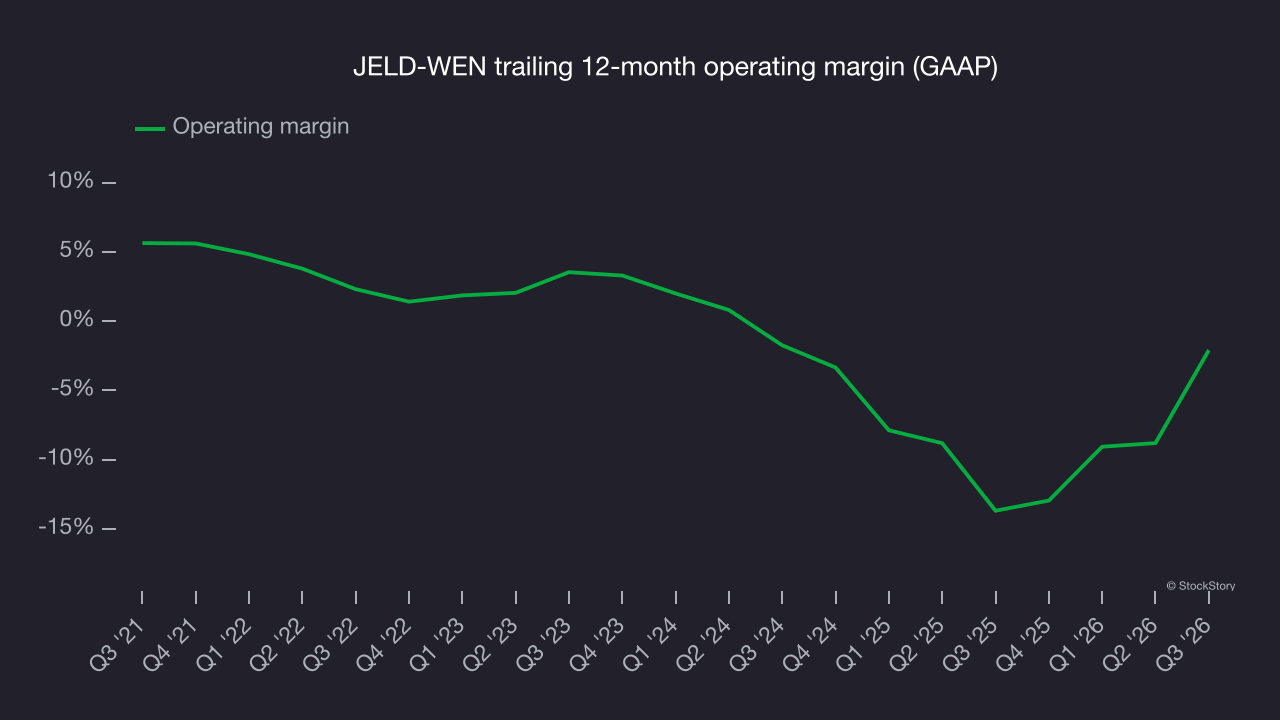
This quarter, JELD-WEN generated an operating margin of 1.1%, up 26.1 percentage points year on year. The increase was solid, and its operating margin rose more than its gross margin, indicating it was more efficient with expenses such as marketing, research and development and administrative overhead.
Earnings per share
Revenue trends explain a company’s historical growth, but the long-term change in earnings per share, or EPS, points to the profitability of that growth – for example, a company could inflate its revenue through excessive spending on advertising and promotions.
JELD-WEN’s EPS declined by 20.7% annually over the last five years, more than its revenue. This indicates the company struggled because its fixed cost base made it difficult to adjust to shrinking demand.
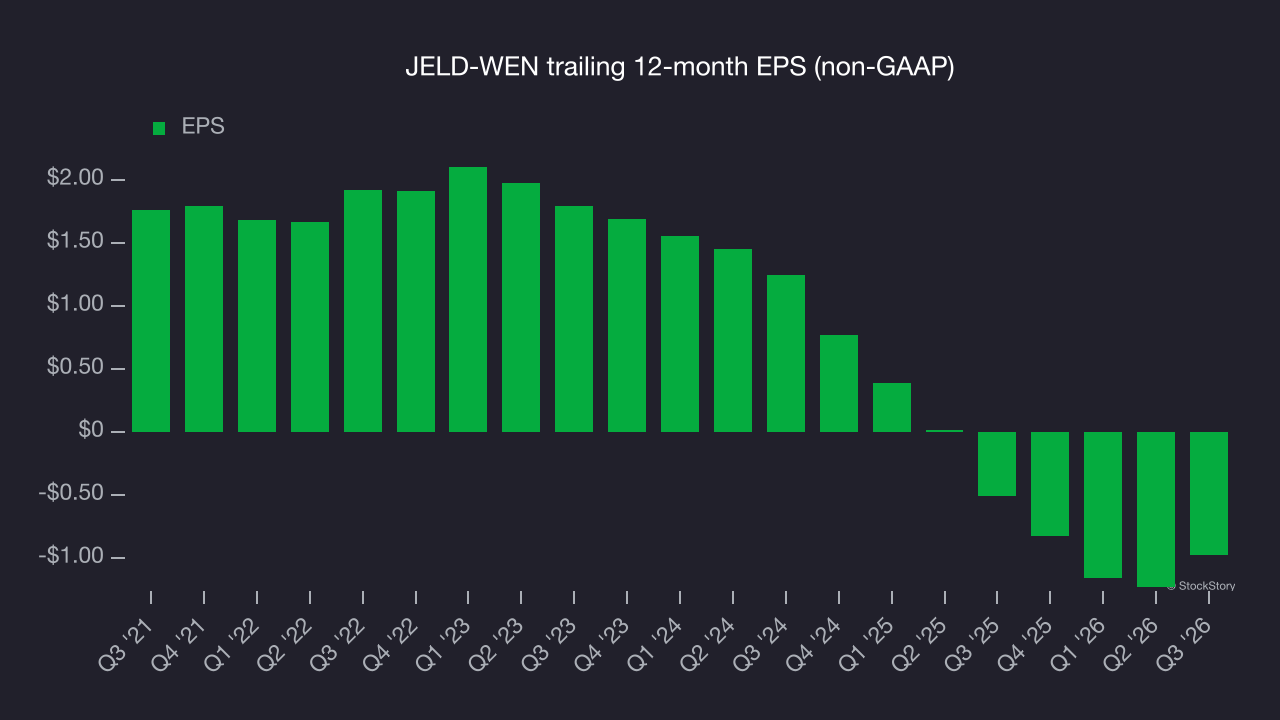
A closer look at JELD-WEN’s earnings can provide a better understanding of its performance. As mentioned earlier, JELD-WEN’s operating margin expanded this quarter but declined by 4.4 percentage points over the last five years. This was the most relevant factor (aside from the revenue impact) behind its lower earnings; interest expenses and taxes can also affect EPS but reveal less about a company’s fundamentals.
As with revenue, analyzing EPS over a more recent period can provide insight into an emerging theme or development for the business.
JELD-WEN’s two-year annual EPS declines of 67% show it has continued to underperform. These results were poor by any measure.
In Q3, JELD-WEN reported adjusted EPS of $0.05, up from negative $0.20 in the same quarter last year. This result beat analysts’ consensus estimates by 9.3%. Over the next 12 months, Wall Street expects JELD-WEN to reduce its losses. Analysts forecast its full-year EPS will improve from negative $0.98 to negative $0.31, according to S&P.
Key takeaways from JELD-WEN’s Q3 results
JELD-WEN delivered a solid quarter, with EBITDA well above analysts’ consensus estimates and full-year EBITDA guidance also topping Wall Street’s consensus. Revenue, however, came in slightly below expectations. Shares surged 9.9% to $1.32 immediately after the release.
JELD-WEN may have had a good quarter, but that alone doesn’t make the stock a buy. The latest quarter matters, but not nearly as much as longer-term fundamentals and valuation when making that decision. For more on those factors, read our free full research report here.