Radiation safety company Mirion (NYSE: MIR) reported Q3 2026 results exceeding the market’s revenue expectations, with revenue up 24.5% year on year to $277.8 million. Its non-GAAP profit of $0.12 per share was in line with analysts’ consensus estimates.
For more on Mirion, read our full research report for free.
Mirion (MIR) Q3 2026 highlights:
- Revenue $277.8 million vs S&P analysts’ consensus estimates of $274.9 million (24.5% year-on-year growth, 1.1% beat)
- Adjusted EPS $0.12 vs S&P analysts’ consensus estimates of $0.12 (in line)
- Adjusted EBITDA $64.8 million vs analysts’ consensus estimates of $69.04 million (23.3% margin, 6.1% miss)
- Adjusted EPS guidance Management slightly raised its full-year adjusted EPS guidance to $0.52 at the midpoint
- EBITDA guidance $288.5 million at the midpoint for the full year, in line with analysts’ consensus estimates
- Operating margin 6.2%, up from 3.8% in the same quarter last year
- Free cash flow margin 17%, up from 5.8% in the same quarter last year
- Market capitalization $3.63 billion
“Third quarter results showcase quarterly orders performance, an inflection in organic revenue growth, and a doubling of year-to-date adjusted free cash flow generation,” commented Mirion’s Chairman and Chief Executive Officer Thomas Logan. “Orders continued to trend higher, up 62% excluding acquisitions, boosted by a 105% increase in nuclear power-related orders. Organic revenue increased 6.5% in the third quarter and we expect mid-to-high teens growth in the fourth quarter. Meanwhile, adjusted free cash flow totaled $47 million in the quarter, or $107 million year-to-date. We expect to reduce net leverage to approximately 2.6x by year-end, reflecting continued strong adjusted free cash flow.”
Revenue growth
A company’s long-term revenue performance can indicate its overall quality. Any business can have short-term success, but a top-tier one grows for years.
With $1.08 billion in revenue over the past 12 months, Mirion is a small player in the business services space, which sometimes brings disadvantages compared to larger competitors benefiting from economies of scale and numerous distribution channels. On the positive side, it can grow faster because it has more room to expand.
Mirion’s 10.3% annualized revenue growth over the last five years was impressive. This shows Mirion’s demand was higher than that of many business services companies.
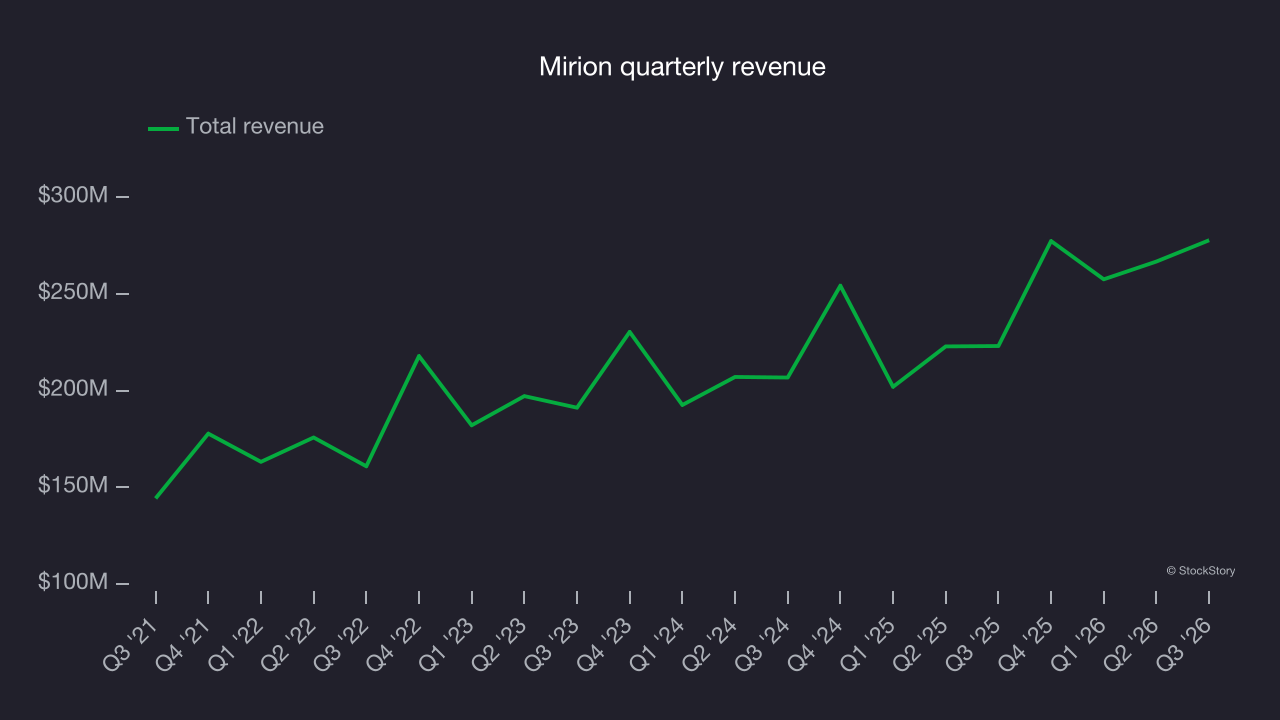
Long-term growth is the most important, but within business services, a half-decade historical view may miss new innovations or demand cycles. Mirion’s annualized revenue growth of 13.6% over the last two years is above its five-year trend, suggesting its demand was strong and recently accelerated. 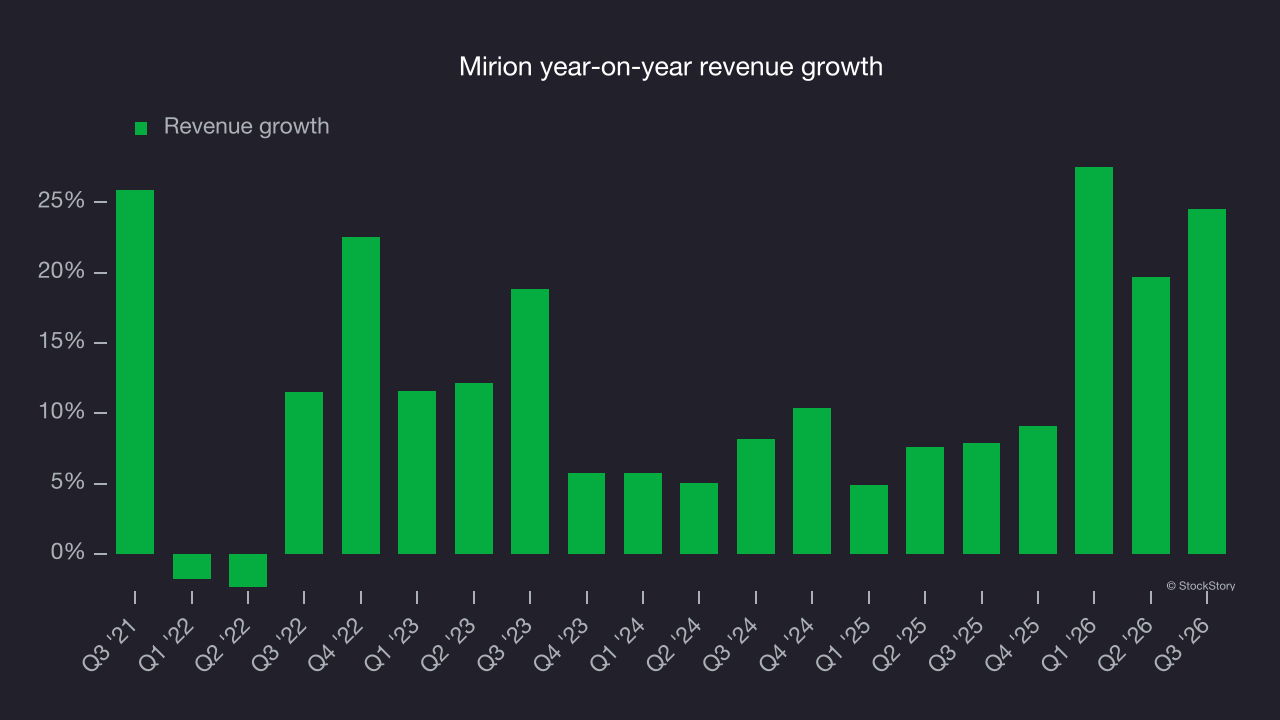
This quarter, Mirion reported strong year-on-year revenue growth of 24.5%, and its $277.8 million of revenue topped Wall Street’s consensus estimates by 1.1%.
Looking ahead, sell-side analysts expect revenue to grow 11.1% over the next 12 months, according to S&P, a slight deceleration versus the last two years. Despite the slowdown, this projection remains strong and suggests the market is forecasting success for its products and services.
Adjusted operating margin
Adjusted operating margin is one of the best measures of profitability because it tells us how much money a company takes home after subtracting all core expenses, like marketing and R&D. It also removes various one-time costs to paint a better picture of normalized profits.
Mirion was profitable over the last five years but held back by its large cost base. Its average adjusted operating margin of 3.6% was weak for a business services business.
On the positive side, Mirion’s adjusted operating margin rose by 14.8 percentage points over the last five years, as its revenue growth provided operating leverage.
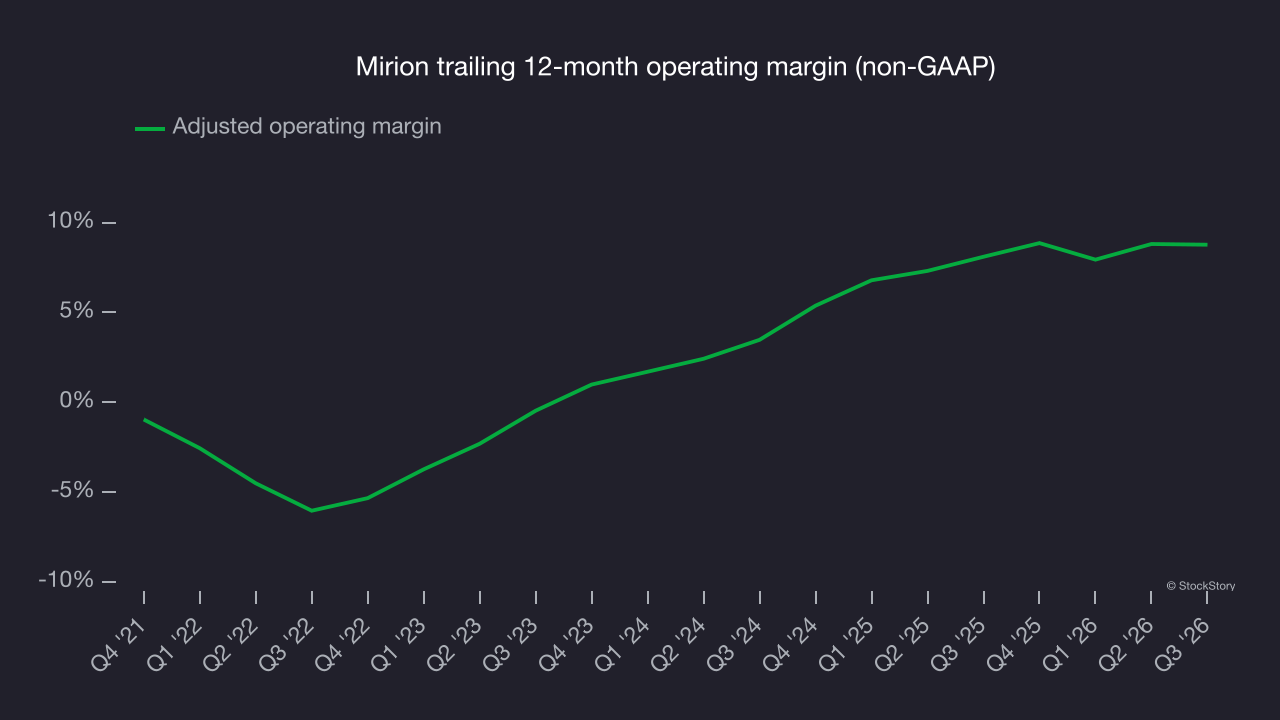
This quarter, Mirion generated an adjusted operating margin of 6.2%, in line with the same quarter last year. This indicates the company’s overall cost structure has been relatively stable.
Earnings per share
Revenue trends explain a company’s historical growth, but the long-term change in earnings per share (EPS) points to the profitability of that growth. For example, a company could inflate its revenue through excessive spending on advertising and promotions.
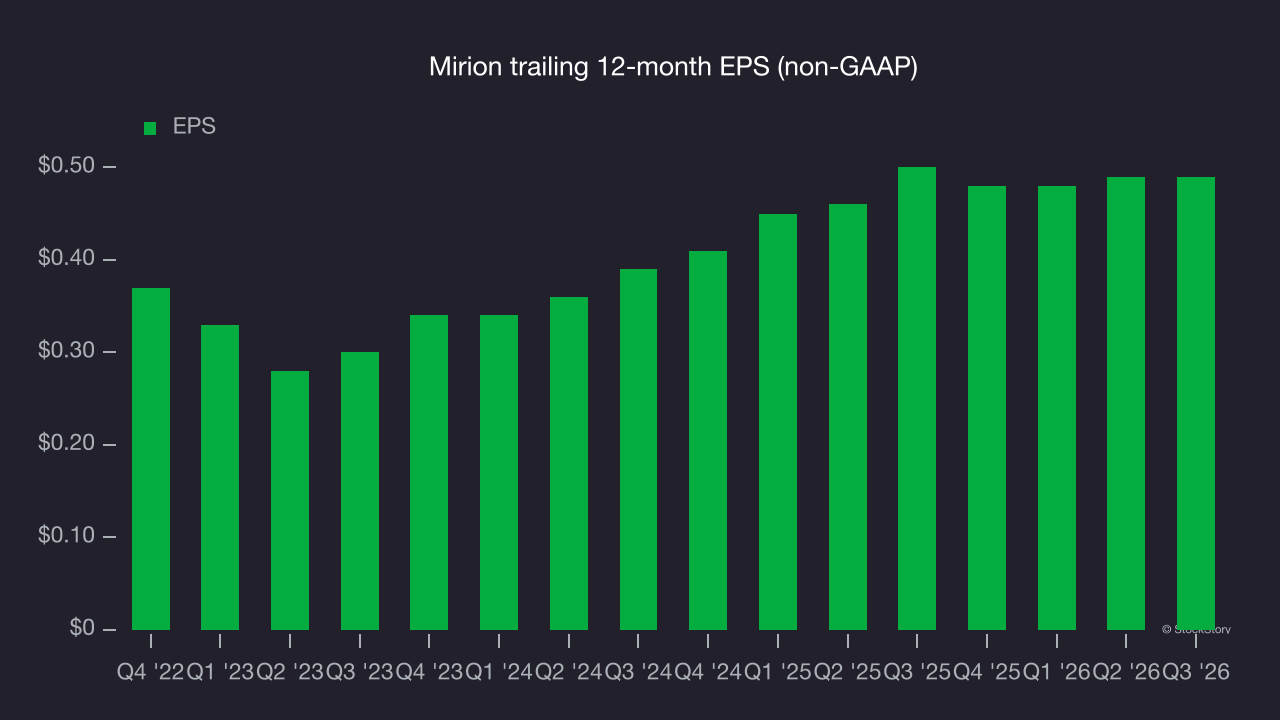
Mirion’s full-year EPS grew at an unimpressive 6.9% compounded annual growth rate over the last four years, in line with the broader business services sector.
As with revenue, looking at EPS over a shorter period can reveal changes in the business.
Mirion’s solid 12.1% annual EPS growth over the last two years aligns with its revenue trend. This indicates its incremental revenue was profitable.
In Q3, Mirion reported adjusted EPS of $0.12, in line with the same quarter last year. This result missed analysts’ consensus estimates. Over the next 12 months, Wall Street expects Mirion’s full-year EPS to grow 30.8% from $0.49 to $0.64, according to S&P.
Key takeaways from Mirion’s Q3 results
Mirion’s narrow revenue beat was a bright spot in an otherwise softer quarter. EPS met Wall Street’s consensus estimates, but full-year EPS guidance fell short. Shares fell 4.5% to $14.70 immediately after the report.
Mirion’s latest quarter was underwhelming. One earnings report doesn’t define a company’s quality, though, so it is worth examining whether the stock is a buy at the current price. What happened in the latest quarter matters, but not as much as longer-term business quality and valuation when deciding whether to invest in this stock. For more on Mirion, read the full research report here (it’s free).