
Date: January 1, 2026
Introduction
As we enter 2026, Amazon.com, Inc. (NASDAQ: AMZN) stands at a pivotal crossroads. No longer just an "everything store," the Seattle-based titan has transformed into a diversified technology and infrastructure powerhouse. Under the leadership of CEO Andy Jassy, Amazon has spent the last two years pivoting from a post-pandemic expansion hangover toward a lean, AI-centric "Efficiency Era." With its cloud computing division reaccelerating and its advertising business becoming a dominant market force, Amazon remains a core focus for institutional and retail investors alike. However, as it navigates a landmark year involving satellite launches and a high-stakes federal antitrust trial, the company’s ability to maintain its "Day 1" culture is being tested like never before.
Historical Background
Founded in 1994 by Jeff Bezos in a Bellevue garage, Amazon began as an online bookstore. Its early years were defined by a relentless focus on customer obsession and a willingness to incur massive losses to build scale. Key milestones—the launch of Prime in 2005, the acquisition of Whole Foods in 2017, and the 2006 birth of Amazon Web Services (AWS)—turned a niche retailer into the backbone of the internet and global logistics. Over three decades, Amazon has survived the dot-com bubble, the 2008 financial crisis, and a global pandemic, consistently reinventing itself. The transition from Bezos to Jassy in 2021 marked the beginning of a shift toward operational optimization and the aggressive integration of Generative AI.
Business Model
Amazon operates a multi-layered business model designed around a "flywheel" effect, where each segment reinforces the others:
- AWS (Cloud Computing): The company’s primary profit engine, providing compute, storage, and AI services to enterprises.
- Retail (1P & 3P): Direct sales (First-party) and a massive Marketplace (Third-party) for independent sellers.
- Advertising: Monetizing the massive search intent on its retail platform and Prime Video streaming services.
- Subscription Services: Prime memberships, which drive customer loyalty and recurring revenue through shipping, video, and music benefits.
- Physical Stores: Primarily Whole Foods and Amazon Fresh, serving as a beachhead in the grocery market.
Stock Performance Overview
As of January 1, 2026, Amazon’s stock performance reflects a company that has successfully matured:
- 1-Year Performance: AMZN ended 2025 at approximately $230.82, a modest gain of roughly 10% for the year, trailing the broader S&P 500 but stabilizing after the volatility of 2024.
- 5-Year Performance: Investors who held from early 2021 have seen a rollercoaster, but the stock has roughly doubled as the company digested its massive 2020-2022 capex cycle.
- 10-Year Performance: A decade-long hold has been transformative, with the stock delivering over 600% returns, vastly outperforming traditional market benchmarks.
The stock reached an all-time high of $258.60 in November 2025 before a year-end consolidation.
Financial Performance
In the 2025 fiscal year, Amazon demonstrated the power of its high-margin segments.
- Revenue: Total revenue is estimated to have crossed $650 billion, driven by 18-20% growth in AWS and nearly 25% growth in advertising.
- AWS Margins: AWS operating margins expanded toward 40% in late 2025, buoyed by the adoption of custom Trainium2 and Inferentia chips.
- Retail Margins: Logistics regionalization helped push North American retail margins to a record 12% in Q4 2025.
- Valuation: The stock currently trades at a forward P/E of roughly 30x 2026 earnings, which many analysts consider attractive given the growth in high-margin cash flow.
Leadership and Management
CEO Andy Jassy has successfully steered the company through a period of intense cost-cutting. In late 2025, Jassy executed a major organizational flattening, reducing the manager-to-individual contributor ratio by 15% and removing roughly 14,000 corporate roles to speed up decision-making. The implementation of a mandatory 5-day in-office policy in January 2025 remains a point of internal contention but underscores the leadership's commitment to returning to a high-intensity, "Day 1" startup culture.
Products, Services, and Innovations
Innovation in 2025 was dominated by "Amazon Nova," a suite of multimodal AI models that compete directly with the industry's best.
- Generative AI: Amazon Q, an AI assistant for businesses, has seen mass adoption for "agentic" workflows.
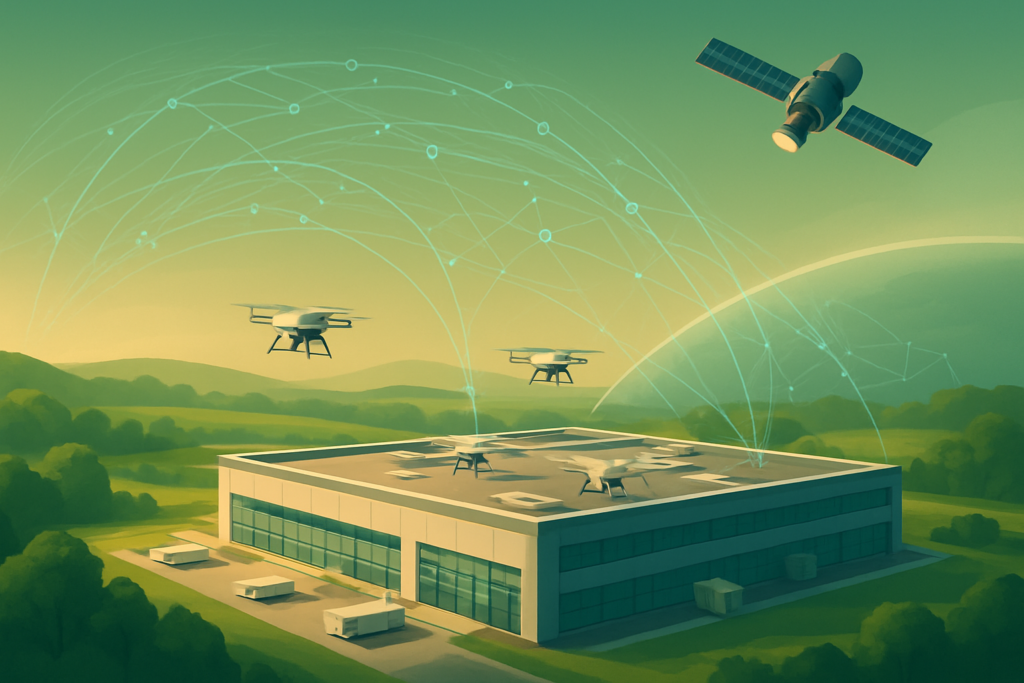
- Amazon Leo (formerly Project Kuiper): Amazon’s low-earth orbit satellite network began production launches in mid-2025. With roughly 150 satellites currently in orbit, it aims to provide global broadband and challenge SpaceX's Starlink.
- Logistics AI: New AI systems now predict regional demand with such accuracy that Amazon can pre-position inventory before orders are even placed, drastically reducing shipping costs.
Competitive Landscape
Amazon faces a multi-front war:
- Cloud: Microsoft (NASDAQ: MSFT) and Alphabet (NASDAQ: GOOGL) continue to challenge AWS, particularly in AI-specific workloads. AWS remains the leader with a ~31% market share.
- Retail: Walmart (NYSE: WMT) has seen its e-commerce market share grow to 7% in 2025, leveraging its physical store network for grocery delivery.
- Low-Cost Competitors: The rise of Temu and Shein forced Amazon to launch a specialized "low-cost storefront" in 2025 to retain budget-conscious consumers in the $20-and-under category.
Industry and Market Trends
The "Amazonification" of logistics continues as the industry moves toward same-day and sub-same-day delivery as the standard. In the tech sector, the transition from GenAI "chatbots" to autonomous "agents" is the defining trend of 2026. Amazon’s deep integration into enterprise data through AWS places it in a prime position to capitalize on these autonomous systems.
Risks and Challenges
The most significant cloud over the stock is the upcoming FTC Antitrust Trial, scheduled for October 2026. The government alleges Amazon uses monopoly power to squeeze third-party sellers. Structural remedies, including a potential breakup, are low-probability but high-impact risks. Additionally, the massive capital expenditure required for AI infrastructure (estimated at $75B+ for 2025) has put pressure on free cash flow growth.
Opportunities and Catalysts
- Advertising Maturation: Prime Video ads are expected to contribute over $5 billion in high-margin revenue in 2026.
- Satellite Connectivity: If Amazon can meet its July 2026 FCC deadline for satellite deployment, "Amazon Leo" could open a multi-billion dollar recurring revenue stream from government and enterprise contracts.
- Healthcare: Further integration of One Medical and pharmacy services into the Prime ecosystem remains an untapped growth lever.
Investor Sentiment and Analyst Coverage
Wall Street enters 2026 with a "Strong Buy" consensus on AMZN. Analysts highlight the "earnings power story," suggesting that as AWS and Advertising become a larger percentage of the total revenue mix, the company's consolidated margins will continue to rise. Major institutional holders like Vanguard and BlackRock have increased their positions in late 2025, citing the company’s disciplined approach to AI spending compared to its peers.
Regulatory, Policy, and Geopolitical Factors
Regulatory pressure is intensifying globally. In September 2025, Amazon settled a $2.5 billion case with the FTC regarding "dark patterns" in Prime cancellations. In the EU, the Digital Markets Act (DMA) continues to force Amazon to open its platform to more competition. Geopolitically, the company is diversifying its supply chain away from China toward India and Southeast Asia to mitigate trade tensions and potential tariffs.
Conclusion
As of January 1, 2026, Amazon is a leaner, more focused version of its former self. By successfully navigating the "Efficiency Era," Andy Jassy has proven that the company can grow profits even when top-line growth in retail slows. For investors, the bull case rests on the dominance of AWS in an AI-driven world and the expansion of its advertising empire. However, the looming antitrust trial and the execution risks of the "Amazon Leo" satellite project demand a cautious, long-term perspective. Amazon remains the ultimate "flywheel" business, but in 2026, the friction of regulation and competition is greater than ever before.
Disclaimer: This content is intended for informational purposes only and is not financial advice. The author has no position in the mentioned securities at the time of writing.