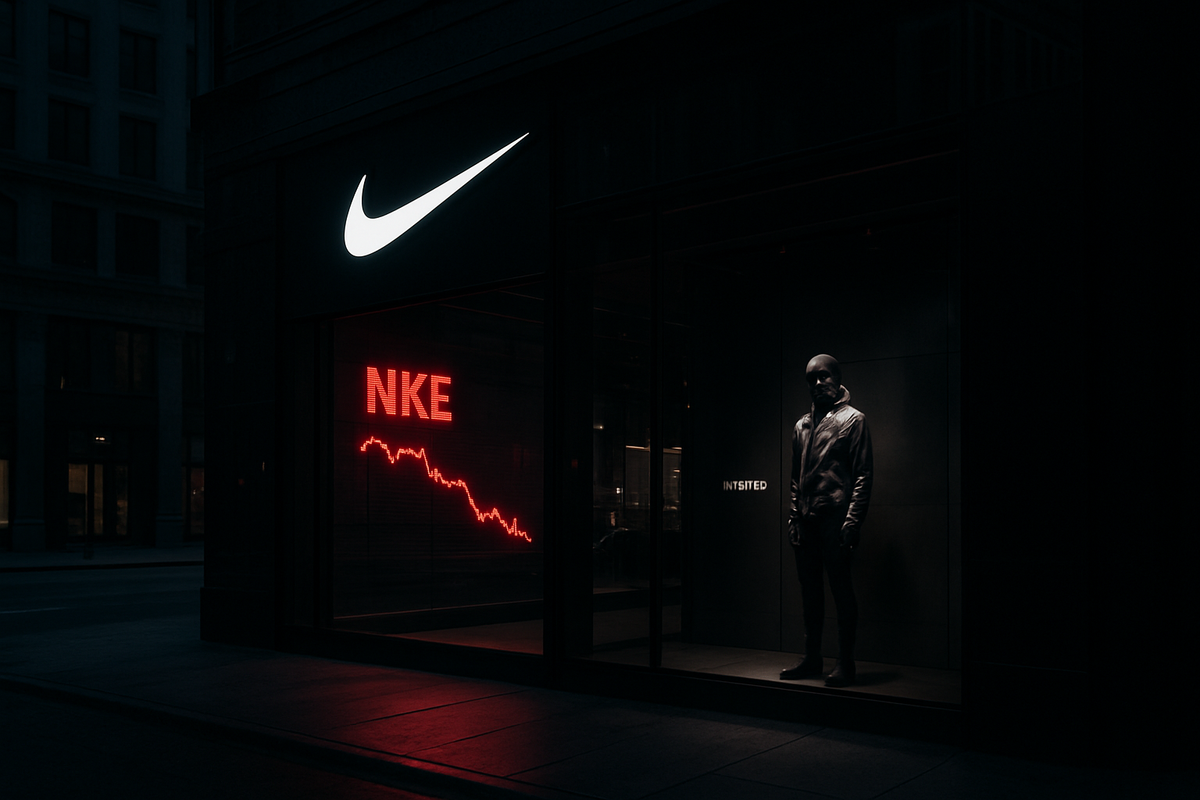
The global titan of athletic footwear and apparel, Nike (NYSE: NKE), has found itself in an unfamiliar position: the underdog. On April 2, 2026, the company’s stock price plummeted to a staggering 10-year low of $44.19, closing a brutal week that saw nearly 15.5% of the company's market capitalization vanish in a single session. This collapse follows a disastrous third-quarter earnings report that underscored the deepening crisis in the company’s turnaround efforts and a rapidly eroding market share in key territories like Greater China.
For a brand that has dominated the cultural and competitive landscape for decades, the current freefall is a sobering reality check. The immediate implications are clear: investor patience is wearing thin as the "Win Now" strategy spearheaded by veteran CEO Elliott Hill faces its first major stress test. With the stock now down roughly 30% year-to-date and a staggering 75% below its 2021 peak, the pressure on management to prove that the brand has not lost its "cool" factor—or its competitive edge—has reached a fever pitch.
The Quarter of Discontent: A Timeline of the Plunge
The catalyst for the current slide was the April 1, 2026, release of Nike’s Q3 fiscal results. While the company technically managed a slight beat on earnings per share, the underlying metrics told a story of a business in retreat. Revenue remained flat year-over-year at $11.3 billion, but net income cratered by 35%, falling to just $520 million. The most alarming data point came from Greater China, where sales dropped by 10%, with management warning of a potential 20% decline in the upcoming fourth quarter. This regional weakness, combined with $1.5 billion in profit erosion due to North American tariffs, sent shockwaves through the market.
The timeline leading to this decade-low reflects a long-brewing storm. In late 2024, Nike replaced then-CEO John Donahoe with Elliott Hill, a 32-year company veteran who was brought back from retirement to fix what many saw as a broken culture. Under Donahoe, the "Consumer Direct Acceleration" (CDA) strategy had prioritized Nike’s own digital channels while alienating traditional wholesale partners like Foot Locker (NYSE: FL) and Dick’s Sporting Goods (NYSE: DKS). This move inadvertently opened the door for hungrier, more specialized competitors to take over shelf space that Nike had voluntarily vacated.
The market reaction has been swift and unforgiving. In the days following the Q3 report, major financial institutions issued a flurry of downgrades. Goldman Sachs (NYSE: GS) lowered its rating to "Neutral," slashing its price target from $76 to $52, citing "muted momentum" that could stretch well into 2027. DA Davidson followed suit with an even more cautious stance, downgrading the stock to "Neutral" and setting a price target of $46, reflecting deep skepticism about the near-term sales trajectory of the brand's core running and lifestyle categories.
Winners and Losers in the Footwear Arms Race
As Nike struggles to find its footing, a new guard of athletic brands is capitalizing on the giant's missteps. Adidas (OTC:ADDYY) has emerged as a primary beneficiary, staging a massive resurgence in 2025 and 2026. By leaning into its "Terrace" shoe trend—anchored by the Samba and Gazelle models—and successfully launching its "Back to Sport" marketing campaign, Adidas has reclaimed the lifestyle zeitgeist that Nike once owned. Analysts note that for every point of market share Nike loses in urban centers, Adidas appears to be picking up a significant portion.
The premium performance sector has seen the most dramatic shift. On Holding (NYSE: ONON), the Swiss-based running company, reached a milestone of $2.4 billion in annual sales by early 2026, growing at a rate of over 40%. Similarly, Deckers Brands (NYSE: DECK), the parent company of Hoka, has continued to dominate the "maximalist" running category. These brands have successfully captured the "wealthy-wellness" demographic that has increasingly viewed Nike’s mass-market offerings as less innovative. Meanwhile, Lululemon Athletica (NASDAQ: LULU) has made significant inroads into the women’s performance footwear space, a segment where Nike reported "stuttering" growth during its recent earnings call.
On the losing side of this equation are the major retail partners who tied their fortunes to Nike’s direct-to-consumer pivot. While Elliott Hill has pledged to restore wholesale relationships, the damage has been significant. Traditional retailers like Foot Locker have had to pivot their own inventories to include more "alternative" brands to compensate for Nike’s reduced pull. Furthermore, in the international theater, Anta Sports (OTC:ANPDY) and other domestic Chinese brands are winning a "home-court advantage," as nationalist buying trends and superior local distribution networks make it increasingly difficult for Nike to compete on its historical terms.
Industry Trends and Innovation Fatigue
Nike’s current predicament is symptomatic of a broader shift in the retail landscape. The era of "DTC-at-all-costs" has ended, replaced by a "hybrid-omnichannel" reality that demands strong wholesale presence for brand discovery and credibility. Nike’s retreat from specialty running stores in the early 2020s is now viewed by many industry analysts as a textbook case of strategic overreach. This created a vacuum that allowed Hoka and On Running to establish deep roots with the most dedicated athletic consumers—the "influencers" of the shoe world—who have now moved the needle for the general public.
Geopolitical factors have also played a role. The 2026 market landscape is heavily influenced by trade tensions and tariffs that have squeezed gross margins for global manufacturers. While smaller, more agile competitors have been able to shift production hubs more rapidly, Nike’s massive supply chain footprint has made it a slower-moving target for rising costs. Furthermore, the industry is grappling with "innovation fatigue." After years of incremental updates to "Air" and "Flyknit" technologies, consumers are demanding radical new concepts, leaving Nike in a position where it must reinvent its product pipeline under immense financial pressure.
Historical precedents suggest that a brand of Nike’s scale can recover, but it is rarely a straight line. Similar "slumps" occurred in the late 1990s and during the 2008 financial crisis, each resolved by a massive reinvestment in product innovation and sports marketing. However, the 2026 landscape is far more fragmented than previous eras. The rise of social-commerce and the speed of trend cycles mean that Nike no longer dictates the "cool" factor alone; it must now compete for attention in an ecosystem where a new brand can go from niche to mainstream in a matter of months.
The Road Ahead: A World Cup Catalyst?
The short-term outlook for Nike remains cloudy, but the company is banking on two major catalysts to spark a "U-shaped" recovery. The first is the Nike Mind line, a neuroscience-based footwear series launched in January 2026. Designed with anatomically mapped foam nodes to stimulate sensory receptors, Nike Mind represents the company’s boldest attempt to move beyond traditional mechanical cushioning into "mental performance" and recovery. If the Mind 001 trainer and its counterparts can capture the imagination of the wellness-obsessed public, it could provide the high-margin "halo" product Nike desperately needs.
The second, and perhaps more critical, event is the 2026 FIFA World Cup. Hosted across North America, the tournament is the central pillar of Nike's "Sport Offense." The company is debuting its Aero-FIT apparel technology, which utilizes 3D ventilation and is manufactured from 100% textile waste. RBC Capital Markets (NYSE: RY) projects that the tournament could generate $1.3 billion in incremental revenue for Nike. This event is being treated as a "make-or-break" moment for CEO Elliott Hill, as a successful World Cup could silence critics and provide the momentum needed to carry the brand into the latter half of the decade.
However, challenges persist. Strategic pivots take time, and rebuilding the wholesale pipeline while managing inventory bloat is a delicate balancing act. Investors should prepare for a volatile transition period. The company may need to consider further structural shakeups or more aggressive cost-cutting measures if the World Cup "bump" fails to materialize. The next six months will likely determine whether Nike’s current decade-low is a generational buying opportunity or the beginning of a long-term decline in dominance.
Summary and Investor Outlook
The descent of Nike shares to a decade low marks a watershed moment for the "Swoosh." The combination of a failed digital-first strategy, rising geopolitical costs, and a resurgence of nimble competitors has stripped the company of its perceived invincibility. While the return of Elliott Hill brings "blue-blood" Nike experience back to the C-suite, the road to recovery is fraught with obstacles that cannot be solved by marketing alone.
Key Takeaways for Investors:
- Watch the World Cup: Success in the 2026 FIFA World Cup is the primary barometer for Nike’s near-term health. Look for sell-through data on the Aero-FIT kits and Mind footwear during the tournament.
- Wholesale Recovery: Monitor the quarterly reports of Foot Locker and Dick’s Sporting Goods for signs that Nike is reclaiming premium shelf space.
- The China Factor: Until Nike can stabilize its decline in Greater China against domestic brands like Anta, the stock’s upside will remain capped.
- Margin Discipline: Pay close attention to how management handles tariff-related costs and whether they can restore gross margins to historical 44-45% levels.
For the market, Nike’s struggle is a reminder that even the most iconic brands are not immune to the shifts in consumer behavior and strategic misalignment. Moving forward, the investment community will be looking for more than just "athleisure" trends; they will be looking for the undeniable product innovation that once made Nike the gold standard of global business.
This content is intended for informational purposes only and is not financial advice.