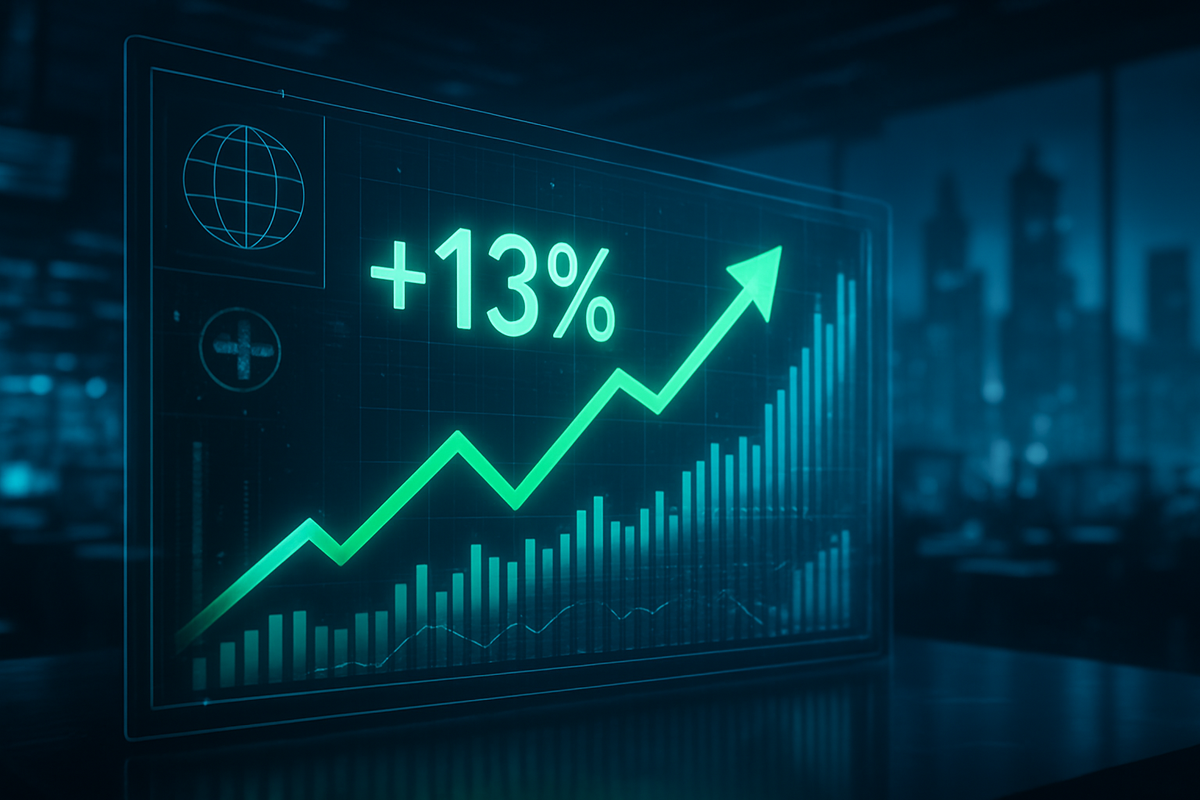
As the first quarter of 2026 draws to a close, the financial world is bracing for an earnings season that could define the market’s trajectory for the rest of the year. Investors are entering this period with high expectations, as the consensus forecast for the S&P 500 points to a robust 13% year-over-year earnings growth. This marks the sixth consecutive quarter of double-digit gains, a streak of corporate resilience that has persisted despite shifting interest rate environments and recent geopolitical tremors.
The coming weeks will serve as a critical reality check for a market that has largely priced in a "soft landing." With the Federal Reserve having stabilized interest rates in a neutral range of 3.50% to 3.75%, the focus has shifted from macro-policy debates to bottom-line execution. As the reporting cycle kicks off, all eyes are on the traditional bellwethers of the economy: the banking giants and the healthcare behemoths.
Banking Giants and Healthcare Titans Take the Stage
The unofficial start of the season begins mid-April, headlined by the banking sector. JPMorgan Chase & Co. (NYSE: JPM) is scheduled to report on April 14, with analysts expecting earnings per share (EPS) in the range of $5.32 to $5.50. This report is particularly significant as it marks a transition point for the nation's largest lender. After years of reaping the benefits of rising interest rates, JPMorgan's Net Interest Income (NII) is expected to show signs of plateauing. However, the bank is likely to offset this with a resurgence in investment banking and advisory fees, as a long-dormant pipeline of initial public offerings and mergers begins to flow again.
Following closely on April 15, Bank of America Corp. (NYSE: BAC) will provide further insight into the health of the American consumer. With a consensus EPS estimate of approximately $1.00, Bank of America is aiming for double-digit growth driven by strong global markets momentum and AI-driven trading volatility. Investors will be parsing the bank's efficiency ratios and asset repricing strategies to see if it can maintain its 16-quarter streak of trading revenue growth. The bank's ability to manage credit costs in a "neutral" rate environment will be a key indicator for the broader financial sector.
The narrative shifts to the healthcare sector on April 21, when UnitedHealth Group Inc. (NYSE: UNH) releases its results. Unlike the optimistic outlook for the banks, UnitedHealth is facing a more complex landscape. Analysts are forecasting a year-over-year earnings decline of roughly 8%, with adjusted EPS expected between $6.62 and $6.69. The focus here will be the Medical Care Ratio (MCR), which management is targeting at 88.8%. This report follows a turbulent 2025 marked by cyberattacks and regulatory hurdles, making this a "clean-up" quarter where the company must prove it can manage rising utilization costs and tighter Medicare Advantage reimbursement rules.
Identifying the Winners and Losers in a Polarized Market
The expected 13% growth for the S&P 500 is not being distributed equally across all sectors, creating a market of "haves" and "have-nots." The clear winners this season are expected to be the Information Technology and Communication Services sectors, which continue to benefit from the massive infrastructure build-out for artificial intelligence. Additionally, the Energy sector has seen a flurry of upward revisions following the "March Oil Shock," which sent crude prices above $120 per barrel. Companies in this space are likely to report windfall profits, providing a significant boost to the overall index’s growth figures.
Conversely, the healthcare and consumer discretionary sectors face uphill battles. For companies like UnitedHealth, the expiration of enhanced Affordable Care Act (ACA) tax credits and new "service-based flat-fee" models for Pharmacy Benefit Managers are squeezing margins. In the consumer space, a "K-shaped" recovery is becoming more pronounced. While high-income earners continue to spend, retailers catering to lower-income demographics are reporting tightening credit conditions and a slowdown in big-ticket purchases. Investors will likely rotate away from these "policy-sensitive" or "inflation-strained" areas toward sectors with stronger pricing power.
Macro Trends and Historical Context: The 2026 Inflection Point
The Q1 2026 season is unfolding against a backdrop of a "normalization" of the U.S. economy. The Federal Reserve’s success in guiding rates to a 3.50%-3.75% neutral range has created what some analysts call a "Goldilocks" environment—high enough to maintain bank margins but low enough to foster corporate investment. This is a sharp departure from the zero-interest-rate era of the early 2020s and the aggressive hiking cycle of 2023-2024. This stability has allowed the market to focus on productivity gains rather than just "interest rate math."
However, new regulatory headwinds are emerging. The recently signed Consolidated Appropriations Act of 2026 has introduced significant changes to how healthcare is funded and managed, specifically targeting vertical consolidation. This is reminiscent of the regulatory shifts seen in the early 2010s but with a modern focus on data transparency and AI ethics. Furthermore, the geopolitical instability in the Strait of Hormuz acts as a reminder that external shocks remain the greatest threat to the current expansion, potentially reviving inflationary fears just as they appeared to be conquered.
Strategic Pivots and the Road Ahead
As companies navigate the remainder of 2026, several strategic adaptations will be required. For the financial giants like JPMorgan and Bank of America, the focus is shifting toward "operating leverage"—ensuring that revenue growth outpaces cost increases through the integration of generative AI in back-office operations and risk management. We are also seeing a shift in capital allocation, with many firms moving away from aggressive buybacks in favor of strategic acquisitions to bolster their digital ecosystems.
In the healthcare sector, UnitedHealth and its peers must adapt to a more transparent and fee-capped regulatory environment. This may trigger a new wave of divestitures of underperforming clinic networks or a pivot toward more specialized care models. The short-term challenge will be managing the "utilization spike" from an aging population, while the long-term opportunity lies in the data-driven optimization of patient outcomes. Market participants should prepare for higher-than-usual volatility as these sectors re-rate based on their ability to navigate these structural shifts.
Final Assessment: A Pivotal Moment for Investors
The Q1 2026 earnings season is more than just a quarterly update; it is a test of whether the U.S. economy can sustain growth without the crutch of stimulus or zero-percent interest rates. The 13% growth target is ambitious, and any significant misses from heavyweight companies like JPMorgan or UnitedHealth could lead to a broader market correction. However, if these companies can meet or exceed their targets, it will validate the current valuations and provide a runway for further gains into the second half of the year.
Investors should watch the Medical Care Ratio for healthcare firms and the Net Interest Income guidance for banks as the primary indicators of sector health. Additionally, the commentary regarding the impact of the March oil price spike will be crucial for understanding the future path of inflation. As we move further into 2026, the theme of "execution over expectation" will likely be the guiding principle for the successful investor.
This content is intended for informational purposes only and is not financial advice