As of April 3, 2026, the global gold mining industry finds itself in a paradoxical crisis. While gold prices have ascended to a staggering record of $5,600 per ounce, the industry’s "super-margins" are being systematically dismantled by an unprecedented energy shock. The "Golden Squeeze," as analysts have dubbed it, has turned the world’s most lucrative extraction business into a defensive battle for cost-containment. Despite the soaring value of the yellow metal, the literal fuel required to pull it from the earth—off-road "red diesel"—has become prohibitively expensive, leading to a massive upward revision in operating costs for the sector's biggest players.
The immediate implications are severe: the once-lucrative gap between the cost of production and the market price of gold is narrowing faster than anticipated. Investors who flocked to gold as a safe haven during the current Middle East geopolitical turmoil are discovering that the miners themselves are not immune to the same volatility. With profit margins under siege, the industry's titans are being forced to scrap aggressive expansion plans in favor of radical restructuring and a desperate pivot toward energy independence.
The Geopolitical Chokehold on Global Mining
The current crisis traces its roots to late February 2026, following the onset of "Operation Epic Fury," a series of targeted military strikes by Western and regional allies against Iranian infrastructure. In a swift retaliatory move, Iran effectively blockaded the Strait of Hormuz, a maritime artery responsible for the passage of roughly 20% of the world’s petroleum supply. The resulting shockwave sent Brent crude prices screaming past $120 per barrel within days. For the mining industry, the impact was immediate and localized in the price of red diesel, the tax-exempt fuel used for massive haul trucks and heavy machinery.
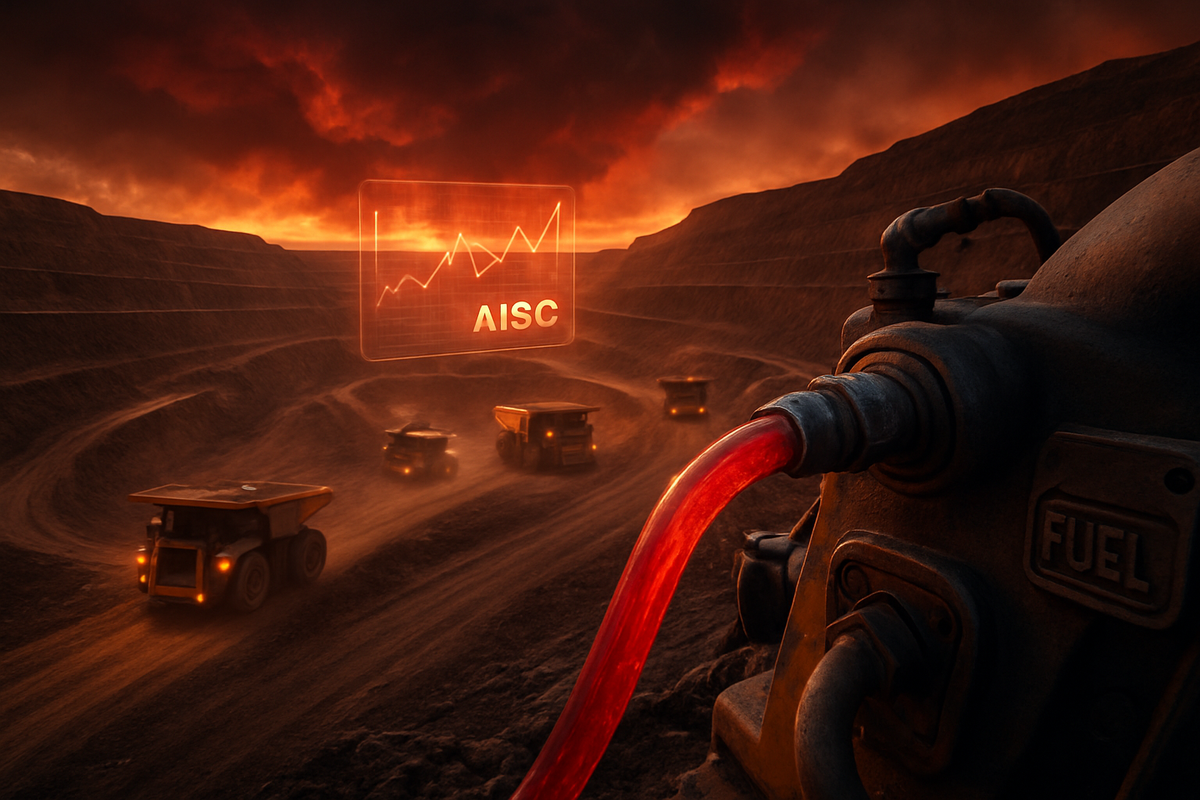
In many mining jurisdictions, the cost of red diesel surged by over 70% in less than a month, reaching nearly $5.00 per gallon in some remote operations. Because every $10 increase in the price of oil typically adds $10 to $15 to the All-In Sustaining Cost (AISC) per ounce of gold, the blockade has functioned as a massive, unplanned tax on production. The timeline of this squeeze has been brutal: by mid-March, the initial supply chain disruptions evolved into a full-scale margin crisis, forcing executives to go back to the drawing board for their 2026 guidance.
The Margin Crisis: Newmont vs. Barrick
Newmont (NYSE: NEM) sent shockwaves through the market last week when it officially revised its 2026 AISC guidance to $1,680 per ounce. This marks a dramatic climb from its 2025 average of $1,358, signaling that even the world’s largest producer is struggling to outrun the inflation of its inputs. Newmont’s management attributed the hike to the diesel spike, coupled with acute labor shortages in its Australian operations and higher royalty payments that scale with the gold price. Furthermore, the company has guided for a "trough" production year of 5.3 million ounces, down from nearly 6 million, as it prioritizes high-margin ore over sheer volume.
Barrick Gold (NYSE: GOLD) is facing even steeper hurdles, with AISC guidance now projected in the $1,760–$1,950 range for 2026. In a move that has divided shareholders, Barrick announced the formation of "NewCo" on March 13, a strategic spin-off of its premier North American assets, including its stake in Nevada Gold Mines. The goal is to shield these "Tier 1" assets from the geopolitical and energy volatility affecting its international portfolio in regions like Mali and Pakistan. However, this has triggered a fierce legal standoff with its partner, Newmont, which recently issued a "Notice of Default" against Barrick, alleging that the focus on corporate restructuring has led to operational declines at their shared Nevada sites.
A Fundamental Pivot in Industrial Strategy
The "Golden Squeeze" is not merely a temporary blip; it represents a fundamental shift in how the mining industry operates. For decades, the primary metric for success was reserve growth—finding more gold at any cost. That era has ended. The industry is now pivoting toward "survival mandates," where margin protection is the only priority. We are seeing an accelerated exodus from high-risk jurisdictions where energy security cannot be guaranteed, and a renewed focus on "jurisdictional safety" in regions like Canada and the United States.
This event has also catalyzed a massive technological shift. Mining giants are now fast-tracking the electrification of their fleets to bypass the volatile diesel market. Formerly viewed as "green" ESG initiatives, the transition to battery-electric haul trucks and autonomous, AI-driven fleets has become a mandatory financial strategy. Competitors like Agnico Eagle Mines (NYSE: AEM) have managed to weather the storm slightly better due to their lower-risk footprints in Finland and Canada, providing a blueprint for the "defensive" miner of the future.
What Lies Ahead: The Post-Diesel Mine
In the short term, investors should prepare for continued volatility as the Strait of Hormuz remains a flashpoint. If the blockade persists through the summer of 2026, we may see further upward revisions to AISC, potentially pushing the cost of production for marginal miners above $2,100 per ounce. Strategically, the industry is likely to see a wave of "defensive M&A," as larger companies look to acquire smaller, energy-efficient operations to blend down their overall cost profiles.
The long-term outlook will be defined by the success of the electrification pivot. By 2028, the "super-margin" may return, but it will be built on a foundation of renewable energy and autonomous systems rather than the cheap fossil fuels of the past. The "Golden Squeeze" has served as a brutal wake-up call that the value of gold is irrelevant if the energy required to extract it is too expensive to maintain a profit.
Summary and Investor Outlook
The "Golden Squeeze" of 2026 has fundamentally altered the relationship between gold prices and mining stocks. Despite gold reaching $5,600 an ounce, the massive surge in diesel costs and the closure of the Strait of Hormuz have capped the upside for the world’s largest miners. Newmont (NYSE: NEM) and Barrick Gold (NYSE: GOLD) are now leading a painful industry-wide transition from expansion to cost-containment, characterized by production cuts, asset spin-offs, and legal infighting over the industry's most valuable remaining sites.
Moving forward, the market will likely reward companies that can prove energy independence and operational discipline. Investors should keep a close eye on the "NewCo" spin-off developments and the Newmont-Barrick legal dispute in Nevada, as these will set the tone for the industry's corporate structure for years to come. In this new era, the most successful miners won't be those with the most gold, but those with the most efficient ways to get it out of the ground.
This content is intended for informational purposes only and is not financial advice.