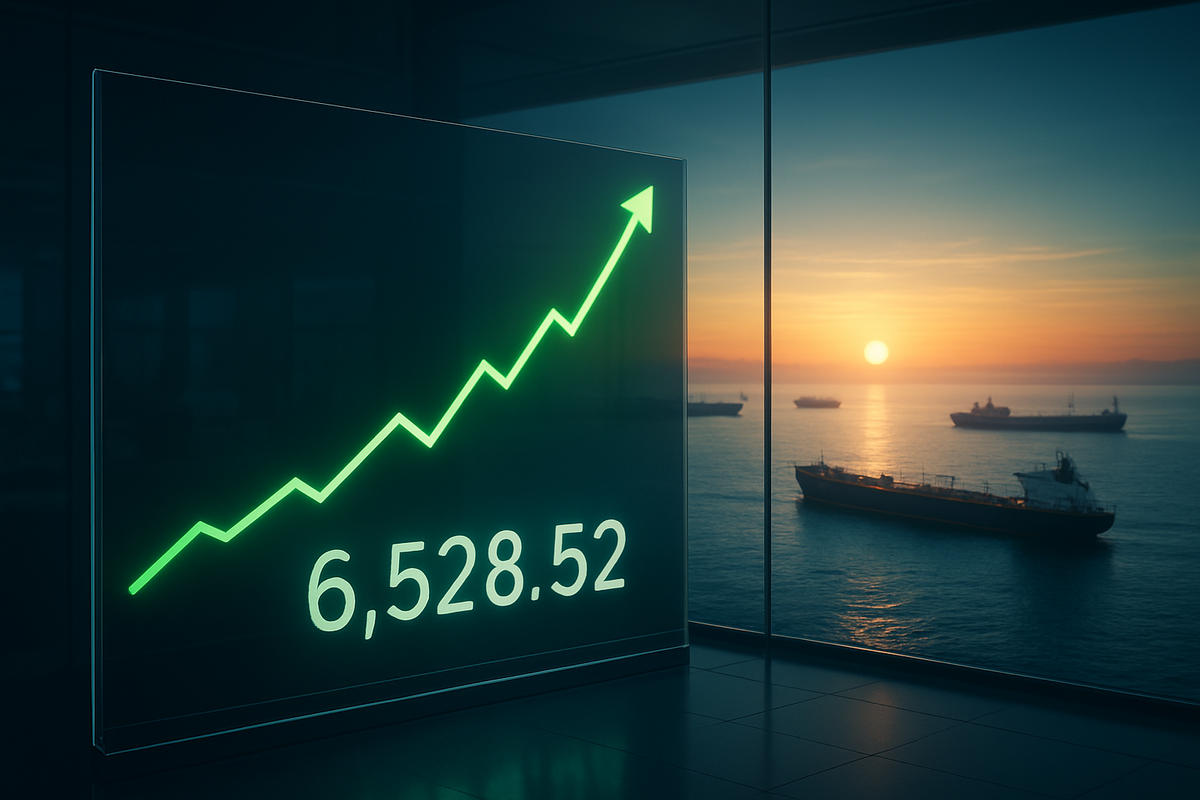
In a dramatic reversal of the bearish sentiment that dominated the first quarter of the year, the S&P 500 index surged 2.91% to close at 6,528.52 on April 3, 2026. This rally effectively erased the bruising volatility of March, providing the index with its first weekly gain in six weeks. The primary catalyst for this "risk-on" return was a series of diplomatic signals emanating from the Middle East, specifically the announcement of a formal maritime protocol for the Strait of Hormuz, which has significantly lowered the geopolitical temperature.
The surge of 184.80 points reflects a newfound optimism among investors who had spent much of the last month retreating into defensive positions. As the CBOE Volatility Index (VIX), often called the market's "fear gauge," retreated from its March highs above 30 to settle near 23.87, the broader market signaled that the immediate threat of a global energy blockade has been substantially mitigated. This shift has reopened the doors for capital to flow back into growth sectors and large-cap equities.
The Muscat Protocol: De-escalation in the Strait
The path to this relief rally was paved with intense diplomatic maneuvering. Throughout March 2026, the global economy teetered on the edge as tensions between the United States and Iran threatened to close the Strait of Hormuz, a transit point for roughly 20% of the world’s oil and liquefied natural gas. Following a period of heightened military readiness, the announcement of the "Muscat Protocol" on April 3, 2026, changed the narrative. Brokered by Omani intermediaries, the agreement establishes a "Green Channel" for commercial shipping and a joint coordination center to ensure safe passage, effectively de-linking merchant shipping from regional military friction.
This diplomatic breakthrough followed a critical timeline that began in late February with the escalation of regional hostilities. By mid-March, the S&P 500 had entered correction territory, falling nearly 10% from its January highs as oil prices spiked toward $120 per barrel. The turning point occurred when the U.S. administration extended a military deadline to April 6, allowing room for the indirect negotiations in Muscat to bear fruit. The market’s reaction was instantaneous; as soon as the framework for the protocol was leaked, institutional buyers moved aggressively back into the equities market, triggering the massive one-day surge that defined the first week of April.
Sector Rotation: Winners and Losers in the Diplomacy Trade
The return of "risk-on" sentiment has fundamentally altered the leadership board on Wall Street. Financial heavyweights were among the primary beneficiaries of the easing tensions. Goldman Sachs (NYSE: GS) and JPMorgan Chase (NYSE: JPM) saw their share prices climb by 4.75% and 3.68%, respectively, as the prospect of a stabilized global economy reduced the risk of a stagflationary recession. Similarly, mega-cap technology firms like NVIDIA (NASDAQ: NVDA) and Apple (NASDAQ: AAPL) rallied as supply chain fears regarding semiconductor logistics eased alongside the cooling of Middle Eastern tensions.
Conversely, the "war premium" that had buoyed certain sectors began to evaporate. Energy giants such as ExxonMobil (NYSE: XOM) and Shell (NYSE: SHEL), which had seen significant gains during the March energy crunch, experienced a cooling of their recent trajectories as crude oil prices stabilized. While these companies remain highly profitable, the sudden removal of the "blockade risk" led to a tactical rotation out of energy and into growth. Defense contractors like RTX Corporation (NYSE: RTX) also saw a mild pullback as the immediate threat of a full-scale regional conflict—which had driven record order backlogs in early 2026—seemed to move toward a managed diplomatic solution.
Geopolitical Risk and the New Market Normal
The events of early April 2026 fit into a broader trend of "geopolitical volatility pricing" that has characterized the mid-2020s. Investors are increasingly forced to account for rapid shifts in regional stability that can instantly disrupt global supply chains. The success of the Muscat Protocol serves as a historical precedent similar to the maritime agreements of the late 20th century, proving that even in an era of "Great Power Competition," economic necessity can drive diplomatic pragmatism. For the shipping industry, the protocol is a lifeline; A.P. Møller - Mærsk (CPH: MAERSK-B) has already indicated it will begin transitioning vessels back to their traditional routes, moving away from the expensive and time-consuming detours around the Cape of Good Hope.
From a policy perspective, this relief rally provides the Federal Reserve with a complicated backdrop. While the easing of energy-driven inflation is a welcome development, the sudden surge in equity prices and the return of "animal spirits" may force the central bank to maintain its hawkish stance on interest rates to prevent the economy from overheating. The S&P 500’s climb to 6,528.52 suggests that the market is currently more focused on the removal of "tail risks" than on the long-term cost of borrowing.
The Road Ahead: Monitoring the Thaw
In the short term, market participants will be looking for concrete evidence that the Muscat Protocol is being implemented without friction. Any reports of vessel boardings or technical violations of the "Green Channel" could quickly reignite the VIX and send the S&P 500 back toward its March lows. Strategic pivots are already underway, as hedge funds and institutional desks rebalance portfolios to favor sectors that underperformed during the "fear cycle" of the previous month, particularly consumer discretionary and high-growth tech.
Long-term, the challenge remains the sustainability of this peace. While the 2.91% rally is a powerful signal of confidence, the structural issues in the Middle East remain unresolved. Investors should watch for the next round of indirect talks scheduled for late May, which are expected to address broader regional security frameworks. If those talks fail, the relief rally of April 2026 may be remembered as a "dead-cat bounce" in a larger geopolitical bear market; if they succeed, it could be the foundation for the S&P 500 to challenge the 7,000 mark once again.
A Decisive Turn for Global Markets
The early April surge to 6,528.52 marks a decisive moment for the S&P 500 in 2026. By wiping out the volatility of March and ending a five-week losing streak, the index has demonstrated the immense power of diplomatic resolution in an interconnected global economy. The calming of the VIX and the restoration of "risk-on" sentiment suggest that while investors are wary of conflict, they are equally quick to reward progress and stability.
As we move forward, the key takeaway for investors is the importance of agility. The rapid rotation from defensive energy plays to high-beta tech and financials highlights a market that is hyper-sensitive to headline risk. Moving into the second quarter, all eyes will remain on the Strait of Hormuz and the Federal Reserve’s reaction to this sudden injection of liquidity and optimism. For now, the "fear gauge" has been silenced, and the bulls are back in control.
This content is intended for informational purposes only and is not financial advice.