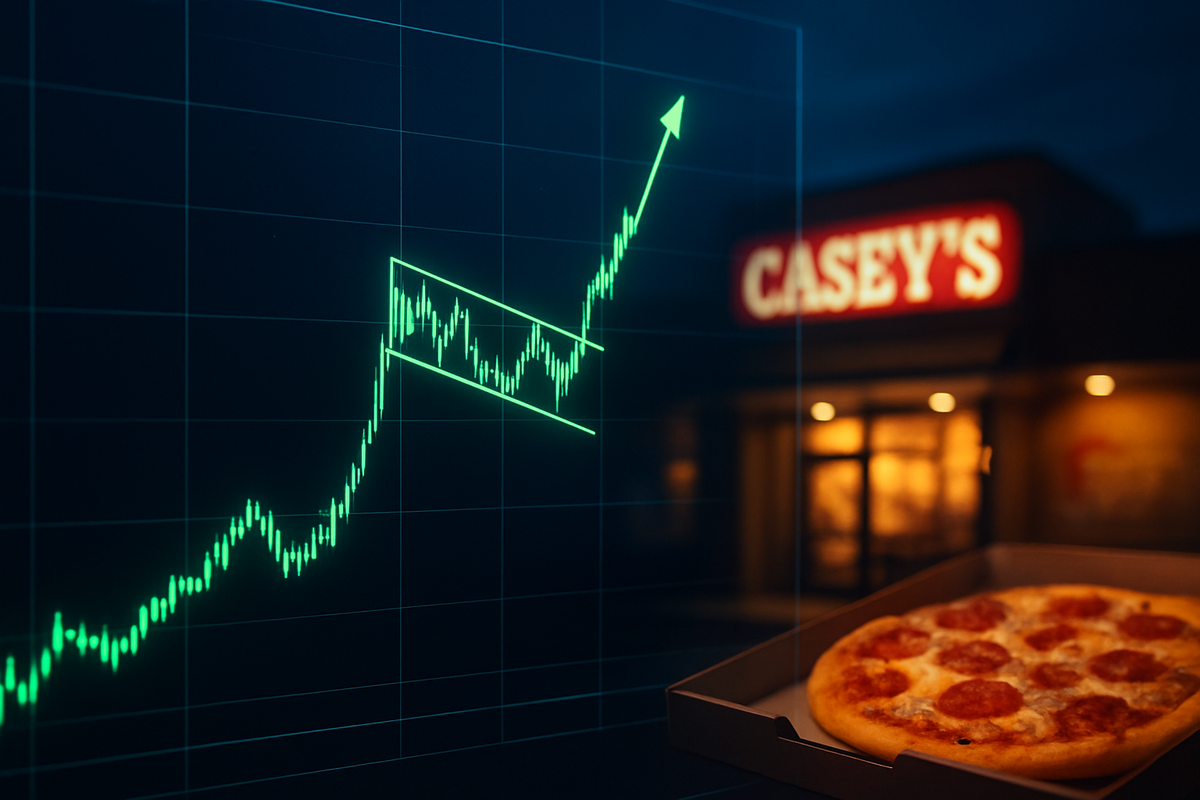
The retail sector has found a new champion in the early months of 2026 as Casey’s General Stores (NASDAQ: CASY) surges to record highs, catching the eyes of momentum traders and fundamental analysts alike. Following a decisive technical breakout from a multi-month "bull flag" pattern, the stock has catapulted beyond traditional resistance levels, reaching a fresh 52-week high of $746.57 on April 2, 2026. This surge represents a year-to-date return of over 33%, nearly doubling the performance of the broader S&P 500 and cementing the company's status as a dominant force in the convenience store industry.
The immediate implications of this breakout are significant for the retail landscape. Technical traders, who use chart patterns to predict future price movements, view this "bull flag" resolution as a confirmation of a sustained upward trend rather than a temporary spike. As Casey’s continues its "price discovery" phase, the stock is no longer tethered by historical ceilings, allowing it to trade at a premium valuation that reflects its evolving identity as a "food-first" destination rather than a mere fuel stop.
A Textbook Breakout: The Technical Path to $746
The journey to the current valuation began in late 2025, when Casey’s stock entered a period of rapid appreciation, forming what technical analysts call the "pole" of the flag. This was followed by a strategic consolidation phase throughout January and February 2026, where the stock traded within a tight, slightly downward-sloping range. This "flag" allowed the market to digest previous gains while building the energy necessary for the next leg up. The official breakout occurred in mid-March 2026, when the stock cleared a key trigger point at $667.87 on high trading volume, signaling that the bulls had reclaimed control.
Driving this technical strength was a massive fundamental catalyst: the Fiscal Q3 2026 earnings report released on March 9, 2026. Casey’s reported an earnings per share (EPS) of $3.49, obliterating the consensus estimate of $3.01. This 16% beat was fueled by a 4.0% rise in same-store inside sales, specifically within their prepared food segment. The national rollout of chicken wings and the continued popularity of their signature pizza have transformed the company’s profit margins, allowing them to maintain a high-margin profile even as retail fuel prices saw fluctuations earlier in the year.
The timeline of this rally was also supported by a "Golden Cross" in February 2026, where the 50-day simple moving average crossed above the 200-day moving average. This classic bullish indicator brought institutional buyers back to the table, providing a floor for the stock at the $600 mark. By the time April arrived, the Relative Strength Index (RSI) stood at 66.16—strong enough to show momentum but still below the "overbought" threshold of 70, suggesting there may still be room for further appreciation before a cooling-off period is required.
Sector Divergence: Winners and Losers in the Convenience Space
Casey’s performance has created a notable divergence within the retail and fuel sector. While Casey's (NASDAQ: CASY) is soaring, its peers are grappling with different technical and fundamental realities. Murphy USA Inc. (NYSE: MUSA), for instance, has recently entered an "NR7" consolidation pattern, reflecting a period of low volatility and indecision. While Murphy USA remains a strong player, it is more heavily exposed to discretionary merchandise spending and fuel volume fluctuations, which have been more volatile than Casey’s reliable food service revenue.
On the international front, Alimentation Couche-Tard Inc. (TSE: ATD) has seen a more difficult technical setup, with some analysts identifying a "bear flag" pattern in late March 2026. While Couche-Tard remains a titan of M&A, its stock has lagged the broader market as investors weigh the costs of its recent large-scale integrations. The success of Casey’s highlights a clear market preference for the "quality food" model, where higher-margin prepared foods act as a hedge against the lower-margin and highly competitive fuel business.
For investors, the "win" in this scenario belongs to those positioned in diversified retail plays that prioritize private-label growth. Casey’s private brand expansion has reached record levels, often offering better margins than national brands while providing value to consumers who are increasingly price-sensitive. Conversely, "pure fuel" plays are losing out in the current environment as the market rewards companies that can generate high-margin foot traffic regardless of the price at the pump.
The "Pizza Destination" Pivot and Market Significance
The wider significance of Casey’s breakout lies in its successful rebranding from a rural gas station to a legitimate quick-service restaurant (QSR) competitor. In many of the rural Midwest and Southern markets where Casey’s operates, it is often the primary provider of prepared meals, not just a place to buy tobacco or fuel. This unique competitive moat is what allows the stock to trade at a forward P/E ratio of approximately 33.5x, a valuation more akin to a high-growth tech or specialty retail stock than a traditional utility-style gas station.
This shift mirrors a broader trend in the industry where convenience stores are morphing into "micro-hubs" for food and services. Competitors are now playing catch-up, attempting to replicate the Casey’s "pizza destination" model. However, the regulatory and logistical hurdles of running a fresh-food kitchen inside a fuel station are high, giving Casey’s a first-mover advantage that is proving difficult to bridge. The company’s ability to maintain a fuel margin of 41.0 cents per gallon—well above historical norms—further demonstrates its procurement efficiency and its ability to keep customers on-site for high-margin purchases.
Historically, such breakouts in the retail sector have often preceded periods of industry consolidation. With its high stock price and robust balance sheet, Casey’s is now in a position to act as an aggressor in the M&A market. Analysts are closely watching for any moves into new geographic territories, particularly in the Southeast, where the "convenience as a destination" model still has significant room for growth.
The Road Ahead: Price Targets and Potential Hazards
Looking ahead, the momentum appears to be in Casey’s favor, but the path will not be without its challenges. Wall Street has aggressively raised its price targets following the March breakout. Firms like Jefferies and Evercore ISI have set high-end targets as high as $808.00, suggesting that the current rally could have another 8-10% of upside before hitting a major ceiling. However, conservative voices like Goldman Sachs have maintained more tempered targets, citing concerns that the valuation may be getting ahead of itself in a high-interest-rate environment.
In the short term, traders will be looking for a successful "retest" of the breakout level around $670-$680. If the stock can hold this level during any period of market-wide volatility, it will confirm the strength of the new support zone. In the long term, the primary challenge for Casey’s will be sustaining the growth rate of its prepared food segment. As the company expands into more suburban markets, it will face stiffer competition from established QSR giants and grocery chains that are also expanding their "grab-and-go" offerings.
Scenario planning for late 2026 suggests two likely outcomes: a continued climb toward the $800 mark if Q4 earnings (expected in June) show a continuation of the high-margin food trend, or a healthy retracement to the $650 level if fuel margins compress or if consumer spending on prepared foods begins to cool. For now, the "bull flag" breakout remains the dominant narrative, and the trend is firmly upward.
Summary for the Strategic Investor
The breakout of Casey's General Stores (NASDAQ: CASY) in early 2026 is a masterclass in how technical patterns can align with fundamental strength to drive a stock to new heights. By evolving from a fuel-centric model to a food-centric destination, Casey’s has insulated itself from the typical volatility of the energy markets and tapped into a high-margin revenue stream that investors clearly value. The "bull flag" breakout was not just a chart pattern; it was a reflection of the market’s realization that Casey’s is effectively a diversified retail and restaurant powerhouse.
Moving forward, the market will remain bullish on CASY as long as the prepared food margins hold and the company continues to beat earnings expectations. Investors should watch the $750 psychological resistance level closely in the coming weeks. If the stock clears $750 with conviction, the path to $800 becomes the primary objective. However, any failure to hold the $667 breakout point on a pullback would be a signal that the momentum has stalled.
For now, Casey’s remains the "gold standard" in the convenience store sector, proving that even in a digital age, a well-executed physical retail strategy—built on the foundation of the perfect pizza slice—can still deliver outsized returns for shareholders.
This content is intended for informational purposes only and is not financial advice.