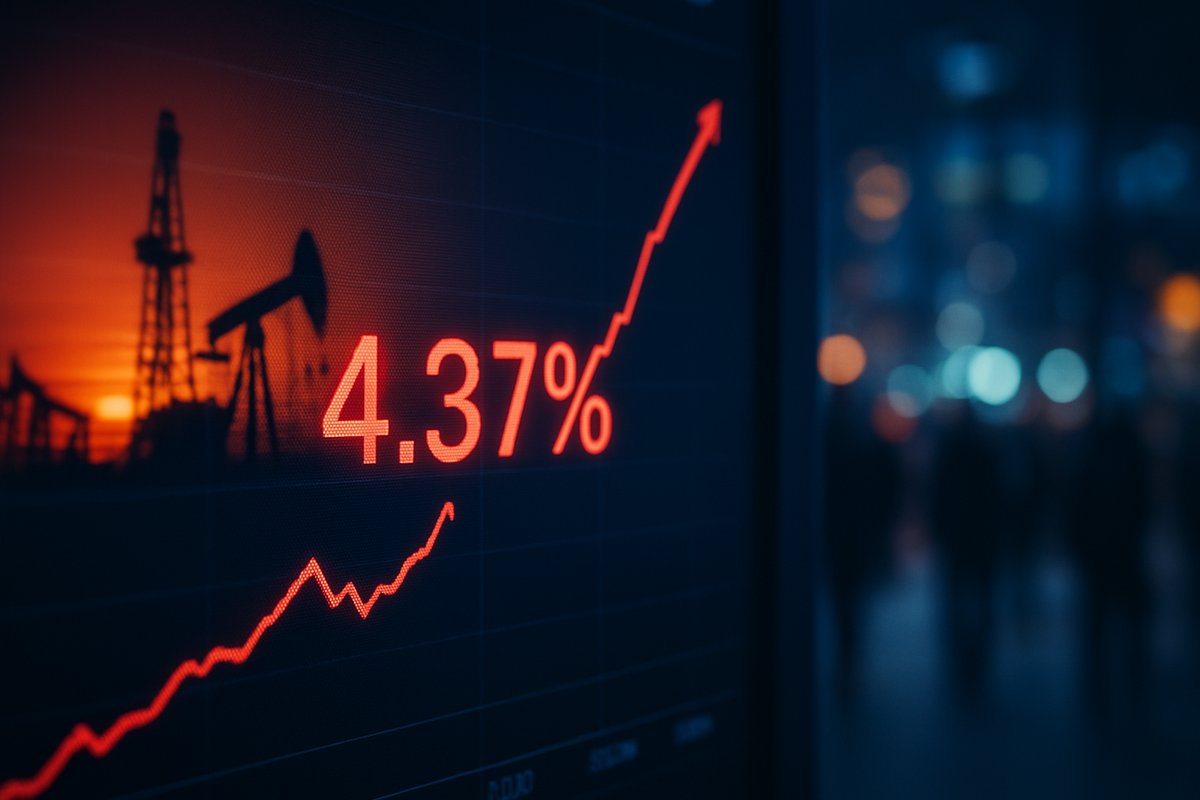
The bond market is sounding a loud alarm as the benchmark 10-year Treasury yield surged to 4.37% today, April 3, 2026. This critical psychological and technical threshold marks a decisive "pushback" from fixed-income investors who are rapidly recalibrating their expectations for inflation and interest rates. Following a blockbuster March labor report and a volatile spike in global energy prices, the "higher-for-longer" narrative has returned with a vengeance, dismantling hopes for a cooling economy and imminent Federal Reserve rate cuts.
The immediate implications are stark: borrowing costs for mortgages, corporate loans, and government debt are climbing, putting pressure on equity valuations and tightening financial conditions across the globe. As the yield hits this 4.37% mark, investors are grappling with the reality that the Federal Reserve may be forced to keep interest rates at multi-decade highs deep into 2026, or perhaps even consider further hikes if energy-driven inflation becomes entrenched.
A Perfect Storm of Economic Resilience and Geopolitical Friction
The climb to 4.37% did not happen in a vacuum. It is the culmination of a weeks-long trend where economic data consistently defied the "soft landing" narrative. The primary catalyst was this morning’s March employment report, which revealed that the U.S. economy added 178,000 jobs—nearly triple the consensus forecast of 60,000. With the unemployment rate hovering at a remarkably low 4.3%, the labor market is showing almost no signs of the cooling required to bring services inflation back to the Federal Reserve’s 2% target.
Compounding the pressure is a severe energy price spike. West Texas Intermediate (WTI) crude oil has surged past $110 per barrel this week, driven by intensifying military conflicts in the Middle East and supply disruptions in the Strait of Hormuz. This "oil shock" has directly impacted inflation expectations, with analysts from BlackRock Inc. (NYSE: BLK) noting that headline CPI could remain "sticky" well above 3.5% for the foreseeable future. The Institute for Supply Management (ISM) also reported robust manufacturing activity, with its "Prices Paid" index hitting multi-year highs, signaling that cost pressures are bubbling up throughout the supply chain.
Key stakeholders, including institutional bond holders and pension funds, have responded by dumping long-term Treasuries, sending the iShares 20+ Year Treasury Bond ETF (NASDAQ: TLT) to its lowest level since the start of the year. The market reaction has been swift; traders have moved from pricing in multiple rate cuts in 2026 to now pricing in a "Hold" for the remainder of the year, with a growing minority of swaps even pricing in a 10% chance of a rate hike.
Winners and Losers in a High-Yield Environment
The move to 4.37% creates a clear divide across the corporate landscape. Traditional "winners" in a rising rate environment include the major financial institutions. Companies like JPMorgan Chase & Co. (NYSE: JPM) and Goldman Sachs Group Inc. (NYSE: GS) could see expanded net interest margins as the gap between what they charge for loans and what they pay for deposits widens, though this is tempered by fears that higher rates will eventually slow loan demand and increase defaults. Energy giants like Exxon Mobil Corp. (NYSE: XOM) are also beneficiaries, not just from the rising crude prices that are driving yields higher, but from the increased investment flow into the energy sector as an inflation hedge.
On the losing side, the housing and real estate sectors are facing significant headwinds. Homebuilders like Lennar Corp. (NYSE: LEN) and D.R. Horton Inc. (NYSE: DHI) are seeing mortgage rates creep back toward 7.5% or higher, which threatens to price out even more potential homebuyers. Additionally, high-growth technology companies that rely on cheap capital to fund future expansion are being punished. As the discount rate—derived from the 10-year yield—increases, the present value of future earnings for companies in the Nasdaq 100 decreases, leading to a rotation out of growth stocks and into more defensive or value-oriented sectors.
Consumer-facing companies are also under pressure. As energy prices spike and borrowing costs rise, discretionary spending is likely to contract. Retailers and travel companies may find it increasingly difficult to pass on higher logistics costs to consumers who are already feeling the pinch of $4.00-plus gasoline and higher credit card interest rates.
Historical Echoes and the Death of the Pivot
This current surge to 4.37% is being viewed by many as a "rhyme" of the events of April 2024. Two years ago, the market faced a similar crisis when the 10-year yield hit the exact same level, leading to a massive repricing of Fed expectations. However, the 2026 version of this crisis is arguably more dangerous because of the geopolitical component. While the 2024 move was driven largely by post-pandemic manufacturing recovery, the 2026 move is driven by a structural "Oil Shock" and a labor market that refuses to bend.
This trend fits into a broader industry shift toward "Active Fixed Income." For years, passive bond strategies were the norm, but the volatility of 2026 has proven that the old "60/40" portfolio model is under threat. The ripple effects are extending to the U.S. Treasury itself; as yields rise, the cost of servicing the national debt balloons, potentially leading to a "fiscal dominance" scenario where the government’s interest payments limit its ability to fund other programs. This has significant policy implications, as the Fed and the Treasury must now coordinate to ensure market liquidity while fighting a two-front war against inflation and rising debt costs.
Looking Ahead: The Path to 4.50%
In the short term, all eyes will be on the next Consumer Price Index (CPI) release. If inflation data confirms the energy-driven spike seen in the ISM reports, the 10-year yield could easily breach the 4.40% level and head toward 4.50% by early summer. Strategic pivots are already underway; many hedge funds have shifted to "short duration" positions, essentially betting that long-term rates will stay higher for longer than the Fed's current dot plot suggests.
Market opportunities may emerge in the form of "inflation-protected" securities (TIPS) or commodities-linked equities. However, the challenge for investors will be navigating the volatility that comes with a "no-cut" environment. If the labor market finally begins to crack under the weight of these yields, we could see a rapid "flight to quality," but for now, the momentum is clearly on the side of higher rates. The potential scenario of a "hard landing" is once again being discussed in the halls of the major investment banks, particularly if the 10-year yield remains north of 4.3% for an extended period.
A Summary of the Bond Market Rebellion
The return of the 10-year Treasury yield to 4.37% on April 3, 2026, marks a watershed moment for the post-2024 economy. The combination of a blowout jobs report and a geopolitical oil crisis has effectively neutralized the Federal Reserve’s plans to ease monetary policy. Investors have moved from hope to a defensive crouch, recognizing that the battle against inflation is far from over.
Moving forward, the market will likely experience increased volatility as it adjusts to this new reality. The era of cheap money is firmly in the rearview mirror, and the "higher-for-longer" mantra is no longer a warning—it is a reality. Investors should watch the 4.40% level closely in the coming months; a sustained move above that could trigger a more aggressive sell-off in equities and a broader re-evaluation of global economic growth. For now, the bond market has spoken, and its message is clear: inflation is back, and it isn't going away without a fight.
This content is intended for informational purposes only and is not financial advice.