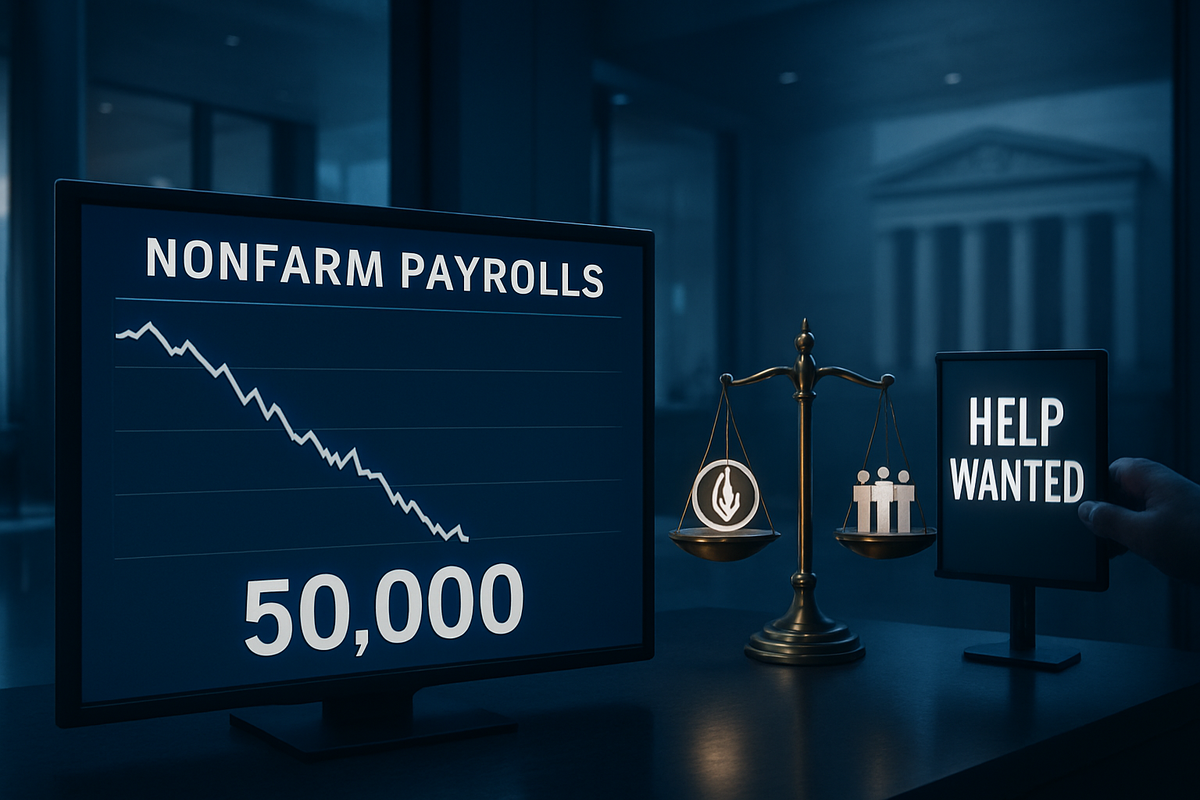
The U.S. labor market has entered a precarious "low-hire, low-fire" equilibrium, with the latest March 2026 jobs report revealing a sharp deceleration in hiring. Nonfarm payrolls grew by a meager 50,000—the lowest monthly gain since the 2020 recovery—while the unemployment rate has settled into a 4.3% to 4.4% range. This softening comes at a critical juncture for the Federal Reserve, as it navigates a leadership transition and the complex economic signals sent by recent fiscal policy shifts.
For the Federal Reserve, these figures represent a "double-edged sword." While the cooling labor demand could help anchor core inflation, which has remained stubbornly near 3.0%, the rising unemployment rate has brought the Sahm Rule back into the national conversation. With the economy balanced on a razor's edge, markets are now looking to the incoming Fed leadership to determine if the current "restrictive-to-neutral" stance is sufficient to prevent a deeper downturn or if more aggressive rate cuts are looming on the horizon.
A Chill in the Labor Market: The 50,000 Threshold
The data released by the Bureau of Labor Statistics (BLS) on April 3, 2026, confirmed what many economists had feared throughout the first quarter: the "Great Cool-Down" of 2025 has transitioned into a stagnant hiring environment. The 50,000 payroll gain for March was a significant drop from the 178,000 recorded in February, which itself was a recovery from a strike-impacted February. This volatility has been attributed to a combination of business uncertainty regarding the One Big Beautiful Bill Act (OBBBA) and a generalized "wait-and-see" approach by major employers.
The timeline leading to this moment began in mid-2025, as the post-pandemic hiring frenzy finally exhausted itself. Throughout late 2025, the economy saw a steady decline in job openings, though mass layoffs remained conspicuously absent—a phenomenon economists have dubbed "labor hoarding." By January 2026, the labor market began to show signs of structural fatigue. Initial market reactions to the April 13 report have been a mix of relief and anxiety; while bond yields dipped on expectations of a Federal Reserve pivot, equity markets remained bifurcated as investors weighed the risks of a potential recession.
Key stakeholders, including the Department of Labor and major industry groups, have pointed to several factors contributing to the stall. A sharp reduction in immigration in late 2025 has slowed labor force growth, which ironically prevented the unemployment rate from spiking even higher. Meanwhile, the implementation of the OBBBA, which eliminated federal income taxes on overtime and tips, has created administrative complexity for service-sector employers, leading many to pause expansion plans until the fiscal dust settles.
Corporate Divergence: Winners and Losers in a Slowing Economy
In this environment of cooling labor and shifting fiscal policy, the stock market has seen a "Great Rotation." Companies that can leverage AI for productivity or benefit from direct fiscal stimulus are emerging as winners. Microsoft (NASDAQ: MSFT) has proven resilient, utilizing the OBBBA’s 100% bonus depreciation for AI-related infrastructure to offset its massive capital expenditures. Similarly, Caterpillar (NYSE: CAT) and GE Vernova (NYSE: GEV) have seen strong performance as the "real economy" buildout of AI data centers continues regardless of the broader hiring slowdown.
Conversely, retailers and tech firms with heavy import exposure or high labor costs are feeling the squeeze. Best Buy (NYSE: BBY) has been hit hard by a 10% global balance of payments tariff, which is expected to cost the company over $1.2 billion in 2026 alone. Import-heavy retailers are finding it increasingly difficult to pass these costs to a consumer base that, while currently bolstered by retroactive tax refunds from the OBBBA, is becoming more cautious as job security weakens.
The banking sector, led by giants like JPMorgan Chase (NYSE: JPM), is also under pressure. A flattening yield curve and the prospect of the Federal Reserve holding rates in a "restrictive-to-neutral" range of 3.50%–3.75% are compressing net interest margins. Furthermore, the "crypto bear market" of early 2026 has impacted fintech players like Robinhood (NASDAQ: HOOD), which has seen its shares tumble nearly 40% year-to-date as retail trading volume dries up in tandem with the slowing job market.
The Fed Mandate and the Sahm Rule Warning
The current unemployment rate of 4.4% has officially reignited the debate over the Sahm Rule. Historically, a 0.5 percentage point rise in the unemployment rate's three-month moving average above its 12-month low has been a near-perfect recession indicator. While the rule was "triggered" in July 2024 without a full recession following, its persistent hovering near the 0.50 threshold in April 2026 suggests the margin for error has evaporated.
This event fits into a broader trend of "fiscal-monetary tension." While the Federal Reserve, currently under the nomination of Kevin Warsh, seeks to maintain a cautious stance to prevent an inflation resurgence driven by $120/barrel oil and geopolitical instability, the OBBBA has injected a massive $150 billion fiscal stimulus into the economy. This policy mismatch makes the Fed’s job exponentially harder; they must decide whether to cut rates to support a flagging labor market or stay "higher for longer" to combat the inflationary pressures of the new fiscal and trade regimes.
Comparisons to the 2023–2024 slowdown are frequent, but the 2026 landscape is distinct due to the "neutral rate" transition. In 2024, the Fed was fighting a clear inflation spike; in 2026, they are managing a "low-hire" economy where labor supply and demand are both shrinking. This suggests that traditional policy tools may not have the same immediate impact on job creation as they did in previous cycles, as the bottleneck is now as much about regulatory and trade policy as it is about the cost of capital.
The Road Ahead: Potential Scenarios for 2026
In the short term, all eyes are on the confirmation of Kevin Warsh as the next Federal Reserve Chair. The market is currently pricing in a single 25-basis-point rate cut for the remainder of 2026, likely in the summer, provided that inflation does not breach the 3% ceiling. However, if payroll gains remain at or below the 50,000 mark for consecutive months, the Fed may be forced into a "strategic pivot," accelerating cuts to prevent the "low-hire" environment from devolving into a "high-fire" scenario.
For corporations, the remainder of 2026 will require a focus on operational efficiency. We expect to see more companies following the lead of Walmart (NYSE: WMT) and Costco (NASDAQ: COST) by prioritizing value and domestic supply chain resilience. The "AI-driven productivity" play will continue to be a dominant theme, as firms look to technology to maintain margins in the face of rising tariff costs and stagnant consumer demand.
A potential "soft landing 2.0" remains a possibility if the OBBBA tax refunds effectively bridge the gap for consumers until the Fed begins its easing cycle. However, a more pessimistic scenario involves a "stagflationary stall," where tariffs and energy prices keep inflation high while the labor market continues to atrophy. In such a case, the Fed would be paralyzed, unable to cut rates without risking a currency crisis or an inflationary spiral.
Conclusion: Navigating the New Economic Reality
The early 2026 labor market slowdown is more than just a data point; it is a signal that the post-pandemic economic cycle has reached a definitive end. The drop to 50,000 nonfarm payrolls and a 4.4% unemployment rate marks the transition to a more fragile, policy-sensitive era. For investors, the key takeaways are the importance of "real economy" resilience and the reality that the Federal Reserve is no longer the only primary driver of market liquidity—fiscal and trade policy have taken center stage.
As we move forward, the market will likely remain volatile as it adjusts to the "Warsh Era" at the Fed and the full impact of the OBBBA. The "low-hire, low-fire" regime offers stability, but it lacks the dynamism that drove the mid-2020s bull market. Investors should watch for the next few BLS reports to see if the 50,000 figure was an anomaly or the start of a trend, and pay close attention to core PCE data as the ultimate arbiter of Fed policy.
The coming months will test the resilience of the U.S. consumer and the agility of the Federal Reserve. While the headlines focus on the 50,000 jobs, the real story is the delicate balancing act between a new fiscal regime and a cooling labor engine.
This content is intended for informational purposes only and is not financial advice.