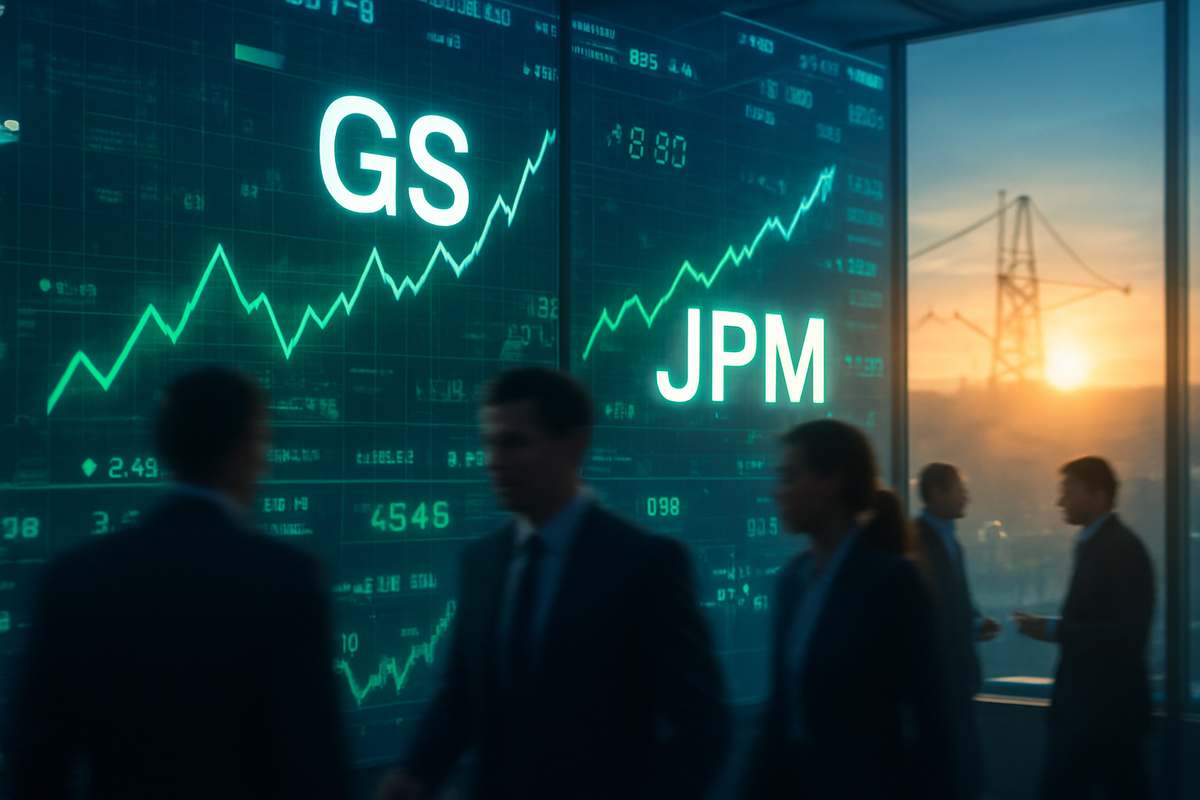
The first day of the second quarter brought a wave of optimism to the floor of the New York Stock Exchange, as the financial sector spearheaded a significant market rally on April 1, 2026. Propelled by a decisive shift toward "risk-on" sentiment and a retreat in global energy prices, the S&P 500 climbed 184.80 points to close at 6,528.52—a 2.91% gain that effectively wiped out the volatility seen in the preceding month. At the heart of this resurgence were the banking titans, signaling that the "Iran War wrinkle" that haunted the first quarter might finally be smoothing out.
This rally marks a critical turning point for the 2026 fiscal year. After a period of defensive positioning where investors flocked to safe havens, the rotation back into equities—specifically high-beta financial stocks—suggests a growing confidence in the resilience of the U.S. economy. As the market looks toward the Q2 earnings season, the immediate implication is clear: the heavyweights of Wall Street are once again the primary drivers of market momentum, benefitting from a stabilized interest rate environment and a renewed appetite for deal-making.
A Decisive Pivot: Goldman Sachs and JPMorgan Take the Lead
The trading day was dominated by two of the most influential names in global finance: Goldman Sachs (NYSE: GS) and JPMorgan Chase (NYSE: JPM). Goldman Sachs shares surged 4.75%, closing at $845.99, while JPMorgan Chase followed closely with a 3.68% gain to end the day at $294.21. This performance was not merely a coincidence but the result of a perfectly timed "relief rally." Markets had been suppressed throughout March due to escalating tensions in the Middle East, specifically involving Iran, which had sent Brent crude oil prices spiking above the $100 per barrel mark. However, news of potential ceasefire negotiations and a de-escalation of hostilities on April 1st acted as a catalyst for investors to move back into riskier assets.
Leading the charge, Goldman Sachs benefited from a "reset" in market expectations. Analysts noted that the prior sell-off had created an attractive entry point for institutional investors who anticipate a major rebound in investment banking activity. Simultaneously, JPMorgan Chase CEO Jamie Dimon signaled cautious optimism, noting that while geopolitical volatility remains a variable, the underlying U.S. consumer and corporate sectors remain remarkably sturdy. This sentiment was echoed across the sector as the KBW Bank Index saw its strongest single-day performance in over six months.
The timeline of this rally is rooted in the Federal Reserve’s March meeting, where the federal funds rate was held steady at 3.5%–3.75%. While the Fed initially projected a hawkish "higher for longer" stance, the sudden dip in Brent crude to approximately $95 per barrel on April 1st provided the "inflationary breathing room" the market desperately craved. This easing of energy pressure has recalibrated the Q2 outlook, leading many to believe that the peak of the 2026 inflationary cycle may have passed.
Winners and Losers in the Risk-On Rotation
The primary beneficiaries of this shift are undoubtedly the large-cap universal banks. Goldman Sachs (NYSE: GS) is positioned to win significantly from the expected thaw in the Mergers and Acquisitions (M&A) market. With energy prices cooling, corporate boardrooms are likely to revisit expansion plans that were shelved during the Q1 energy spike. Similarly, JPMorgan Chase (NYSE: JPM) continues to leverage its massive balance sheet, with forecasts now projecting Net Interest Income (NII) to reach $95 billion for the year—a 2.6% growth that many analysts consider conservative given the current trajectory.
Other winners include the broader financial ecosystem, such as Bank of America (NYSE: BAC) and Morgan Stanley (NYSE: MS), which both saw gains exceeding 3% during the rally. These institutions are well-positioned to benefit from a "low fire, low hire" economy—characterized by steady, if unspectacular, growth and manageable credit losses. Conversely, the "losers" of this April 1st pivot were the defensive safe havens. Gold prices, which had reached record highs during the height of the Iran conflict, saw a marked retreat as the S&P 500-to-gold ratio climbed to 1.47, indicating a mass migration of capital out of "fear trades" and back into growth-oriented sectors.
The Macroeconomic Ripple Effect and Industry Trends
This financial rally is symptomatic of a wider trend in the 2026 landscape: the normalization of the "post-crisis" interest rate environment. For years, the banking sector navigated near-zero rates, but the current 3.5%–3.75% range has restored the traditional "spread" model of banking profitability. This event fits into a broader trend of financial institutions reclaiming their role as the backbone of the stock market, moving away from the tech-only dominance that defined the early 2020s.
The significance of this rally extends to the regulatory and policy spheres. With the term of the current Federal Reserve leadership drawing toward a close, rumors regarding the next Fed Chair—with Kevin Warsh frequently cited as a top nominee—have begun to influence market behavior. Investors are betting that a new leadership transition in late 2026 or 2027 could bring a more "pro-growth" tilt to monetary policy. Furthermore, the structural shift in the energy market cannot be ignored. While oil remains volatile, the "AI-driven energy boom" has shifted long-term focus toward electricity and data center financing, a niche where major banks are currently racing to establish dominance.
Looking Ahead: The Q2 Horizon and Beyond
In the short term, the primary focus for investors will be the Q1 earnings reports due later this month. The April 1st rally has set a high bar, and companies like Goldman Sachs (NYSE: GS) and JPMorgan Chase (NYSE: JPM) will need to demonstrate that their "deal pipelines" are indeed converting into realized revenue. A key challenge remains the "deposit beta"—the competition for deposits among regional banks—which could continue to squeeze margins if the Fed remains hesitant to cut rates.
Longer-term, the market is bracing for a potential supply glut in the oil market. The U.S. Energy Information Administration (EIA) projects Brent crude could fall below $80 per barrel by the third quarter of 2026. For the banking sector, this is a double-edged sword: it lowers the inflationary floor, potentially allowing for the 50 to 75 basis points of rate cuts forecasted by Goldman Sachs economists, but it could also signal a slowdown in energy-related lending. Strategic pivots toward "green financing" and AI infrastructure are expected to be the defining themes for the remainder of the year.
Summary of the Market Outlook
The April 1, 2026, rally has provided a much-needed shot of adrenaline to the financial sector. By leading the charge, Goldman Sachs and JPMorgan have signaled that the U.S. banking system is prepared to thrive in a "risk-on" environment, provided that geopolitical tensions continue to simmer down. The easing of energy prices has acted as the ultimate "QE-lite," providing relief to both consumers and corporations without the need for immediate Federal Reserve intervention.
As we move forward, investors should keep a close eye on the PCE inflation data and any official shifts in the Fed's "dot plot." While the immediate outlook is bullish, the persistence of service-sector inflation and the potential for "zero rate cuts" in 2026, as predicted by some hawkish analysts at JPMorgan, remain the primary risks to this recovery. For now, the bulls have reclaimed the narrative, and Wall Street is looking toward a lucrative spring.
This content is intended for informational purposes only and is not financial advice.